
Why Many Dollar Stores Source General Merchandise from China and Yiwu

A professional and well-established ceramic and porcelain tableware supplier showing thousands of available selections, in Yiwu Market
If you have ever walked through a dollar store and looked at shelves packed with kitchen tools, party supplies, toys, stationery, storage products, hair accessories and seasonal decorations, you may have wondered: Where do dollar stores get all these products?
There is no single answer.
Dollar stores buy from domestic wholesalers, importers, manufacturers, closeout suppliers and brand distributors. Large chains may also source directly from overseas factories.
But when it comes to general merchandise, China—and Yiwu in particular—has become an important part of the supply chain for many value retailers around the world.
That is not simply because products are “cheap in China.” The real reason is much more practical: dollar stores need huge product variety, workable prices, flexible quantities and efficient consolidation, all at the same time.
And that is exactly where the Chinese supply chain can make sense.
China Fits the Economics of the Dollar Store Business
Dollar stores operate on a fairly simple idea: offer useful or interesting products at prices that feel affordable enough for customers to put them in the basket without thinking too much about it.
That sounds easy. From a sourcing point of view, it is not.
A retailer selling a product for only a few dollars has very little room for an expensive supply chain. The purchase price, packaging, international freight, import duty, warehouse cost and local delivery all have to leave enough margin for the retailer.
China has spent decades building manufacturing clusters around many of the categories commonly found in discount stores: household products, kitchenware, stationery, toys, seasonal decorations, party supplies, beauty accessories, storage items, pet accessories and hundreds of other small consumer products.
You can see how important China is just by looking at a big chain like Dollar Tree. According to its latest annual filing, around 40% of the merchandise it buys by retail value is imported directly, and most of those direct imports come from China. And even some of the products Dollar Tree buys from U.S. suppliers were originally imported from overseas. In other words, a product may arrive at Dollar Tree through a U.S. wholesaler, but the supply chain can still start in China.
Of course, an independent dollar store does not buy the same way as Dollar Tree. Smaller retailers are much more likely to work through wholesalers, importers or sourcing companies.
But somewhere farther up that supply chain, many of those products may still begin with Chinese manufacturers.
So Why Yiwu?

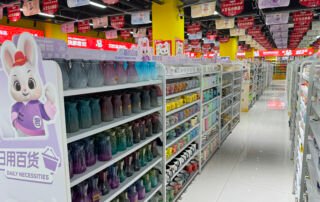
This a street in dollar store items section in 4th floor of district 5 in Yiwu Market

This is the dedicated dollar items wholesale section in district 5 in Yiwu Market
China has many manufacturing and wholesale centers. Shenzhen is famous for electronics. Guangzhou is strong in fashion, accessories and many consumer goods. Shantou has major toy manufacturing clusters.
Yiwu is different.
It is built around small commodities and general merchandise.
Yiwu International Trade Market has around 80,000 stores offering more than 2.1 million kinds of products across 26 major categories. In 2025, official regional information reported that the market was attracting more than 3,000 overseas buyers a day.
For a dollar-store buyer, that concentration matters.
Imagine you need kitchen gadgets, artificial flowers, hair clips, stationery, gift bags, pet toys, cleaning brushes and Christmas decorations.
Finding eight factories in eight different Chinese cities is possible. But it creates another problem: eight negotiations, eight minimum order quantities, eight production schedules, eight domestic shipments and eventually eight sets of cartons that somehow need to come together.
In Yiwu, many of those categories can be sourced within the same trading ecosystem.
That can make the buying process much easier.
Dollar Stores Need Variety, Not Just Volume

a major established wholesale dollar store supplier’s big showroom featuring extensive inventory of household and cleaning products in Yiwu Market
This is one of the biggest differences between dollar-store sourcing and traditional factory sourcing.
A normal importer might order:
50,000 pieces of one item.
A dollar-store buyer may instead need:
300 different items, with several cartons of each.
The total order may still be large, but it is spread across a lot of SKUs.
That changes everything.
Factories are usually most efficient when a buyer orders one product in large quantities. Dollar stores, however, live on variety. Customers return partly because there is always something different to discover.
Yiwu works particularly well for this model because buyers can source from many suppliers and bring the goods together into one warehouse before shipment.
A ready-stock supplier may sell by the carton and allow a relatively small trial order. Another may allow mixed colors. A factory producing customized packaging, however, may require a much larger MOQ.
There is no such thing as one universal “Yiwu MOQ.”
The real advantage is flexibility across the sourcing program, not the promise that every seller will accept tiny orders.
Consolidation Can Matter as Much as the Product Price
New importers often spend most of their time asking one question:
“What is your unit price?”
Experienced buyers usually ask another:
“What will my landed cost be?”
There is a big difference.
A product may be extremely cheap at the supplier’s warehouse and still become expensive after domestic transportation, handling, international freight, customs clearance, duty and local delivery are added.
This is especially important for dollar store items because many products have a low selling price. A few extra cents of logistics cost per unit can make a noticeable difference to the final margin.
That is why consolidation is such an important part of Yiwu sourcing.
Instead of shipping small orders separately, products from multiple suppliers can be delivered to one warehouse, checked, repacked where necessary and loaded together into an LCL or full-container shipment.
For a store carrying hundreds of different products, this can be much more practical than treating every supplier as a separate import project.
In dollar-store sourcing, the cheapest item to buy isn’t always the cheapest item to sell.
Low Prices Are Not Just About Cheap Labor
People sometimes explain Chinese sourcing with one sentence:
“Labor is cheaper.”
That explanation is far too simple today.
A major reason China remains competitive in general merchandise is the density of its supply chain.
A manufacturer making a plastic kitchen tool may already have nearby suppliers for resin, molds, printing, packaging, cartons and accessories. Freight companies understand the export process. Warehouses are set up for consolidation. Inspection companies are easy to find. Trading companies and sourcing agents can coordinate multiple factories.
In Yiwu, the wholesale market itself is connected to an enormous upstream supplier network. Regional government information describes Yiwu as linking its market with roughly 2 million upstream suppliers across China.
That ecosystem is difficult to measure by looking only at the factory price.
Sometimes the real saving comes from doing ten things in one place instead of coordinating ten separate supply chains.
Product Discovery Is Another Big Advantage
Dollar stores depend heavily on impulse purchases.
A basic toothbrush may sell every day, but new seasonal decorations, unusual kitchen gadgets or trendy accessories give customers another reason to walk through the store.
That means buyers cannot simply reorder the same catalog forever.
They need new ideas.
Yiwu is useful because it is not only a place to place orders. It is also a place to discover products.
A buyer can walk from one category to another, compare similar products, see new packaging, check materials and find variations they may never have searched for online.
For independent dollar stores and discount chains, that ability to discover hundreds of potential products quickly can be valuable.
Sometimes you go looking for one item and leave with ideas for twenty.
China Also Makes Customization Possible
Once a dollar-store business becomes larger, buying an existing product may no longer be enough.
Retailers may want their own:
packaging, colors, labels, barcode, carton markings, brand name or product configuration.
Major discount retailers do this too. Dollar Tree says its direct manufacturer relationships allow it to customize packaging, product sizes and package quantities to better fit the needs of their customers.
This is another reason China works well for value retail.
A product does not always have to be made “cheaper” by lowering quality. Sometimes it can be engineered differently for a particular retail price point through simpler packaging, different pack quantities or a more suitable specification.
There is an important catch, though.
Customization usually means a higher MOQ.
Ready-stock sourcing and private-label sourcing are two different games. A good sourcing plan needs to know when to use each one.
Not Every Dollar Store Should Import Directly from China
Buying directly from China is not automatically the best choice.
If you operate one small store and need only a few cartons every week, buying from a local wholesaler may be easier and sometimes even cheaper after freight and import costs are considered.
Direct importing starts to make more sense when the buyer has enough volume, enough SKU demand and enough planning and follow-through to justify the extra work.
You also need to think beyond price.
Product specifications, testing requirements, labeling rules, intellectual-property issues, quality inspection, customs classification and import regulations all matter. Toys, electrical products, cosmetics and children’s products, for example, may require very different compliance procedures depending on the destination market.
Trade policies and tariffs can also change.
For that reason, professional buyers increasingly focus on landed cost and risk, not simply FOB or EXW price.
A 30-cent product that creates compliance problems is not a good deal.
What Makes a Good Yiwu Sourcing Partner?
For dollar-store merchandise, knowing where to buy products is only part of the job.
The harder part is coordinating everything after you find them.
A useful sourcing partner should be able to help compare suppliers, confirm specifications, negotiate practical MOQs, collect samples, follow production, inspect products, organize labels and cartons, receive goods from multiple suppliers and consolidate everything for export.
This matters because a dollar-store order can easily involve dozens or hundreds even thousands of SKUs.
You are not simply buying products.
You are managing a small supply chain.
And the more fragmented the order becomes, the more valuable good coordination becomes.
China and Yiwu Are Important, But They Are Only Part of the Dollar Store Supply Chain
So, where do dollar stores get their products?
The answer is Everywhere.
They buy from manufacturers, wholesalers, importers, distributors, closeout companies, brand suppliers.
China is particularly important for general merchandise, and Yiwu has developed into one of the world’s most useful sourcing hubs for buyers who need many different low-to-medium value products in one purchasing program.
The appeal of Yiwu is therefore not simply “low price”.
It is the combination of selection, supplier density, flexible purchasing, product discovery, consolidation and export infrastructure.
For a dollar store carrying thousands of different items, that combination can be much more important than saving another cent on one individual product.
And that is why, even as sourcing strategies change, Yiwu continues to attract wholesalers, importers and value retailers from around the world.
Frequently Asked Questions
Are all dollar store products made in China?
No. Dollar stores source merchandise from domestic manufacturers, wholesalers, importers, brand suppliers, closeout companies and many overseas countries. China is especially important for many general-merchandise categories, but it is only one part of the supply chain.
Is Yiwu only suitable for large importers?
No. Yiwu can be particularly useful for small and medium-sized importers because many suppliers sell ready-stock merchandise by the carton and mixed-category orders can be consolidated. However, minimum order quantities vary widely, especially when customization is required.
Can I mix different dollar store items in one container?
Yes. This is a common sourcing model. Products purchased from different suppliers can be delivered to a consolidation warehouse and loaded into the same export shipment after quantities, packaging and quality are checked.
Is sourcing from Yiwu cheaper than buying from a wholesaler?
Sometimes, but not always. Direct sourcing can reduce the product purchase price, particularly at larger volumes, but buyers must also consider freight, duty, inspection, consolidation, customs clearance and local delivery. The right comparison is landed cost, not simply supplier price.
What products are commonly sourced from Yiwu for dollar stores?
Common categories include household goods, kitchenware, stationery, party supplies, toys, seasonal decorations, storage products, beauty accessories, fashion accessories, pet products, gift items and many other types of small general merchandise.
If you have any questions about buying Dollar Store Products from Yiwu Market or somewhere else in China, we’re here for you. Feel free to reach out – whether you need a trustworthy Yiwu Sourcing Agent on the ground, guidance on shipping options, or just someone to talk through your product ideas with, we’re happy to help with.
Contact Information as below:
Email:kevin@china-buying-support.com
Phone | WhatsApp:+86 1860 5899 103
Thank you.
Related Reading:
-> Yiwu, The Best Place for Dollar Store Items Wholesale in China
-> Dollar Store Items Wholesale: Sourcing from China The Ultimate Guide 2026
-> How to Source Stationery & Office Supplies from Yiwu, China
More About Buying from Yiwu Market or China:
-> How to Buy from Yiwu Market: The Only Guide You Need
-> Navigating Yiwu Market: Layout, District Guide and Product Categories
-> How to Get to Yiwu, China – Flights, Trains, Buses & Tips for Yiwu Market Buyers
Joining Us With 1,200+ Happy Clients Enjoying Buying From China now!
Becoming One of China-Buying-Support family to Get a Easier and Trouble-Free Sourcing and Shipping Service.