
How to Import Christmas Trees from China
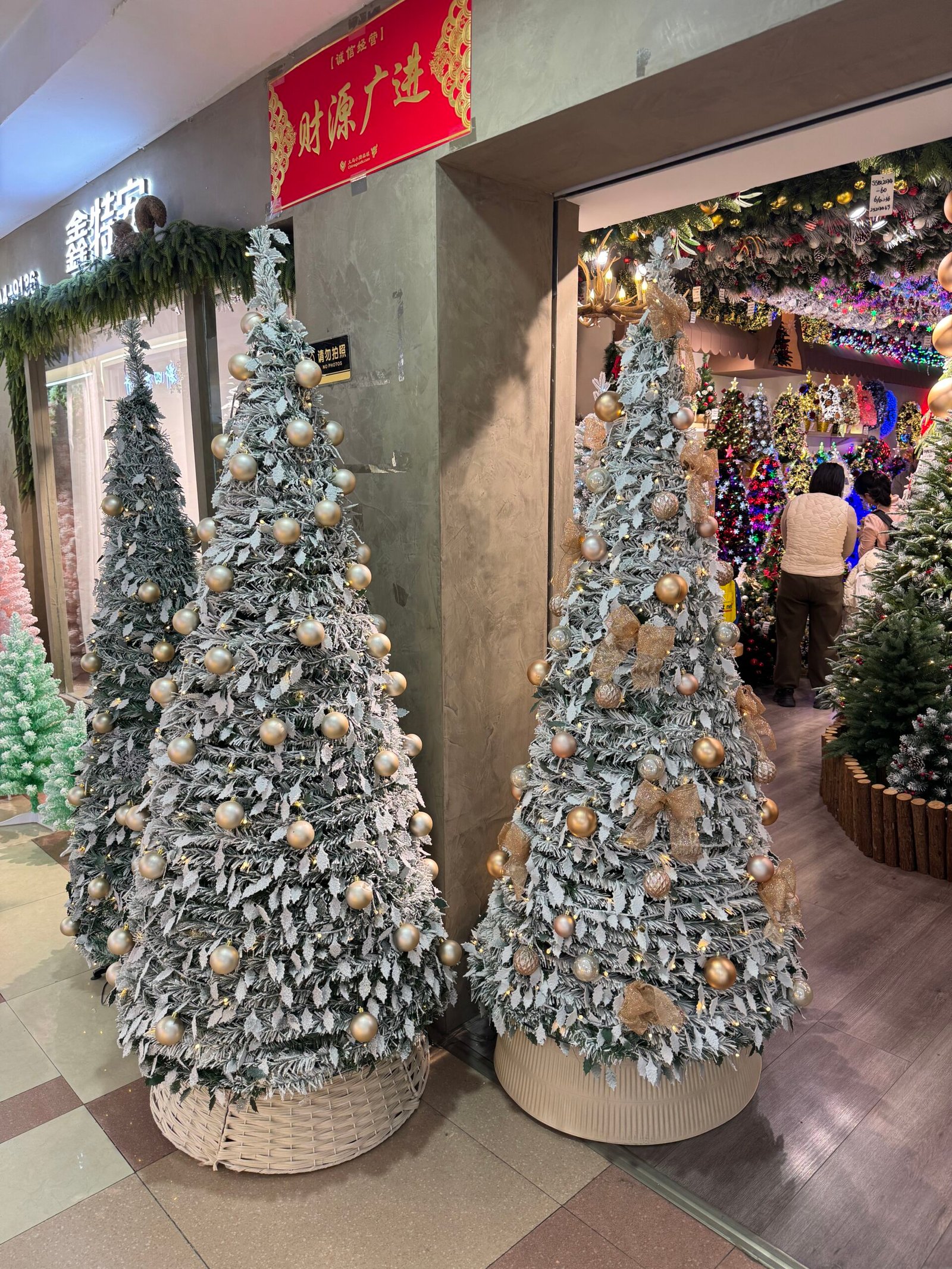
Corner display of two snowy artificial Christmas trees decorated with gold baubles and burlap bows at a Yiwu Christmas Wholesale Market store, ideal for malls and hotel lobbies.
- Why Source Christmas Trees from China?
- When to Plan Your Christmas Tree Imports (Timeline and Seasonality)
- Finding the Best Christmas Tree Suppliers in China
- Ensuring Quality and Compliance (Safety Standards & Vetting Suppliers)
- Shipping and Customs Clearance Logistics for Christmas Tree Order
- US and EU Import Duties for Christmas Trees and Decorations
Importing Christmas trees and holiday decorations from China can be a profitable venture for wholesalers and retailers around the world. China is the global hub for Christmas products – more than 80% of the world’s Christmas decorations are produced in China, and an estimated 85% of artificial Christmas trees imported into the U.S. come from China. These products range from low-cost basic trees to high-end smart trees with built-in lights and music. In this comprehensive guide, we’ll walk you through everything you need to know – from planning your order and finding suppliers, to understanding customs duties (with U.S. and EU tax rates), shipping logistics, and ensuring your Christmas tree imports meet all regulations. This guide will help you import Christmas trees from China smoothly and cost-effectively, so you can meet the needs of your customers during the holiday season.
Why Source Christmas Trees from China?
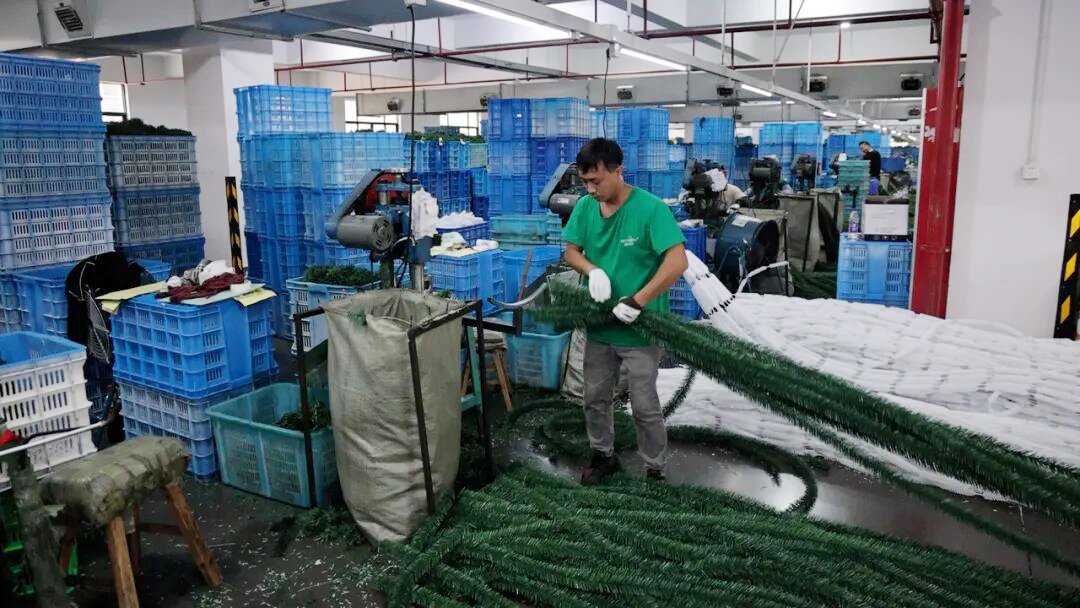
A worker in a Yiwu artificial Christmas tree factory carefully handles long green PVC branches on the workshop floor, while rows of machines and high stacks of blue plastic crates highlight the high-volume production environment supplying Christmas trees and garlands to global buyers.
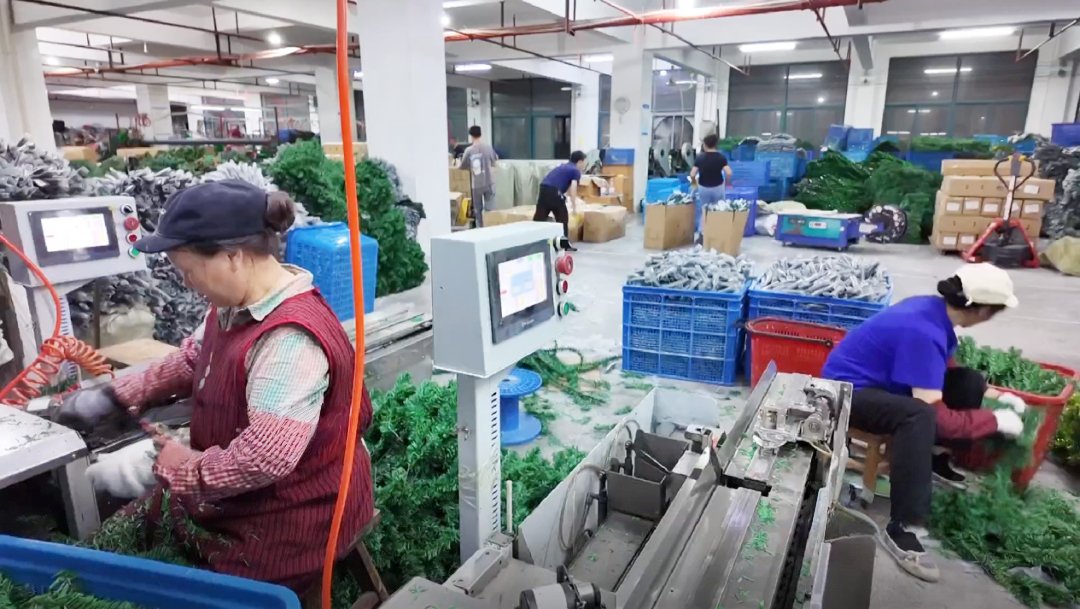
In a Yiwu artificial Christmas tree factory workshop, employees operate cutting machines, assemble green PVC branches and organize plastic components into stacked blue crates and cardboard boxes, illustrating how large-volume Christmas trees and garlands are manufactured and packed for export to global holiday decoration buyers.
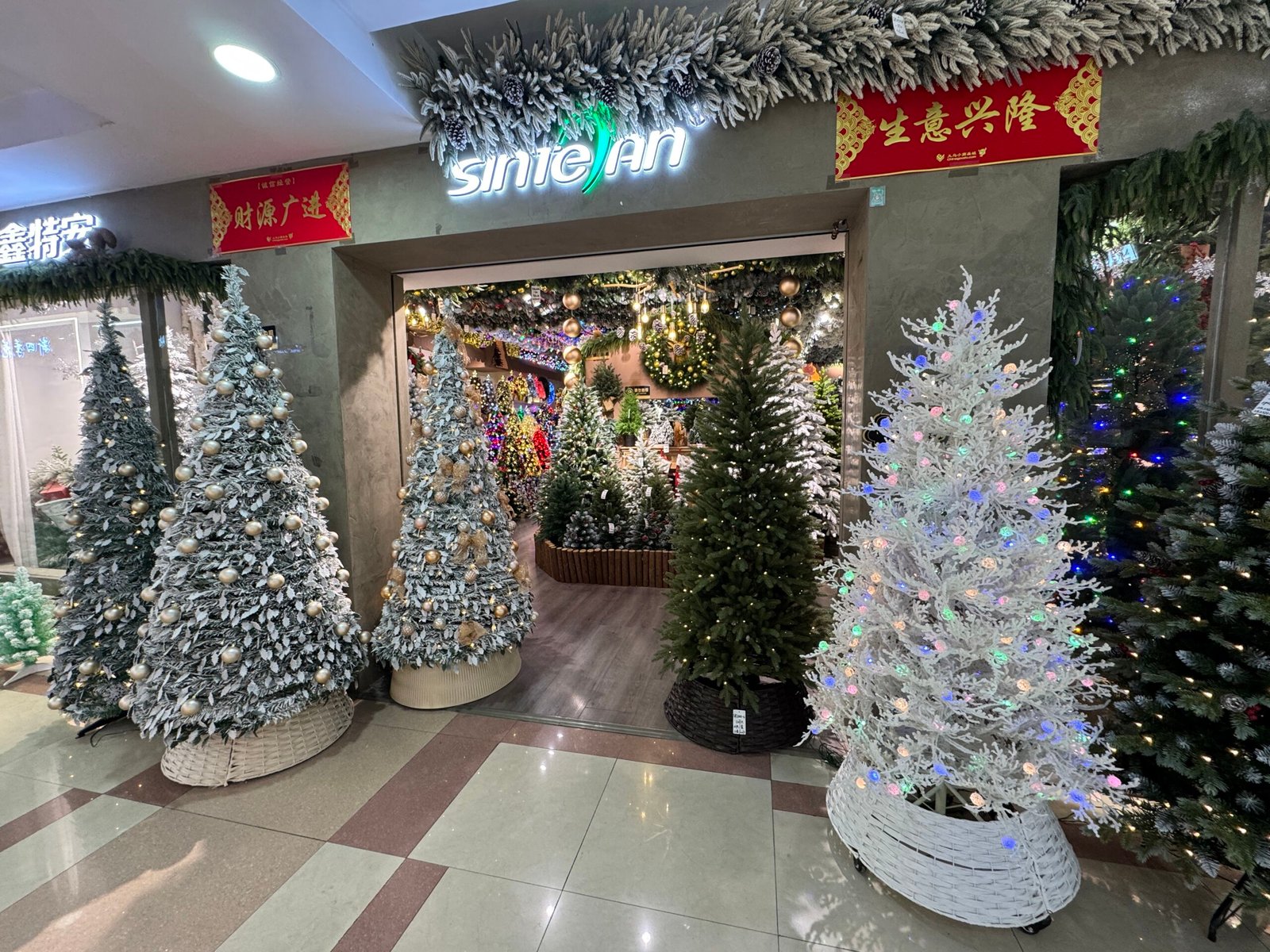
Sintean Christmas shop in Yiwu Christmas Wholesale Market featuring snowy artificial Christmas trees with gold ornaments, white LED trees and green trees in woven baskets, all available in multiple sizes for wholesale.
Unmatched Selection and Scale: China is the clear global leader in manufacturing Christmas trees and decorations. Regions like Yiwu (often nicknamed the “Christmas Village”) specialize in an unmatched variety of Christmas products, from tiny desktop Christmas trees to towering 10-meter showroom trees. Chinese suppliers offer classic green PVC trees, lush PE trees that mimic real pine needles, fiber-optic lit trees, and even “smart” Christmas trees with app-controlled LED lights and music. Whatever style or quality level you need, you can likely find a Chinese factory making it.
Competitive Pricing: High-volume production in China keeps prices competitive. Many buyers turn to China to source festive products easily and cheaply. When you reuse artificial Christmas trees over multiple years, they become much cheaper than repeatedly buying real trees, which is one reason consumer demand for artificial Christmas trees has grown. By importing from China’s cost-efficient manufacturers, wholesalers can secure healthy profit margins while still offering attractive prices to customers.
Rising Global Demand: Importing Christmas trees is a profitable business. For example, the U.S. imports about $80 million worth of artificial Christmas trees each year to meet consumer demand. Around the world, holiday decorators are looking for new and interesting designs every season – and Chinese manufacturers are quick to offer fresh styles (from trendy colored Christmas trees to sustainable materials). By sourcing in China, you can stay ahead of trends and stock the latest designs to attract customers.
Established Supply Chain: China’s ecosystem for exporting holiday goods is well-developed. There are entire industrial clusters focus on Christmas products, along with experienced freight forwarders and customs brokers who know how to handle these seasonal shipments. In short, China offers one-stop convenience for all your Christmas tree and decoration sourcing needs.
When to Plan Your Christmas Tree Imports (Timeline and Seasonality)
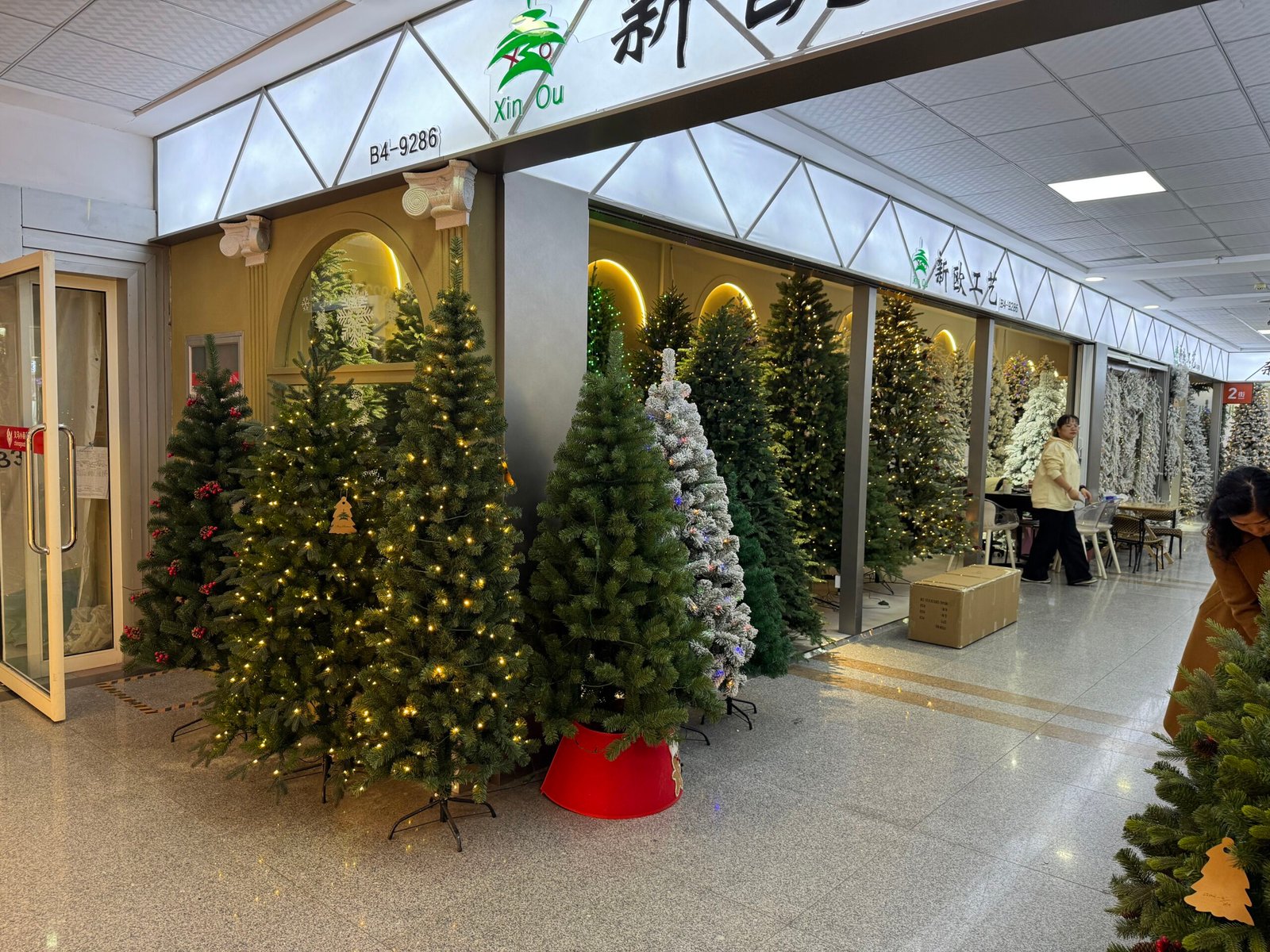
Xin Ou Christmas tree supplier in Yiwu displaying rows of artificial trees in different heights and styles, from plain green to snow-flocked with lights.
Timing is critical in the Christmas product business. Ordering well in advance of the holiday is essential to ensure your Christmas trees arrive in time for the shopping season. Here are some tips on scheduling:
- Start Early in the Year: It’s recommended to begin planning and placing orders as early as spring for Christmas items. Many importers kick off Christmas sourcing in May or even earlier. Chinese factories often start receiving large Christmas orders by spring, and orders peak from May through August. If you wait until fall, it may be too late to produce, ship, and clear customs before December.
- Allow 6–9 Months Lead Time: Aim to order 6–9 months ahead of when you need the stock. A typical timeline: finalize your order by late spring or early summer, manufacturing might take 30-60 days (depending on order size and complexity), and ocean shipping can take 3-6 weeks to reach Western ports. By ordering in June, for example, you could have goods in hand by October. This also provides a buffer for any production delays or port congestion.
- Off-Peak Ordering: If possible, order during the off-season (January–April) to get better pricing and factory attention. During these slower months, suppliers may offer discounts or be more willing to accept smaller MOQs. By contrast, in the rush of peak season, prices for raw materials and shipping may go up. Early orders help you avoid high peak-season shipping costs and shortages of popular tree models.
- Consider Production & Transit Times: Remember to factor in the entire timeline – not just production. For instance, once your Christmas trees are made, consolidating and loading containers efficiently takes time (especially for bulky items like trees). Then there’s sea transit (e.g. ~3-5 weeks from China to U.S. West Coast or Europe), customs clearance, and inland delivery to your warehouse. It’s wise to have your inventory ready a few months before December so you can distribute to stores or fulfill online orders in the fall.
- Peak Import Months: Many U.S. importers receive shipments in July and August for the holiday season. By summer, containers of Christmas artificial X-mas trees are leaving Chinese ports in huge numbers. If you’re importing to the U.S., be mindful that July–Sept is a busy time at ports and customs for holiday goods, so build in extra time for any backlogs. Likewise in Europe, autumn is when holiday inventory lands. All the more reason to plan ahead and be “Christmas-ready” by October.
In short, when it comes to Christmas imports, the early bird gets the worm (or, in this case, the tree)! Good planning ensures you won’t be left scrambling or paying expensive air freight fee to meet last-minute demand.
Finding the Best Christmas Tree Suppliers in China
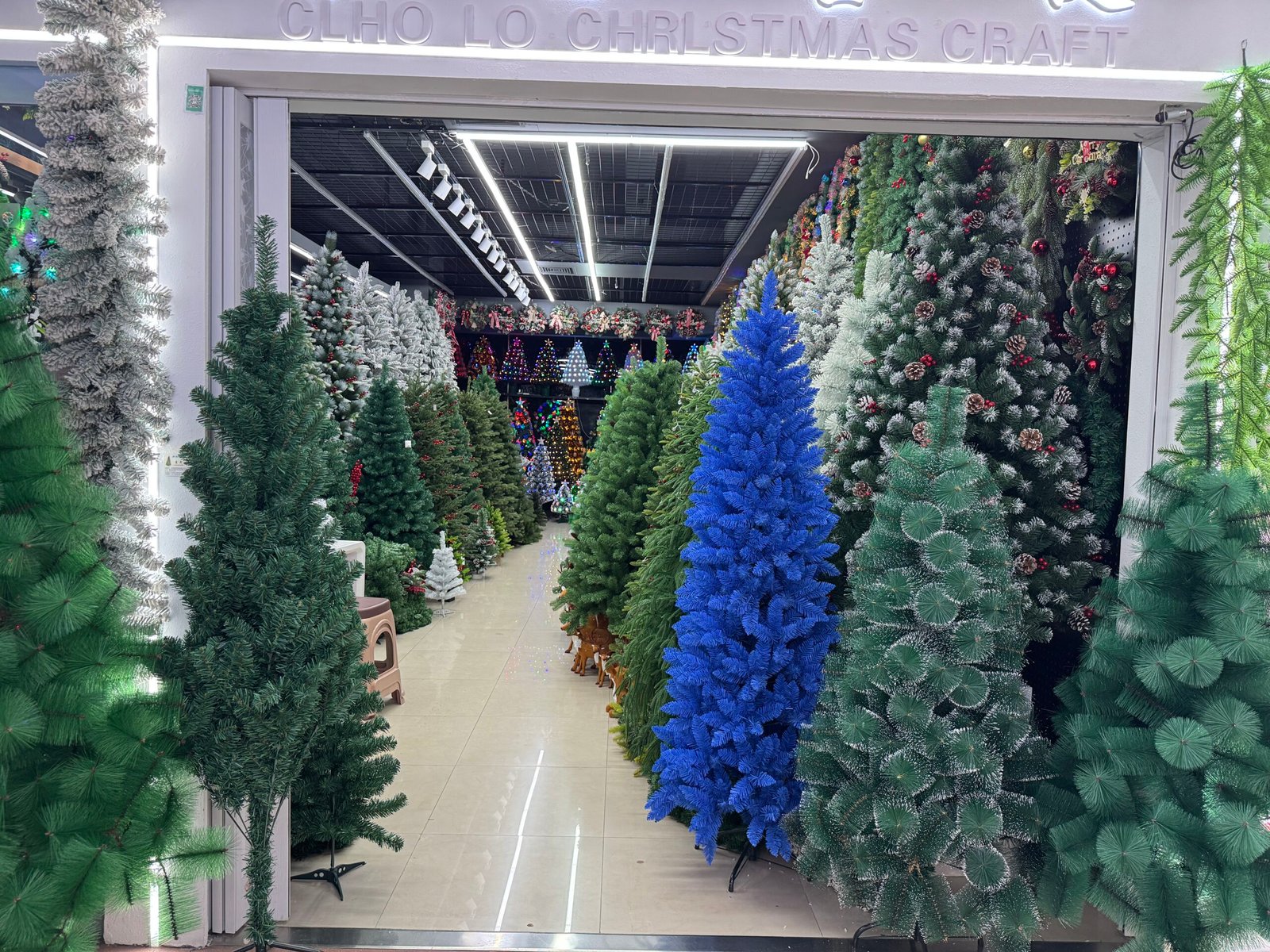
Showroom in Yiwu Christmas Wholesale Market filled with artificial Christmas trees in a range of sizes and colors, including green, snowy white and bright blue trees, ideal for store displays and commercial décor projects.
China’s vast manufacturing landscape can be overwhelming, but knowing where to look will save you a lot of time. Here are the main production hubs and sourcing channels for Christmas trees in China:
Major Manufacturing Hubs: Certain regions are famous for Christmas tree production, each with its own specialty. Key areas include:
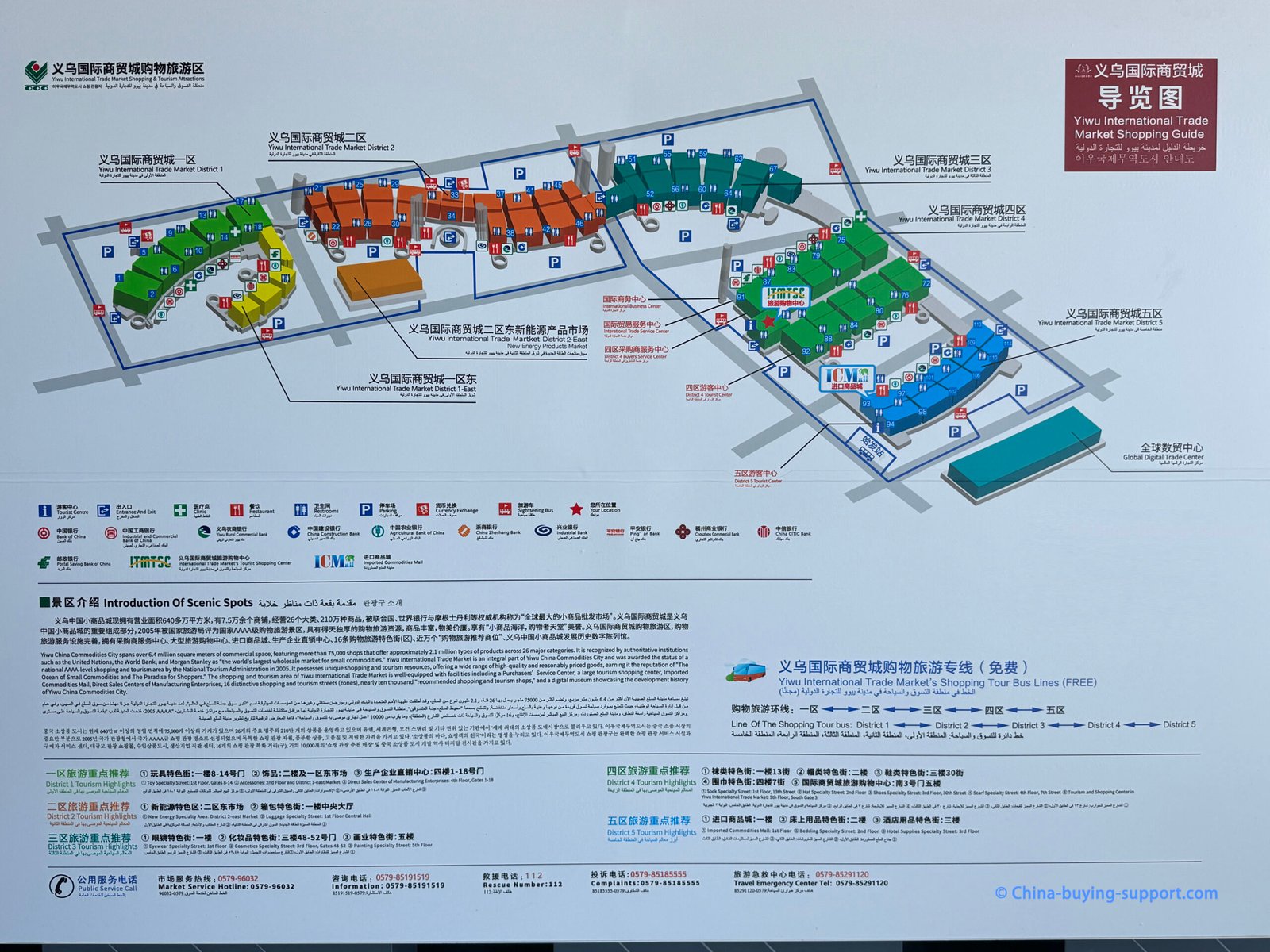
- Yiwu (Zhejiang Province): Yiwu is home to the world’s largest small commodities market and is often called the “Christmas Village” of China. Over 80% of the world’s Christmas items (trees, ornaments, tinsel, etc.) are produced in or around Yiwu. In the Yiwu International Trade Market (District 1), you’ll find a staggering variety of artificial Christmas trees – from mini 30 cm table Christmas trees to huge 3-4 meter showroom pieces. Prices are very competitive, and many suppliers in Yiwu accept small mixed orders. You can often buy a container with many different models and sizes, which is ideal for wholesalers who want variety. The area also has countless factories and workshops, making it easy to buy directly from the source and even get custom designs if needed.
- Dongguan (Guangdong Province): Dongguan is an industrial powerhouse known for its large factories and well-established supply chains. It specializes in extra-large and premium Christmas trees, typically ranging 2 to 10 meters tall, including those for outdoor or commercial displays. Suppliers in Dongguan are renowned for high quality – for example, they often use top-grade materials like mixed PE+PVC needles that look realistic and are flame-retardant. They are also skilled in custom orders (unique shapes, lighting integrations, etc.). Minimum Order Quantities (MOQs) here tend to be higher, often 500–1,000 units per design, so this region is best suited for large importers, big-box retailers, or brands placing bulk orders.
- Shenzhen (Guangdong Province): As China’s tech hub, Shenzhen brings innovation to holiday decor. Manufacturers here produce high-end “smart” Christmas trees with built-in electronics. Think LED Christmas trees that change color via a smartphone app, musical light shows, fiber-optic branches, and other innovations. Shenzhen suppliers focus on quality and cutting-edge design, making their Christmas trees popular in upscale markets (Europe, North America, Japan, etc.). If you’re targeting a premium part or looking for something unique, Shenzhen is a great place to source. Be prepared for higher prices than Yiwu, but also exceptional design and finish.
- Quanzhou (Fujian Province): Quanzhou is known for blending traditional craft techniques with modern manufacturing. It produces a lot of medium-sized Christmas trees (1.5–2.5 m) at reasonable prices. Factories here often have expertise in plastics and resins (thanks to local toy and craft industries), which they leverage to make creative Christmas tree designs. Quanzhou suppliers are a good choice for mid-range products – offering decent quality, some level of customization, and innovative touches (like unique textures or mixed materials) without a high price tag. Buyers from regions like Southeast Asia, the Middle East, and Latin America often source from Quanzhou to get standout products at a value price.
Of course, Christmas tree factories exist all over China (including places like Qingdao, Jinhua, Dongyang (close to Yiwu), etc.). But the hubs above are the most major ones and can serve as your starting point. Now, how do you actually find and connect with these suppliers? You have several options:
Sourcing Channels:
- China Sourcing Agents: If you’re new to importing or want hands-on assistance, using a local sourcing agent can be invaluable. A reputable China sourcing agent (such as a Yiwu or Shenzhen agent) will help you navigate the market, identify reliable factories, negotiate prices, perform quality checks, and handle shipping. They essentially become your on-the-ground partner. This service adds some cost, but it can save you from costly mistakes and ensure you get exactly what you need. For large or complex orders, an agent’s guidance is often worth it – they know which factories have good reputations and which to avoid.
- B2B Online Platforms: Many importers start by browsing online marketplaces. Alibaba.com, Made-in-China, Global Sources, and other B2B platforms list thousands of Christmas tree suppliers. You can search by keywords (e.g. “7ft artificial Christmas tree”) and filter by verified suppliers. Evaluate product photos, specifications, MOQ, and company profiles. It’s a convenient way to gather quotes and compare options from your office. Keep in mind that an impressive online listing doesn’t always guarantee factory reliability – you’ll still need to vet suppliers you find online (request certifications, samples, etc., as discussed below).
- Trade Fairs and Markets: Visiting China’s trade fairs or wholesale markets can be a goldmine for finding Christmas merchandise. The Canton Fair (held biannually in Guangzhou) has a section for holiday decorations where hundreds of suppliers exhibit – it’s an opportunity to see products in person and make contacts. The Yiwu Wholesale Market is open year-round and is basically a permanent trade show for festive products; you can walk through aisles of Christmas items and buy on the spot or arrange orders. Additionally, China hosts specialized seasonal fairs (e.g., the Christmas Items Fair in Yiwu, or regional gift fairs). Internationally, trade shows like Christmasworld in Frankfurt feature many Chinese suppliers as well. Attending these events allows you to touch and see the product quality directly and often to negotiate better deals face-to-face.
- Google and Company Websites: A simple Google search (e.g. “China Christmas tree wholesale supplier”) can lead you to manufacturers’ websites or directories. Many established factories have their own English-language websites showcasing their catalog. You can contact them directly via email/WhatsApp. Just be cautious to verify that the company is legitimate (for example, check that they list a Chinese business license number or ISO certification, etc.). Websites can sometimes be outdated, so double-check any info and always request up-to-date pricing.
Tip: No matter which channel you use, due diligence is key. In the next section, we’ll cover how to vet and verify suppliers before you confirm an order.
Ensuring Quality and Compliance (Safety Standards & Vetting Suppliers)
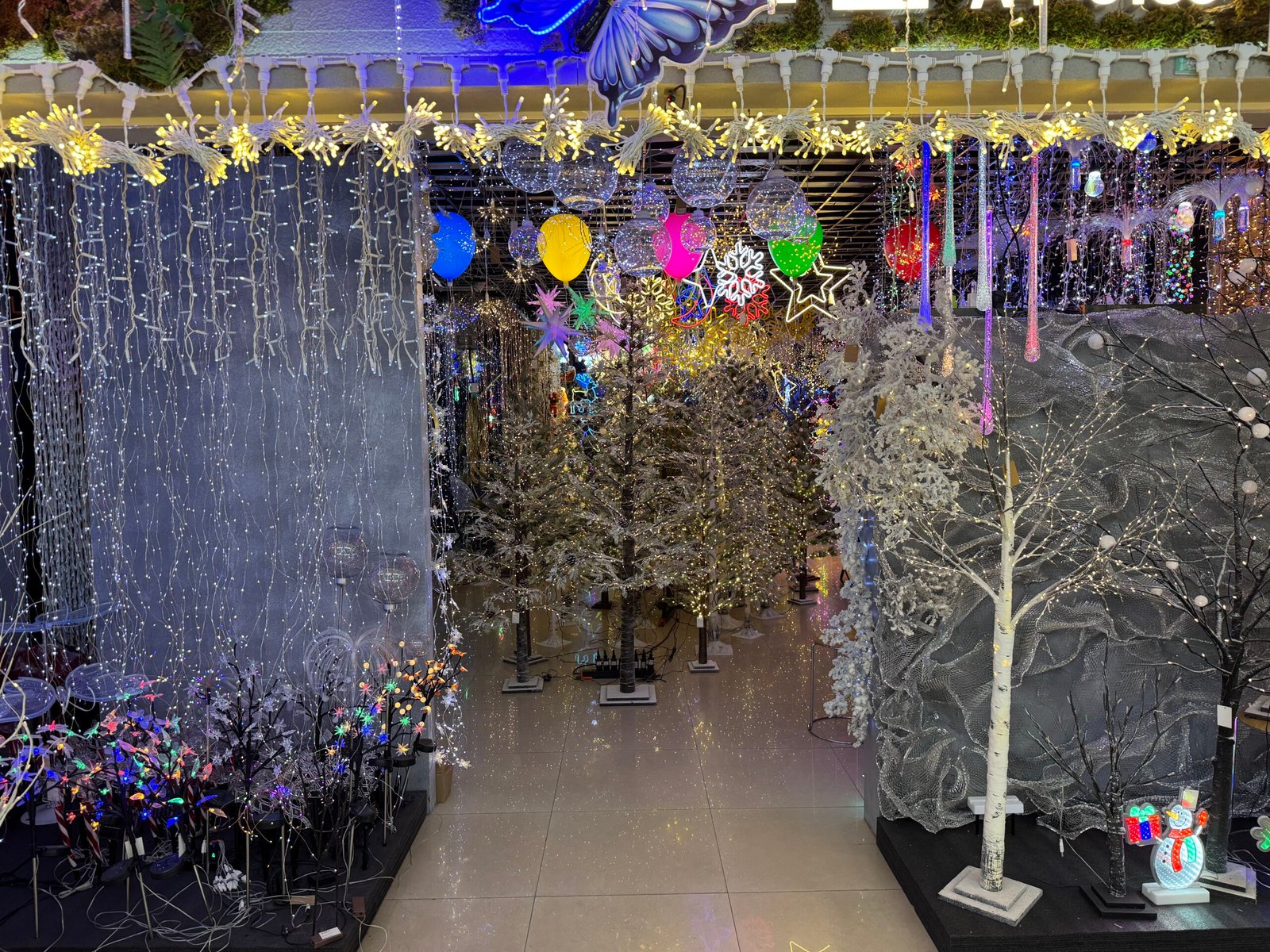
Room filled with LED Christmas trees, curtain lights, icicle lights and neon-style wall decorations in the Yiwu Christmas Wholesale Market, ideal for festive lighting projects and outdoor displays.
Importing high-quality, safe products is crucial for your business reputation and compliance with regulations. Here’s how to ensure the Christmas trees you import meet your standards and your country’s regulations:
Factory Verification: Before placing a large order, vet the supplier’s credentials. Ask for copies of their business license and any factory certifications. Many reputable manufacturers hold audits and certifications like BSCI or Sedex (social compliance) and ISO9001 (quality management). These indicate the factory is experienced in exporting. Most importantly, confirm they have export experience to your country – if they’ve shipped to the US or EU before, they’re likely familiar with required standards and paperwork. You can also search online for the company name to see if they’ve been involved in any disputes or have reviews from other buyers.
Product Safety Standards: Artificial Christmas trees might seem like simple decoration items, but there are important safety considerations:
- Flame Retardancy: Fire safety is paramount. High-quality artificial Christmas trees are made of flame-retardant materials (often treated PVC or PE) to reduce fire hazards. In the U.S., the Consumer Product Safety Commission (CPSC) requires that artificial Christmas trees be able to resist ignition for a certain period and be labeled as flame-retardant. In fact, artificial Christmas trees over 30 inches tall are tested to ensure they won’t easily catch fire. In some areas (for example, certain U.S. states or for use in public spaces), only flame-resistant Christmas trees are allowed. What to do: Ask your supplier if their Christmas trees are made with fire-resistant additives and if they have any flame retardancy certificates or test reports. Reputable suppliers might have a UL94 or NFPA 701 fire resistance test report for their materials. At minimum, ensure the product description explicitly states “flame retardant.” Do not skip this – it’s both a safety issue and a legal requirement in many cases.
- Electrical Safety (for Pre-Lit Trees): If you’re importing pre-lit Christmas trees (Christmas trees that come with light strings or LED elements), you must ensure the electrical components meet safety standards. For the U.S., that means UL or ETL certification for the light sets, and compliance with CPSC rules on wiring. For Europe, look for CE marking on the lights and possibly GS or other EU certifications, plus RoHS compliance (no hazardous substances in electronics). The lights should have built-in fuses or safety features to prevent overload. Ask the supplier for test reports – they might provide a CE Declaration of Conformity for the lights or show that the light strings were tested by a lab for EN 60598 (EU lighting safety) or UL 588 (US holiday light safety) standards. Also, verify that replacement bulbs (if any) and instructions are included as per regulations. Pro tip: If you’re not comfortable assessing this, consider buying X-mas trees without lights and sourcing lights separately from certified suppliers, or hire a third-party inspection company to specifically test the electrical components.
- Lead and Chemical Content: Both the U.S. and EU have strict rules about hazardous substances in consumer products. Artificial Christmas trees are typically made of PVC, which in the past sometimes contained lead as a stabilizer. Today, lead limits apply – for example, the U.S. requires surface coatings to have lead content under 0.009% (90 ppm) for children’s products, and though a tree is not a toy, it still shouldn’t have high lead content. The EU’s REACH regulation restricts chemicals like certain plasticizers, heavy metals, etc., in products. When vetting a supplier, ask if their materials are RoHS compliant and REACH compliant. Some may provide an EN71-3 test report (which checks for heavy metals in toys) as an additional assurance. This is especially important if the Christmas trees might be used around children or the product includes any toy-like decorative parts.
- Structural Quality: Request samples or at least detailed photos/videos of the Christmas trees before finalizing the order. Inspect the density of the needles/branches (a fuller tree with more tips is generally higher value), the evenness of color (no weird off-color branches), and the sturdiness of the stand. Metal stands are preferable to cheap plastic ones for larger trees. If the tree is tall, does it have a stable base? For pre-lit trees, ask to see it powered on to check that all lights work and have consistent brightness. For any Christmas trees that come with decorations attached (like pine cones, berries, etc.), ensure those accessories are securely fastened so they won’t fall off. It’s a good idea to have a third-party quality control inspector do a pre-shipment inspection at the factory – they can do assembly tests, shake tests, and carton drop tests to make sure the product and packaging are in good condition.
- Wooden Components: Be aware if any part of the artificial Christmas tree is made of natural wood (some Christmas trees have a wooden trunk pole or wooden block base for small tabletop trees). Wood can trigger agricultural import regulations. In fact, the USDA once quarantined artificial Christmas trees from China that had untreated wooden poles, due to risk of invasive beetles in the wood. To avoid such issues for U.S. imports, ensure any wood parts are properly treated and certified pest-free (or choose designs with metal or plastic poles). The EU Timber Regulation also requires that wood parts come from legal sources. If your Christmas trees do include wood, check if the supplier has a phytosanitary certificate or fumigation certificate for those components, or opt for non-wood construction when possible.
Regulatory Compliance (US & EU): Make sure you adhere to the import regulations of your target market:
- United States: Other than general product safety, artificial Christmas trees themselves don’t need approval from any specific government agencies (unlike live trees which involve USDA permits). You don’t need an FDA or FCC approval or anything for plain artificial trees. However, CPSC regulations on flammability and electrical safety (as discussed) apply. Ensure the product is properly labeled – for example, include “Made in China” country of origin labels on the cartons and the product (a U.S. customs requirement). Also, for retail, it’s good practice to have appropriate warning labels (like fire safety warnings or electrical warnings) as needed. If you import large shipments (value over $2,500), you’ll need to file a customs bond for entry – a customs broker can help with this. Importantly, if the shipment includes any Christmas lights or electrical components, those might involve Federal Communications Commission (FCC) compliance (for electromagnetic emissions) or other partner government agencies. But generally, artificial trees are straightforward: get your customs documents in order (commercial invoice, packing list, bill of lading, etc.) and clear through CBP with the correct HS code and duty (more on that below).
- European Union: Importing into the EU requires an EORI number (an importer registration), so ensure you have that set up. The EU has broad safety directives like the General Product Safety Directive which mandates that any consumer product on the market must be safe. While there’s no specific “Christmas tree directive,” you should check if your trees fall under any category requiring CE marking. Plain artificial trees likely do not need a CE mark, but if the tree includes electrical lights, it would be covered by the Low Voltage Directive and EMC Directive, hence CE marking is required. Also, any decorative lighting sold in the EU must carry the CE mark to show compliance, so ensure your supplier can provide that. Additionally, EU importers should verify the materials meet REACH and do not contain banned substances (like certain flame retardant chemicals that are restricted). All imported goods also have to go through customs with the correct tariff classification and duties paid (discussed in the next section), and VAT will be applied on import. Don’t forget to pay the import VAT in your country (this is usually applied to get this money back if you’re VAT-registered, but it’s a cash flow consideration).
Request Documentation: A trustworthy supplier should provide product test reports and certificates if you ask. For example, they might give you a flame retardancy test report, RoHS certificate for lights, CE Declaration for lit trees, or EN71 reports for any toy-like items. Also ask for a Certificate of Origin if you plan to use any trade preference or need it for customs (though China Christmas trees typically don’t have a reduced tariff via FTA in US/EU, a COO might still be needed for other regions). When you ship, ensure the supplier provides a detailed packing list and commercial invoice describing the goods correctly (including that they are “Christmas decorations” or “artificial Christmas trees” – avoid generic terms that might confuse customs). It’s much easier to get it right from the beginning than to answer questions later.
Quality Control: Finally, consider hiring an inspection company in China to do a pre-shipment inspection (PSI) on your order. They can visit the factory when production is complete and verify quantity, workmanship, labeling, and perform safety checks (like flammability tests with a small flame, checking plug standards, etc.). This typically costs a few hundred dollars but can save you from receiving a container of unsellable goods. If you can’t send an inspector, at least request live video inspection or detailed batch photos from the supplier.
By thoroughly vetting suppliers and insisting on compliance, you’ll protect your business and ensure your customers receive safe, high-quality Christmas trees. Now, let’s look at the logistics of shipping and customs clearance.
Shipping and Customs Clearance Logistics for Christmas Tree Order
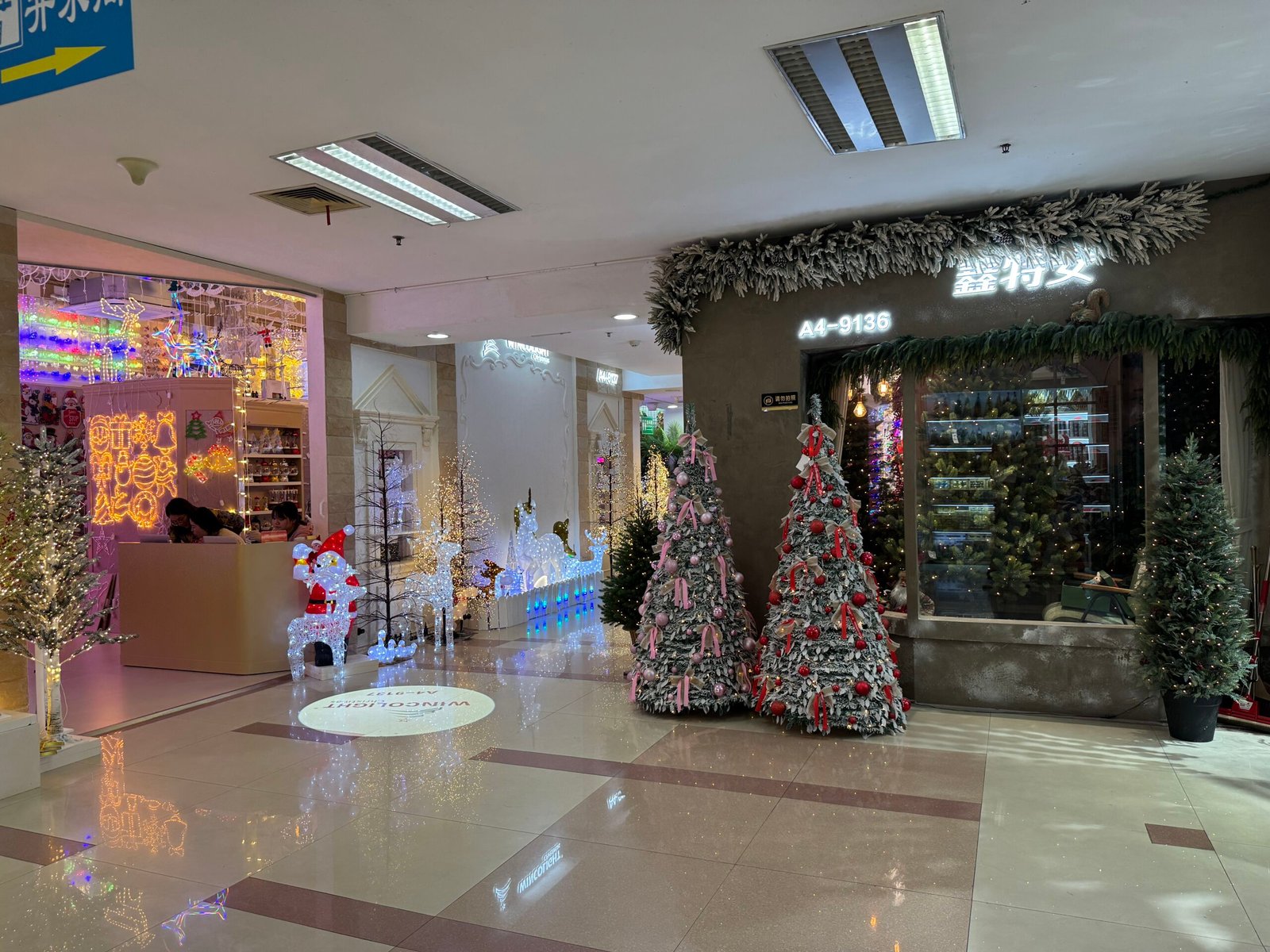
Corner of Yiwu Christmas Wholesale Market near booth A4-9136 displaying LED Christmas trees, acrylic reindeer silhouettes and glowing light sculptures for indoor and outdoor festive lighting projects.
Getting your Christmas trees from the factory floor in China to your warehouse involves careful coordination of shipping and customs procedures. Here’s what to keep in mind:
Freight Options: Given that artificial trees are big and bulky (even when disassembled and compressed, they take up a lot of volume), ocean freight is almost always the way to go. A 40-foot container can fit hundreds of boxed trees, and the cost per unit will be far lower than air freight. Only in exceptional cases (very tight deadlines or very small shipments like samples) would you ship by air, as air freight for large cartons is extremely expensive. Plan your ordering so you can ship by sea in either full container loads (FCL) or a consolidated shipment (LCL) if you don’t have enough volume for a full container.
p.s. We have a very detailed article on FCL and LCL, if you’d like to read more this, please check here <FCL vs LCL: How to Choose the Right Ocean Freight>
Optimize Packaging: Work with your supplier to make the packaging as efficient as possible. Christmas trees are often shipped disassembled – e.g., in sections with branches that fold or detach – to minimize carton size. Choosing designs with removable or foldable bases can significantly reduce the volume each tree takes up. Have the factory pack the trees tightly in sturdy export cartons. Strong double-corrugated boxes are a must to protect the products on the long journey. Moisture barriers (like a polybag lining) can help if the goods might sit in humid conditions. Remember, ocean shipments can be subject to bumps and jostling; you want packaging that prevents any damage to the branches or bending of parts. It’s a fine balance: you want compact cartons, but also enough cushioning (foam, bubble wrap) for any easily damaged parts like pre-strung lights or decorative elements.
Container Loading: Because freight is charged by container space, use all available container space wisely. Trees are light for their size, so you will “cube out” (fill the container by volume) before you “weigh out”. In practice, this means arranging cartons to avoid empty space. Factories experienced in exporting trees will know how to load containers to make the best use of the space. For especially large trees (3 meters and above), the factory may split them into multiple cartons and load unassembled, then you or your customer will assemble them upon arrival. This can save a lot on shipping because a fully assembled giant tree is mostly air (much empty space in the carton). As a rule, discuss container optimization strategies with your supplier or freight forwarder; sometimes slightly adjusting carton dimensions can allow an extra row of boxes in the container, saving you money on per-unit shipping cost.
Shipping Schedule: Aim to ship out of China by late summer for Christmas goods. Keep an eye on carrier schedules and space availability. Since a huge volume of holiday goods (toys, décor, electronics) ship around the same timeframe, book your vessel space well in advance (a month or more ahead of when production finishes). Your freight forwarder can help ensure you get a booking. Also, be mindful of Chinese holidays – for example, factories and ports shut down for about a week during Golden Week (early October). Plan around those to avoid delays.
Customs Documentation: Work with your supplier and shipper to prepare the necessary documents. These typically include: Commercial Invoice, Packing List, Bill of Lading (or Air Waybill), and potentially a Certificate of Origin. Make sure the commercial invoice clearly describes the goods as “Artificial Christmas Trees” (or “Christmas decorations” for mixed shipments) and includes the correct HS codes. If you are in the US, you’ll also need to file an Import Security Filing (ISF) 24 hours before the cargo is loaded in China – your customs broker or forwarder will handle this, but ensure they have the data they need (consignee info, supplier, cargo details, etc.). If any wooden packaging (pallets or crates) is used, it must be ISPM 15 stamped (heat treated) – typically Chinese suppliers use plywood or treated wood pallets to comply. The packing list should detail the number of cartons, CBM (cubic meters), and weight, matching the actual shipment.
Customs Clearance (US): For the US, hire a Licensed Customs Broker to file your entry with Customs and Border Protection (CBP). They will use the HTS code (tariff code) for your products to determine duties (as we’ll discuss next). Good news: artificial Christmas trees and most ornaments have no import quota or special license requirement – they are not like textiles or food that need extra permits. Customs will mainly be checking documentation and possibly doing an exam to ensure contents match the invoice and there are no prohibited items. As noted, if your shipment includes any plant material (real pinecones, or wood stands), there might be an agriculture exam. But purely plastic/metal Christmas trees sail through relatively easily. Customs bonds: In the US, if the shipment value is over $2,500, you must have a customs bond. You can get a single-entry bond or have a continuous bond if you import regularly. Your broker can arrange this. Also be aware of Section 301 tariffs (more in the next section) – your broker will apply those if applicable. Once duties are paid and the shipment is cleared, you or your freight agent can arrange trucking from the port to your warehouse. Pro tip: try to coordinate delivery so that you’re ready to receive and unload immediately – storage at ports or warehouses during the holiday rush can be costly.
Customs Clearance (EU): In the EU, you (or your appointed customs agent) will file an import declaration. Ensure you’ve had your EORI number beforehand. The process is similar: declare the proper commodity code, pay the import duties and VAT. The TARIC system will show if any extra measures apply; for example, TARIC can indicate if anti-dumping duties, quotas, or required certificates exist for the HS code. For Christmas decorations, typically there are no anti-dumping or quotas in the EU – these products are straightforward, with just the standard tariff. After customs clearance, VAT will be charged (at your country’s rate, e.g. 20% in UK, 19% in Germany, etc.), calculated on the CIF value plus duty. You’ll need to pay that VAT to customs, but you can usually reclaim it in your VAT return if you’re reselling the goods. Arrange transport from the port (or if by rail via transcontinental routes) to your warehouse. Note: Europe also has strict rules on packaging waste – ensure that you or your suppliers are compliant with any recycling logo requirements (some EU countries require a Green Dot or recycle symbol on packaging).
Insurance: Don’t forget to insure your shipment. Ocean freight can encounter rough seas; containers can get wet or occasionally lost overboard (rare, but it happens). Marine cargo insurance is relatively inexpensive and will give you peace of mind for such a high-value seasonal shipment.
Using a Freight Forwarder: If all this sounds complex, a good freight forwarder will handle the transportation and a good customs broker will handle the import clearance. You can also find logistics providers that do both. Provide them with your shipment details and they’ll guide you through each step. Many importers opt for door-to-door service where the forwarder picks up from the factory and delivers to your door, handling all customs paperwork in between. This can simplify things greatly, especially if you’re not familiar with international shipping documents.
In summary, pay attention to packing efficiency, book your shipments early, have all documents in order, and use experienced logistics partners. Now, let’s move to the crucial topic of import tariffs and taxes – understanding these will help you price your products right and avoid surprises.
US and EU Import Duties for Christmas Trees and Decorations
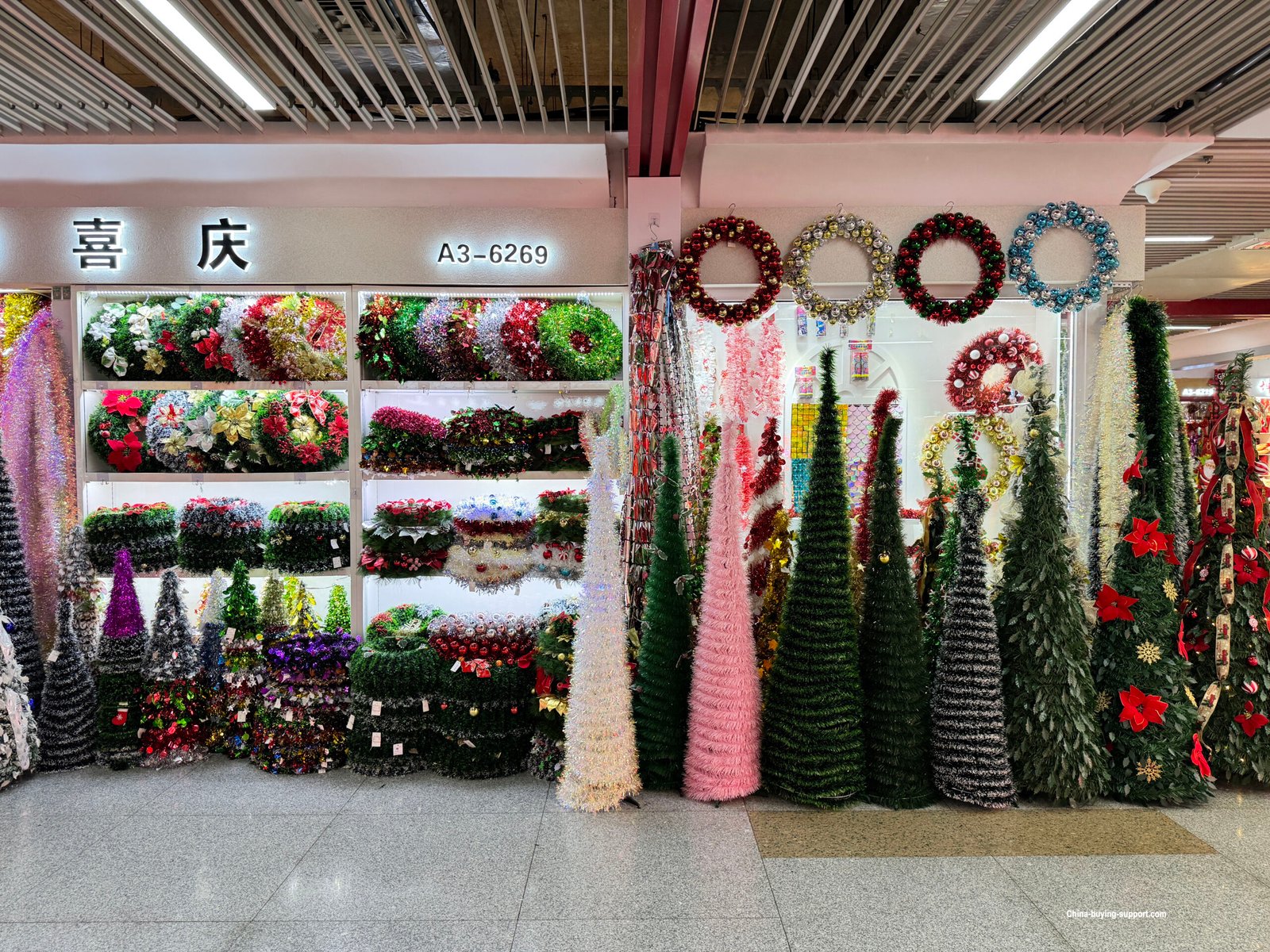
Yiwu Christmas wholesale shop in China displaying tall artificial Christmas trees, tinsel garlands and wreaths at stall A3-6269, ideal for holiday decor sourcing.
One of the biggest questions importers have is: How much tax or tariff will I pay on these goods? The good news is that Christmas trees and many holiday decorations often carry low import duties. In some cases, they are even duty-free. Below we’ll break down the US and EU tariff rates for key Christmas products and how to ensure you’re getting the best rate. We’ll also answer whether Christmas trees are duty-free.
First, here’s a quick reference table comparing U.S. and EU import duty rates for typical Christmas tree products:
| Product (HS Code) | U.S. Import Duty (MFN) | EU Import Duty (MFN) |
|---|---|---|
| Artificial Christmas Trees (HS 9505.10) | 0% base rate (Duty-free under HTS, classified as festive articles). + Note: Subject to extra 7.5% tariff for China origin (Section 301). |
2.7% (CN 9505.10.90.00 – “Articles for Christmas festivities, other than of glass”). No extra tariffs for China (standard MFN apply). |
| Christmas Ornaments – Glass (HS 9505.10) | 0% (e.g. HTS 9505.10.10 – glass ornaments are duty-free in US). | 0% (CN 9505.10.10.00 – glass Christmas ornaments are duty-free in EU). |
| Christmas Ornaments – Other Materials (plastic, wood, etc) | 0% (HTS 9505.10.25 and 9505.10.15 – ornaments of other materials are duty-free). | 2.7% (CN 9505.10.90.00 covers non-glass festive articles, including plastic ornaments). |
| Christmas Light Strings (HS 9405.30) | 8% base rate (e.g. HTS 9405.30.00 – electric Christmas light sets have 8% MFN duty). + 7.5% additional if from China (Section 301). |
3.7% (CN 9405.30.00.00 – lighting sets for Christmas trees). |
MFN = Most Favored Nation (the normal tariff rate for WTO members like China). All rates are as of 2025.
As you can see, in the United States the base import duty for most Christmas items is 0%. Artificial Christmas trees are classified under HTS 9505.10 as festive articles, which carry no general import duty. Similarly, decorative ornaments (whether of plastic, wood, etc.) also have a 0% duty rate under their respective subheadings. Christmas lights are one exception – they have an MFN duty (~8%). So, are Christmas trees duty-free in the US? – Yes, the base tariff is 0%, meaning you don’t pay normal customs duty on artificial Christmas trees. This greatly simplifies cost calculations for importers.
However, there’s an important key point: additional China tariffs. As of now, the US has imposed Section 301 tariffs on many Chinese goods, including Christmas products. These were the tariffs introduced during the US-China trade dispute. For some holiday items, the additional tariff is 7.5% (this was originally 15%, reduced to 7.5% in early 2020). For others, it could be 25% (items on earlier tariff lists). According to recent data, artificial trees and many ornaments from China face an extra 7.5% tariff at U.S. customs, while Christmas light strings face 7.5% on top of the 8% base, effectively 15.5% total. These are subject to change with trade policy updates – there’s always a possibility tariffs are lifted, increased, or new exclusions granted. Tip: Stay updated on the status of Section 301 tariffs. Your customs broker can advise you, or you can check the USTR/CBP websites. Some importers try to get around this by sourcing certain components from elsewhere (e.g., importing from Vietnam or Mexico, which have no extra tariff, but if you’re buying fully from China, you should budget for these additional duties in the US.
In the European Union, artificial Christmas trees and most Christmas decorations are not duty-free, but the tariffs are low. The EU classifies these under similar HS codes (9505.10.xxxx). For example, “Articles for Christmas festivities, of other materials” carry a 2.7% duty. This category includes artificial trees (since they’re not made of glass) and plastic or wooden ornaments, etc. Glass Christmas ornaments happen to be duty-free (0%) in the EU, likely to support the fact that European producers (like those in Poland or Germany) also make glass baubles. Christmas lighting sets fall under a lighting equipment category with 3.7% duty in the EU. Fresh (real) Christmas trees are a different HS category (0604), and they have a small tariff (2.5% in EU), but since you wouldn’t import real trees from China (there real trees are usually sourced regionally), we focus on artificial trees here.
Finding the Best Tariff Rates: The key to ensuring you pay the lowest necessary import tax is correct product classification and awareness of any special programs:
- Use the Correct HS Code: Classifying your product under the right HS (Harmonized System) code is crucial. As we saw, “festive articles for Christmas” codes have low or zero duty. If one were to mis-declare an artificial Christmas tree under a generic plastic goods category (Chapter 39) or as furniture, for example, you could be charged a much higher duty (those could be 6.5% or more). So, be sure to use the specific codes in Chapter 95 for Christmas items. The Harmonized Tariff Schedule of the US (HTSUS) and the EU Combined Nomenclature (CN) have detailed breakdowns. For instance, an artificial Christmas tree made of plastic should be classified as HTSUS 9505.10.40.10 in the US, which is duty-free. In the EU, it would fall under CN 9505.10.90.00 (Christmas articles, other than glass) at 2.7%. Getting the code right ensures you take advantage of the intended low tariff for festive items.
- Check Tariff Databases: To double-check rates and any updates, use official tools. The U.S. International Trade Commission’s HTS search or websites like HTS.USITC.gov can confirm the current U.S. duty for your HS code. For the EU, use the EU TARIC system – it’s an online database where you input the 10-digit CN code and the country of origin (China) and it will output the current duty % and any other applicable measures (like if an anti-dumping duty existed, it would show it, but for Christmas decorations there are none). TARIC is very useful because it also tells you if you need any licenses or extra documentation for that code (usually not for Christmas items, but to be safe, it’s a good idea to double-check for that). The TARIC system is basically the “dictionary” for EU importers to check applicable customs rates and requirements.
- Preferential Trade Agreements: Currently, neither the US nor EU have a free trade agreement with China (so you pay MFN rates). But if you ever decide to source from another country, check if a trade agreement applies. For the EU, some developing countries have GSP (Generalized System of Preferences) reduced rates, but China is not eligible for GSP in the EU. So when importing from China, you will pay MFN rates. Just know this concept: the country of origin matters. Always correctly declare the origin and see if any preferential rate could apply (in our case with China, no special preference, but you do need to ensure “Country of Origin: China” is on your customs entry and import paperwork).
- Customs Value and VAT: Remember that in Europe you’ll pay VAT on import. This isn’t a duty but it’s a tax. VAT rates differ by country (e.g., 21% in Spain, 20% in France, etc.). You pay VAT on the CIF (cost + insurance + freight) value plus duty. For instance, if you import €10,000 worth of trees into an EU country with 2.7% duty and 20% VAT: duty would be €270, then VAT is applied on €10,270 (which would be ~€2,054). You can typically claim back that €2k later if you’re selling those goods, but you need to account for it. In the US, there’s no import VAT, but states might charge sales tax when you sell the items – that’s separate from importation.
- Duty Drawback (USA): If there’s any chance you might re-export some of the imported trees (for example, selling to customers in Canada or Mexico after bringing them to the U.S.), look into duty drawback. The U.S. allows reclaiming 99% of duties paid (including those hefty Section 301 tariffs) for goods that are re-exported. It’s an involved process, but for high volumes it could be worth it. This is more of a niche case, but I mention it because “best rate” could include getting money back.
- Customs Broker Advice: Leverage your customs broker’s expertise. A good broker will ensure you’re using the optimal tariff codes and claim any exemptions. For example, they will ensure that a tree with lights isn’t mistakenly classified entirely as a light (which would be charged 8%) if it is properly a composite good – though usually a pre-lit tree is still classified as a tree/decoration, not as lighting, since the lights are accessory. These small differences in classification can save money. Brokers also stay on top of any temporary duty suspensions. In rare cases, the U.S. Congress passes temporary reductions on certain imports – unlikely for Christmas trees since they’re already free, but for example, if any special tariff holiday existed, they’d apply it.
In summary, import tariffs for Christmas trees are very importer-friendly: the base rates are low. U.S. importers currently pay $0 in standard duty for artificial trees (If there weren’t a U.S.-China trade war), and EU importers pay a small percentage. The main thing to watch out for is the U.S. Section 301 China tariff, which means your Chinese-origin trees will have an extra cost (currently 7.5%) and the US-China trade war led to a significant increase in tariffs. Even with that, Chinese trees often remain cost-effective due to their low unit cost. But do include that into your cost calculations so you’re not caught by surprise.
For the EU, Christmas products from China face the normal MFN duty (2.7% or 3.7% etc.) with no additional surcharges, since the EU hasn’t placed any special tariffs on such goods from China as of now.
To find the best rates: use the tools at your disposal (HTS database, TARIC), classify correctly, and stay informed on trade policy changes. If you do all that, you can be confident you’re paying the lowest legal duty and maximizing your profit on these imports.
Bring Holiday Cheer to Your Business
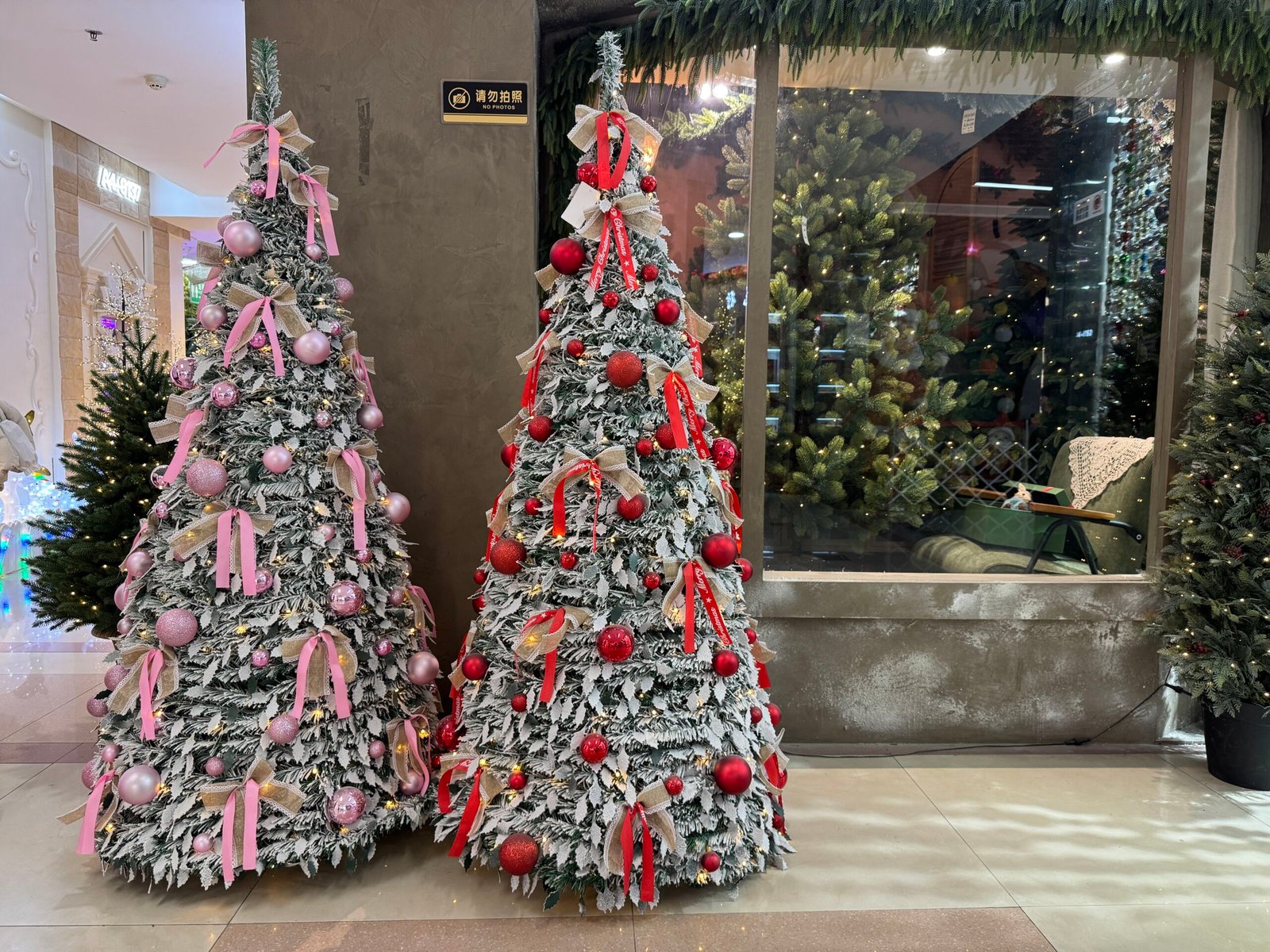
Pair of snowy artificial Christmas trees decorated with pink and red ribbons, baubles and warm lights in front of a showroom window at Yiwu Christmas Decorations Wholesale Market.
Importing Christmas trees and decorations from China may seem complex at first glance, but with the right approach it can be extremely rewarding. China’s vast selection, competitive pricing, and manufacturing expertise make it the go-to source for holiday merchandise. By planning your purchases well ahead of the season, choosing reliable suppliers in key hubs like Yiwu or Dongguan, and enforcing quality/safety standards, you set yourself up for success. Remember to mind the details of shipping and customs – pack efficiently, file the proper documents, and classify your products correctly to get minimal duties (often 0% in the U.S. for artificial trees and low rates in the EU).
In this guide, I shared how to find the best China Christmas tree wholesalers, ensure your products meet U.S. CPSC and EU requirements, and even gave you a handy tariff rate table for reference. Use this information to your advantage. There’s a world of festive opportunity awaiting – global consumers spend billions on holiday décor each year, and sourcing from China allows you to tap into that demand with a great margin.
Finally, consider building strong partnerships – whether it’s a trusted sourcing agent who can be your eyes in the factory, or a seasoned customs broker who smooths out the import process. With the right partners and knowledge, even a small retailer can import like a pro.
By importing Christmas trees from China, you can bring joy to your customers’ homes and profitable growth to your business. Happy importing, and may your holiday sales be merry and bright!
If you have any questions about sourcing Christmas Trees or Christmas decorations from Yiwu Market or China, or if you’d like professional assistance to make your buying process easier, we’re here for you. Feel free to reach out – whether you need a trustworthy agent on the ground, guidance on shipping options, or just someone to talk through your product ideas with, we’re happy to help. Sourcing can be complex, but you don’t have to do it alone. Contact us anytime for friendly advice or support on making your China sourcing journey a smooth success.
Contact Information as below:
Email:kevin@china-buying-support.com
Phone | WhatsApp:+86 1860 5899 103
Thank you.
Joining Us With 1,200+ Happy Clients Enjoying Buying From China now!
Becoming One of China-Buying-Support family to Get a Easier and Trouble-Free Sourcing and Shipping Service.