
Visiting China Without a Visa (2026): 30-Day Visa-Free, 240-Hour Transit & China Customs Dos & Don’ts
Quick Jump to The Topic You Are Interesting in by Clicking Below Highlighted Headings:
- China’s Unilateral Visa-Free Entry Policy (48 Countries)
- China’s Mutual Visa-free Agreements for Ordinary Passport Holders (29 Countries)
- 240-Hour Visa-Free Transit Policy (55 Countries, Up to 10 Days), China National Immigration Administration (NIA)
- Other Regional Visa-Free Programs in China
- China Visa-Free Policies Compared: Who Qualifies, How Long, and Where You Can Go
- Tips for a Smooth Entry and China Customs Experience
- FAQ: Common Questions on China’s Visa-Free Entry
Introduction
Planning a trip to China – whether for a travel, a vacation, or a business visit to Yiwu Markets, or attending the Canton Fair in Guangzhou – has become easier thanks to China’s current / updated visa-free entry policies. In recent years, China has expanded its visa exemption / visa-free programs, allowing many foreign travelers to enter without needing to apply for a visa in advance.
This guide will break down the China’s various visa-free entry options available, explain who is eligible under each policy, and provide important tips for a smooth experience at Chinese immigration and customs.
We’ll focus on three major visa-free policies – China’s 48-country unilateral visa exemption, 29-country mutual visa exemption agreements, and the 55-country, 240-hour visa-free transit policy – and also give a brief overview of regional visa-free programs (like Hainan Island visa-free entry, ASEAN tour group visa-free visits, and cruise ship visa-free entry policy). By the end, you should know whether you can visit China visa-free, how long you can stay, and what to prepare for your trip.
China’s Unilateral Visa-Free Entry Policy (48 Countries)
China currently unilaterally offers visa-free entry to citizens of 48 countries for short stays. “Unilateral” means this is a one-way concession by China – travelers from these countries can enter China without a visa, though Chinese nationals might still need a visa to visit those countries. This policy was first trialed in late 2023 with a handful of countries and has been expanded multiple times. As of late 2025, it covers a broad range of nations across Europe, Asia, Oceania, and South America. For example, most European countries (including France, Germany, Italy, Spain, etc.), Australia and New Zealand in Oceania, several Asian countries (such as Japan and South Korea, plus Middle Eastern states like Saudi Arabia and Oman), and a few South American countries (like Brazil and Argentina) are on the list.
Under this unilateral visa-free policy, eligible foreign visitors can enter China without a visa for up to 30 days per entry. This is valid for common travel purposes like tourism, business meetings, visiting family or friends, and transit stops. (Working or long-term study still requires a visa.)
The 30-day clock starts from 00:00 the day after entry. That means if you land in China on January 1, you can stay until January 31 (30 days counted from Jan 2). There’s no official single entry visa fee or paperwork – you’ll simply get a stamp on arrival allowing a 30-day stay. However, be careful not to overstay beyond those 30 days, as overstaying can lead to fines or other penalties.
Which countries are included? China’s National Immigration Administration has published the full list of the 48 countries eligible for this visa exemption (visa-free entry), grouped by region.
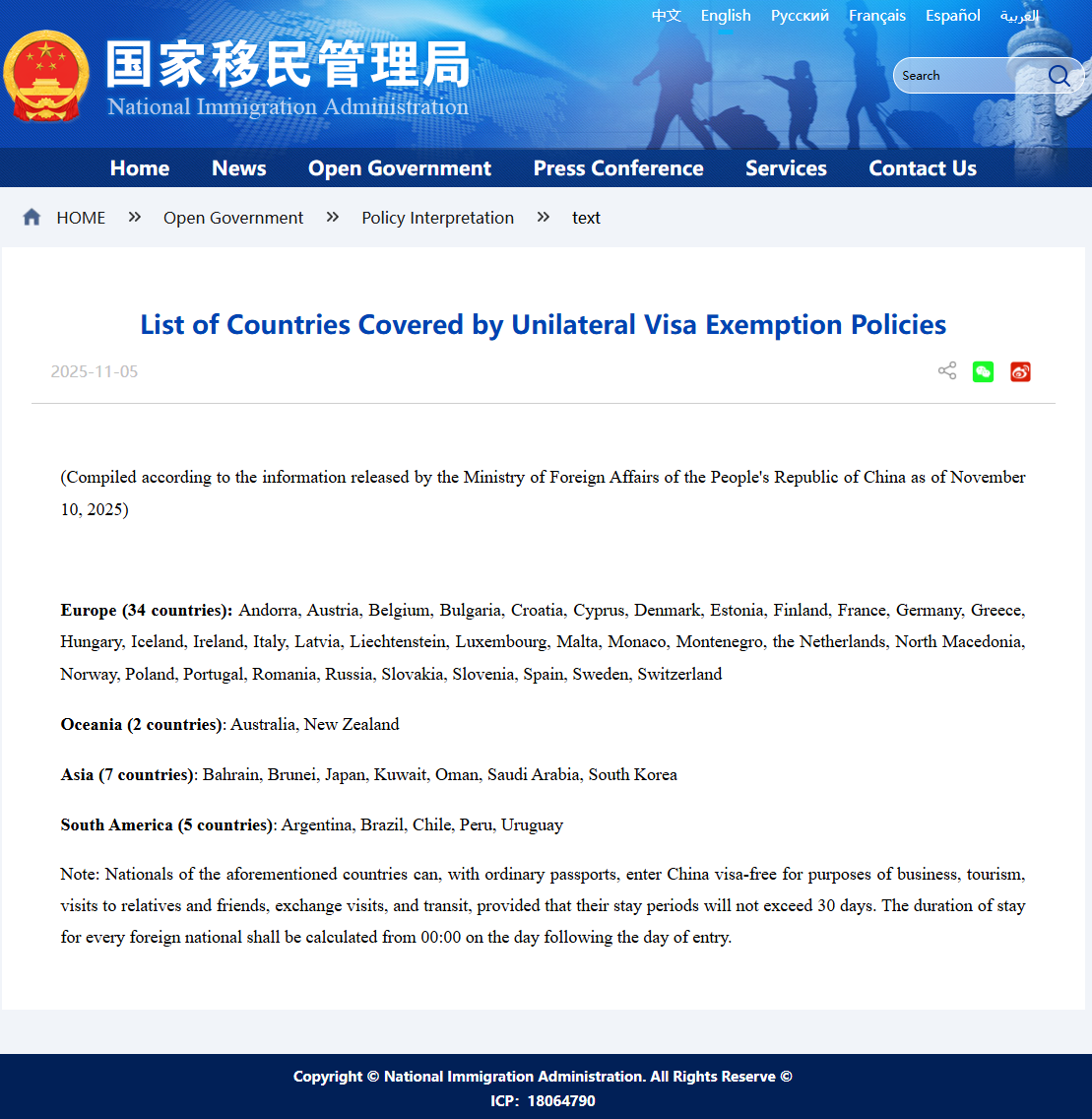
National Immigration Administration (China) official page listing countries eligible for China’s unilateral visa-free entry and the 30-day stay rule, latest update.
List of Countries Covered by Unilateral Visa Exemption Policies – China’s National Immigration Administration
Announced date: November 10, 2025
(Compiled according to the information released by the Ministry of Foreign Affairs of the People’s Republic of China as of November 10, 2025)
Europe (34 countries): Andorra, Austria, Belgium, Bulgaria, Croatia, Cyprus, Denmark, Estonia, Finland, France, Germany, Greece, Hungary, Iceland, Ireland, Italy, Latvia, Liechtenstein, Luxembourg, Malta, Monaco, Montenegro, the Netherlands, North Macedonia, Norway, Poland, Portugal, Romania, Russia, Slovakia, Slovenia, Spain, Sweden, Switzerland
Oceania (2 countries): Australia, New Zealand
Asia (7 countries): Bahrain, Brunei, Japan, Kuwait, Oman, Saudi Arabia, South Korea
South America (5 countries): Argentina, Brazil, Chile, Peru, Uruguay
Note: Nationals of the aforementioned countries can, with ordinary passports, enter China visa-free for purposes of business, tourism, visits to relatives and friends, exchange visits, and transit, provided that their stay periods will not exceed 30 days. The duration of stay for every foreign national shall be calculated from 00:00 on the day following the day of entry.
In summary, the list includes 34 European countries (all Schengen Area countries and more, from Austria to Switzerland), 7 Asian countries (such as Japan, South Korea, Brunei, and several Middle Eastern nations such as Bahrain, Saudi Arabia), 2 Oceanian countries (Australia and New Zealand), and 5 South American countries (including Brazil, Argentina, Chile, Peru, and others). Notably, the United States, Canada, and the United Kingdom are not in this 48-country list – travelers from those countries currently do not have 30-day visa-free entry to China and will need a visa unless they qualify under a different program (like the transit exemption described later).
Key points for 48-country visa-free entry:
- Duration: Maximum of 30 days per visit, non-extendable. If you need to stay longer, you must exit China and re-enter (or obtain a visa for a longer stay).
- Purpose: Tourism, business (e.g. buying visit like Yiwu Market, meetings, trade fairs like the Canton Fair), short-term family visits, and similar activities are allowed without a visa. You cannot work, enroll in university, or perform journalism under this trip / visit.
- Entry requirements: You must hold a valid ordinary passport from one of the 48 countries. It’s recommended to have at least six months validity on your passport and at least one blank page for the entry stamp.
In practice, Chinese border officers may also ask for your return or onward ticket and proof of accommodation or plans in China, so have those documents handy. There is no special application needed beforehand – just ensure the airline knows you are visa-exempt (they might check your nationality against the allowed list during check-in). - Multiple entries: If you plan to hop in and out of China, this policy can be used for multiple trips as long as each entry is separate and you don’t overstay 30 days each time. There isn’t a formal limit on how frequently you can enter visa-free, although staying out for a reasonable period before re-entering is wise. (Some countries impose a “90 days in 180 days” rule for visa waiver / visa-free visitors – China’s unilateral 30-day policy currently does not have an official 180-day cumulative limit for most countries, but it’s always important not to abuse the allowance. If you need long-term stay or very frequent travel, consider getting a visa or residence permit.)
China’s Mutual Visa-free Agreements for Ordinary Passport Holders (29 Countries)
In addition to its one-sided visa exemptions, China has also established bilateral visa-free agreements with a number of countries. As of 2025, China has mutual visa-free deals for ordinary passport with 29 countries, meaning citizens of those countries can visit China without a visa, and Chinese citizens can reciprocally visit those countries without a visa. This is a growing trend as China works to facilitate two-way travel and business. Many of these 29 countries are in Asia and the developing world, but there are some in Europe, the South Pacific, and the Americas as well.
What does a mutual visa exemption entail? Generally, if you hold an ordinary passport from one of these countries, you can travel to China visa-free for a certain period (often up to 30 days), and likewise Chinese travelers enjoy the same privilege in your country.
The exact length of stay can vary by agreement, but in recent agreements 30 days has become a standard maximum per visit. Some agreements also stipulate a cumulative maximum of 90 days within a 180-day period for multiple trips – which is similar to the “90/180” rule used in Schengen and other visa-free schemes. Always check the specific terms for your country, but as a rule of thumb: you can come without a visa for short stays, but not live or work long-term without proper visas.
Who are these 29 countries? They include a diverse mix of nations. Notably, several are in Southeast Asia – for example, Singapore, Thailand, Malaysia, and Indonesia have or are implementing mutual visa-free travel with China. (Singapore and Thailand both started 30-day mutual visa-free entry in early 2024, and Malaysia’s agreement came into effect in July 2025 – more on that in a moment.) There are also a number of Caribbean and Pacific island countries like Bahamas, Barbados, Fiji, Grenada, Samoa, and Tonga. Central Asian countries such as Kazakhstan and Uzbekistan are on the list, as well as some Eastern European and Balkan countries like Serbia, Albania, Bosnia and Herzegovina, Belarus, and Georgia. African or Middle Eastern countries are fewer, but Qatar is one notable inclusion (30 days visa-free) and United Arab Emirates is expected to join soon (though not in the list of 29 at the time of writing). Mauritius and Seychelles (Indian Ocean nations) have also had mutual visa-free arrangements with China for years.
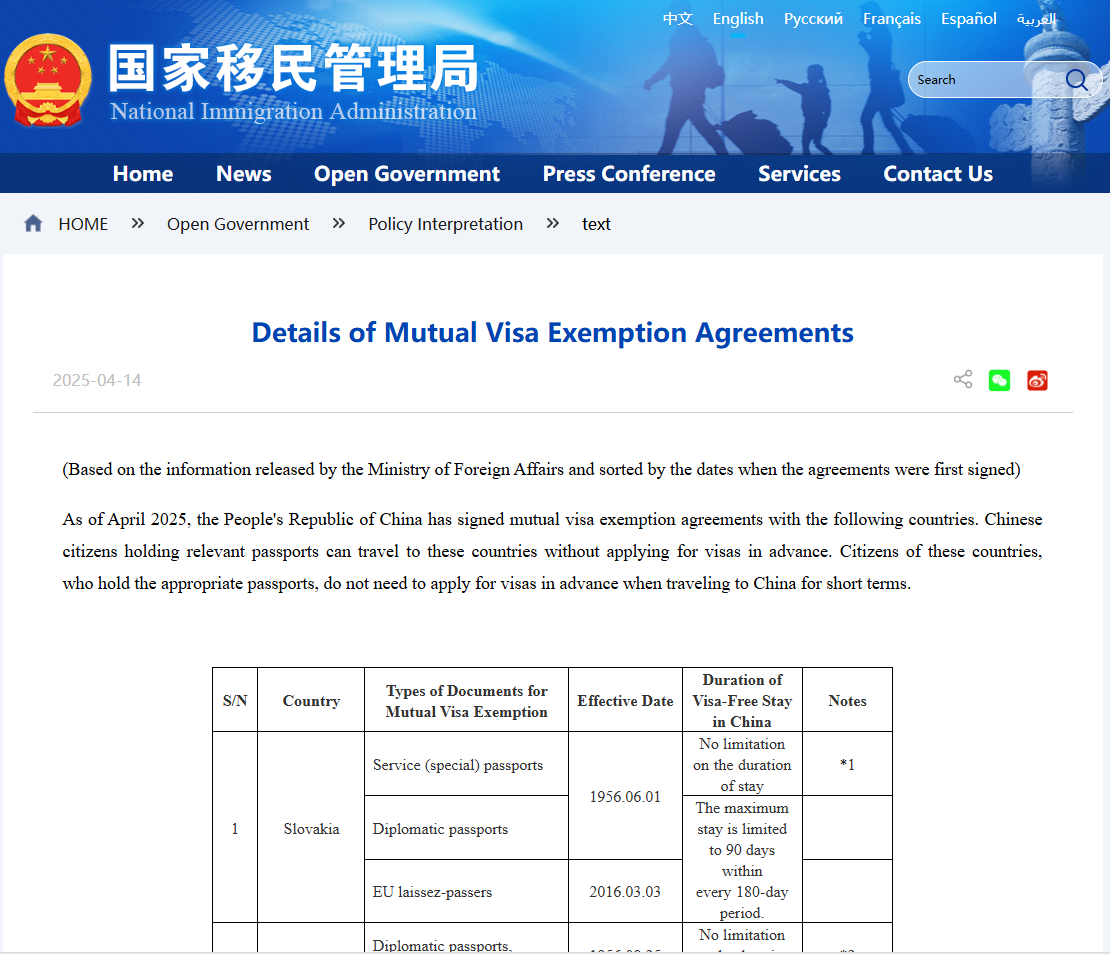
Official National Immigration Administration of China page summarizing mutual visa exemption agreements, with a country table listing passport/document types, effective dates, and permitted visa-free stay duration
For reference, some major examples from this list are: Malaysia, Singapore, Thailand, Indonesia, Maldives, Kazakhstan, Uzbekistan, Azerbaijan, Albania, Serbia, Belarus, Qatar, Bahamas, Barbados, Fiji, Grenada, etc., among others. Each agreement has its own start date and specifics, but the general idea is the same – ordinary passport holders on both sides can travel without visas for short visits.
It’s worth highlighting China–Malaysia as a case study, since this was a significant recent development. China and Malaysia signed a mutual visa exemption agreement in early 2025, and it officially came into force on July 17, 2025.
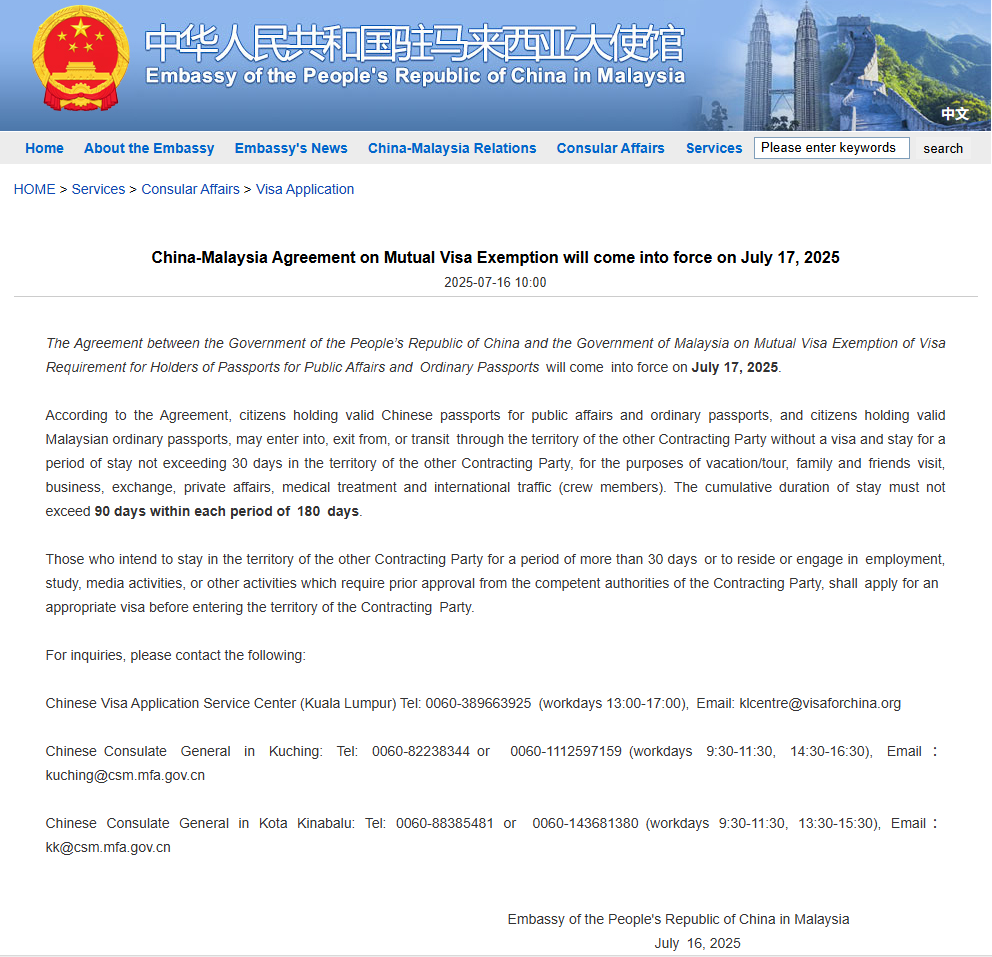
Embassy of China in Malaysia announcement: China–Malaysia mutual visa exemption starts July 17, 2025, with 30-day stays and a 90/180-day cumulative limit.
Official release source page:
https://my.china-embassy.gov.cn/eng/fwzc/lsyw/qz/202507/t20250714_11670217.htm
Now, Malaysians can visit China visa-free, and Chinese nationals can visit Malaysia visa-free, for up to 30 days per stay. The agreement also specifies that the total stay should not exceed 90 days within a 180-day period for multiple trips. This move was preceded by a trial program and is seen as a boost for tourism and business exchange between the two countries.
For example, if you are a Malaysian businessperson traveling to Guangzhou to explore suppliers or attend the Canton Fair or go to Yiwu Market for small commodities and daily necessities, you no longer need to apply for a Chinese visa – just pack your passport and go. The same convenience applies to Chinese tourists visiting Kuala Lumpur or Penang. Many other ASEAN nationals (Singaporeans, Thais, Bruneians, etc.) similarly enjoy visa-free access now, reflecting stronger regional ties.
China-Malaysia Agreement on Mutual Visa Exemption will come into force on July 17, 2025
Announced date: 2025-07-16 10:00
The Agreement between the Government of the People’s Republic of China and the Government of Malaysia on Mutual Visa Exemption of Visa Requirement for Holders of Passports for Public Affairs and Ordinary Passports will come into force on July 17, 2025.
According to the Agreement, citizens holding valid Chinese passports for public affairs and ordinary passports, and citizens holding valid Malaysian ordinary passports, may enter into, exit from, or transit through the territory of the other Contracting Party without a visa and stay for a period of stay not exceeding 30 days in the territory of the other Contracting Party, for the purposes of vacation/tour, family and friends visit, business, exchange, private affairs, medical treatment and international traffic (crew members). The cumulative duration of stay must not exceed 90 days within each period of 180 days.
Those who intend to stay in the territory of the other Contracting Party for a period of more than 30 days or to reside or engage in employment, study, media activities, or other activities which require prior approval from the competent authorities of the Contracting Party, shall apply for an appropriate visa before entering the territory of the Contracting Party.
Important notes for mutual visa-free travelers:
- Ensure your nationality is covered: Only citizens of the countries that have signed these agreements qualify. For instance, if you hold a Singaporean passport, you’re good to go for visa-free entry to China. But if you’re a permanent resident of Singapore with a different passport (say, Indian), that does not qualify – you’d need a visa because the agreement is based on nationality. Always double-check the current list of mutual visa-free countries, as new agreements are being added over time.
- Passport validity: Just like any international travel, your passport should be valid for at least 6 months beyond your trip. Immigration officers may deny entry if your passport is near expiration, even if you don’t need a visa.
- Length of stay and extensions: The visa-free period (typically 30 days) cannot be extended in-country because there is no actual visa to extend. If you need to stay longer for some reason, you would have to apply for an appropriate visa at a Chinese embassy/consulate or exit and re-enter (if your 90/180 limit allows). However, most short-term travelers find 30 days enough for tourism or business meetings.
- Purpose of entry: Visa-free does not mean you can take up employment or long-term study in China. Those activities require proper visas (work permit, student visa, etc.). Short courses, conferences, or trainings might be okay if they fit within a short visit, but always clarify if unsure. Generally, keep your activities to tourism, business visits, attending trade fairs, buying trips (like to Yiwu or wholesale markets), visiting friends/family, or transit. If an immigration officer suspects you intend to work illegally or overstay, you could be refused entry despite the visa exemption.
- Documentation: Even though no visa is needed, carry proof of your return flight or onward travel, and possibly a printout of your hotel bookings or invitation letter if applicable. While these mutual agreements remove the visa requirement, travelers are still subject to immigration inspection. Officers have the right to ask about your trip’s purpose and itinerary. Showing that you have a round-trip ticket and accommodation booked (or an invitation from a trade fair or Chinese business partner, etc.) can smooth the entry process.
240-Hour Visa-Free Transit Policy (55 Countries, Up to 10 Days)
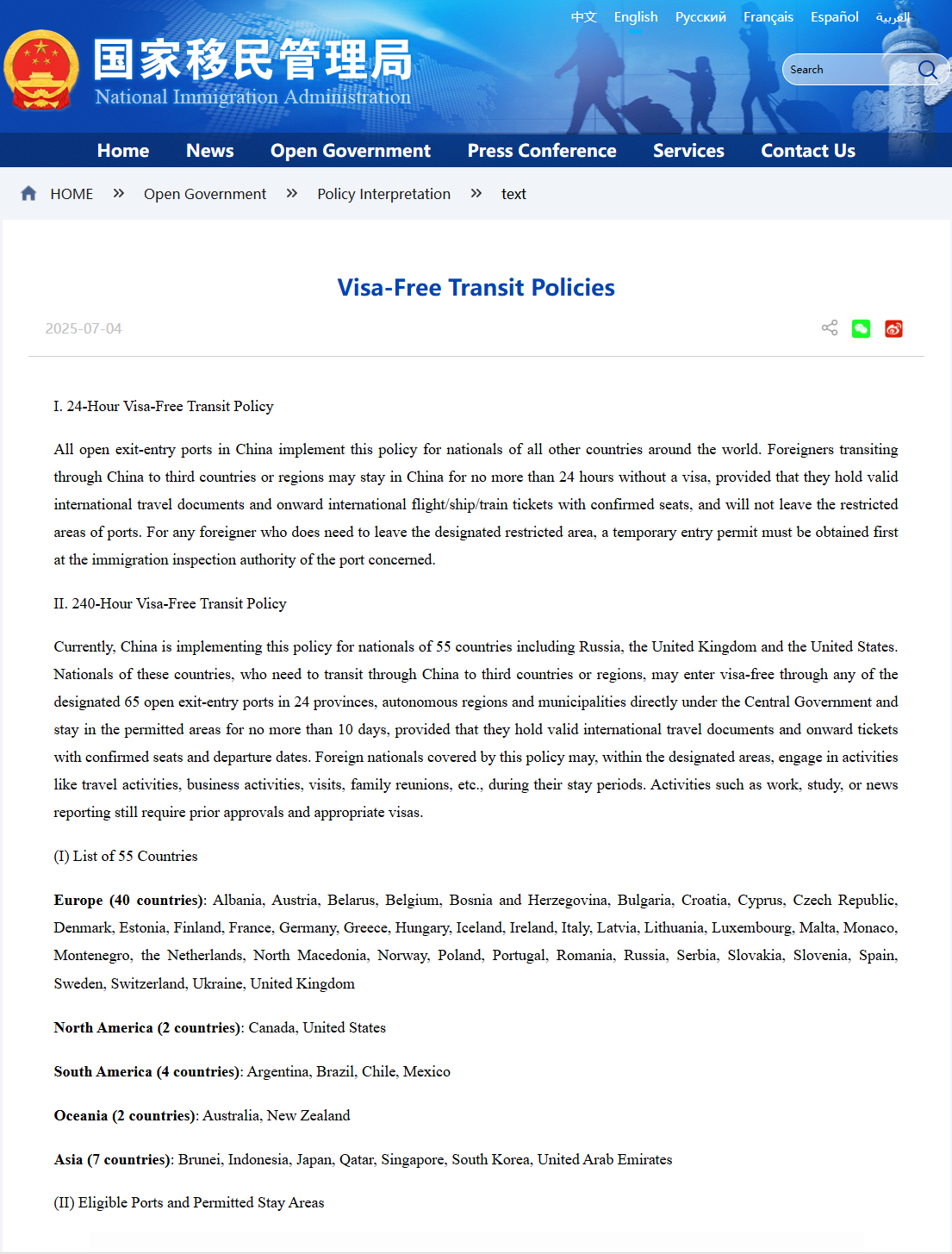
Official NIA guidance on China’s 240-hour (10-day) visa-free transit: eligibility, entry conditions, and the list of 55 countries.
Official release source at National Immigration Administration of China
One of the most flexible ways to visit China without a visa – especially for those whose countries are not on the above lists – is to take advantage of China’s transit visa-free policy, now extended to 240 hours (10 days). This policy is officially known as the 240-hour visa-free transit and currently applies to citizens of 55 countries. It’s designed for travelers who are passing through China on their way to a third country, allowing them to make an extended stopover in China without a visa.
Here’s how it works: If you are from one of the 55 eligible countries (which include the United States, Canada, United Kingdom, Australia, most EU/Schengen countries, Japan, South Korea, and many others), and you are transiting through China, you can stay up to 240 hours (10 full days) in certain cities/regions visa-free, as long as you meet a few conditions. The key conditions are:
- Route requirement (third country transit): Your itinerary must show that you are in transit to a third country or region. This means you cannot have a round-trip ticket that goes back to the same country you came from. For example, New York → Beijing → New York would not qualify for the transit exemption, because China is not a transit stop but the main destination before returning. However, New York → Beijing → Tokyo would qualify (USA → China → Japan), as would London → Shanghai → Hong Kong (UK → China → Hong Kong, and Hong Kong counts as a different region from Mainland China for transit purposes). Essentially, you need an onward ticket to a different country or Hong Kong/Macau/Taiwan scheduled within 240 hours of your arrival in China.
- Eligible ports of entry: You must enter through one of the designated 65 ports (airports, seaports, or land crossings) that are approved for the 240-hour visa-free transit program. The good news is that this list covers most major entry cities in China – including Beijing, Shanghai, Guangzhou, Shenzhen, Chengdu, Xian, Hangzhou, and many more. In total, as of 2025 the transit visa-free scheme spans 24 provinces/regions in China. Practically speaking, if you fly into a major international airport, it’s highly likely to be part of this program. (Some smaller airports have been added recently as well – China expanded from 39 to 65 eligible ports by late 2025 to make transit even easier.) It’s wise to verify if your specific arrival city is included, but major hubs and even some secondary cities are on the list now.
You can check the detailed List of Eligible Entry Ports for 240-Hour Visa-Free Transit from National Immigration Administration of China, here | https://en.nia.gov.cn/n147418/n147463/c183412/content.html - Permitted travel area: Under the old 72-hour or 144-hour rules, travelers had to remain in a limited region (e.g. if you landed in Shanghai, you could move around the Shanghai-Jiangsu-Zhejiang area, but not beyond). With the new 240-hour policy, the allowed travel areas have broadened, but they are still defined by where you enter. Generally, you can travel within the province or city cluster of your entry port. For example, if you enter via Guangzhou, you can explore Guangdong Province (which includes Guangzhou, Shenzhen, etc.) during those 10 days. If you enter via Beijing or Tianjin, you can travel around Beijing-Tianjin-Hebei region. Many regions are now interconnected for transit visitors – and some provinces like Guangxi, Hainan, Anhui, Shanxi, Jiangxi, Guizhou were newly added to the scheme. The exact rules can be a bit complex, but immigration will stamp your passport with the specific areas you are allowed to stay in. Make sure not to leave those areas or depart from a different region than allowed. If you wish to visit multiple far-apart cities in China, you might need to plan your entry/exit accordingly or just get a tourist visa.
You can check the detailed List of Permitted Travel Area for 240-Hour Visa-Free Transit from National Immigration Administration of China, here | https://en.nia.gov.cn/n147418/n147463/c183412/content.html - Duration: 240 hours means 10 days maximum. This count, like others, starts from 00:00 the day after arrival. So effectively you get 10 full nights. There is no extension beyond 240 hours – you must depart on time to that third country. Even a short overstay (like missing your flight and leaving a day late) could cause trouble with immigration, so plan carefully. It’s often recommended to schedule your outbound flight a bit before the deadline rather than last-minute.
- Eligible nationalities: The list of 55 countries is quite broad. It includes almost all European countries (all Schengen members and many others in Europe), the United States and Canada, Australia and New Zealand, a few in Latin America (e.g. Brazil, Argentina, Chile, Mexico), and several Asia-Pacific countries (Japan, South Korea, Singapore, Brunei, Indonesia, Qatar, UAE, etc.). Notably, Russia and Ukraine are also on the list. If your country is not on this list (for example, citizens of India, Pakistan, Bangladesh, or many African countries are not eligible for the 10-day transit visa-free), then you cannot use this policy and would need a visa for any layover longer than 24 hours in China.
Here below are the official release information sourced from National Immigration Administration, PRCChina’s 240-Hour Visa-Free Transit Policy
Released date: July 4th, 2025
Currently, China is implementing this policy for nationals of 55 countries including Russia, the United Kingdom and the United States. Nationals of these countries, who need to transit through China to third countries or regions, may enter visa-free through any of the designated 65 open exit-entry ports in 24 provinces, autonomous regions and municipalities directly under the Central Government and stay in the permitted areas for no more than 10 days, provided that they hold valid international travel documents and onward tickets with confirmed seats and departure dates. Foreign nationals covered by this policy may, within the designated areas, engage in activities like travel activities, business activities, visits, family reunions, etc., during their stay periods. Activities such as work, study, or news reporting still require prior approvals and appropriate visas.
(I) List of 55 Countries
Europe (40 countries): Albania, Austria, Belarus, Belgium, Bosnia and Herzegovina, Bulgaria, Croatia, Cyprus, Czech Republic, Denmark, Estonia, Finland, France, Germany, Greece, Hungary, Iceland, Ireland, Italy, Latvia, Lithuania, Luxembourg, Malta, Monaco, Montenegro, the Netherlands, North Macedonia, Norway, Poland, Portugal, Romania, Russia, Serbia, Slovakia, Slovenia, Spain, Sweden, Switzerland, Ukraine, United Kingdom
North America (2 countries): Canada, United States
South America (4 countries): Argentina, Brazil, Chile, Mexico
Oceania (2 countries): Australia, New Zealand
Asia (7 countries): Brunei, Indonesia, Japan, Qatar, Singapore, South Korea, United Arab Emirates
- Purpose and activities: While in China on the 240-hour transit exemption, you are free to do tourism (e.g. visit the Great Wall, check out Shanghai’s Bund, etc.), visit friends or family, attend business meetings or trade shows, shop in Yiwu markets for a few days, or even make short side trips within your allowed area. It’s a great opportunity for business travelers to squeeze in a visit to suppliers or for tourists to sample a couple of Chinese cities without a visa. You are not allowed to work, study long-term, or do media reporting during this transit stay (those require proper visas). But typical traveler activities are fine. In fact, many travelers use this policy intentionally to avoid the visa process – for instance, an American traveler might book a trip like New York → Shanghai (stay 6 days) → Hong Kong → New York to enjoy a short China visit visa-free.
From a practical standpoint, the transit visa-free process is straightforward: when you arrive at immigration (airports, seaports, or land crossings) in China, you must communicate to the officer that you are in transit and intend to use the 240-hour visa-free stay. You’ll need to show your onward ticket (e.g. an e-ticket printout or phone confirmation) to a third country with a confirmed seat and departure date within the allowable window. The officer will verify you meet the criteria and then issue you a temporary entry permit stamp in your passport (there’s no fee for this). It’s a good idea to also have documentation of your plans during the stay (hotel reservations, etc.) in case they ask, though often they just want to see the ticket. Once admitted, you can collect your luggage and go enjoy China for up to 10 days! Just be sure to depart from an approved port (which in most cases will be the same one you entered or another one in the allowed region), and have your passport stamped when leaving.
This policy is incredibly useful if you’re not from a country with direct visa-free access to China. Travelers from the US, UK, Canada, India, etc. often take advantage of the transit visa waiver to visit China without the hassle of obtaining a tourist visa. For example, if you’re flying from Los Angeles to attend a conference in Guangzhou, you could route your flight LA → Guangzhou → Tokyo, and get up to 10 days in Guangzhou (more than enough to attend the event and do some sightseeing) without a visa. Or if you want to explore Beijing and Shanghai, you might fly London → Beijing, spend 5 days, then fly to Dubai (another 55-country member) or Hong Kong on day 6; then perhaps re-enter via Shanghai on a separate transit a week later on your way home. It just takes some careful planning, but it’s completely legal and used by many experienced travelers and businesspeople. Always double-check the latest rules, as they can adjust the list of countries or ports, but as of now (Dec 18th, 2025) 55 nationalities can leverage this 240-hour (10-day) transit stay policy.
Tips for 240-hour transit travelers:
- Plan your route carefully: You must have a departure to a third country. Consider open-jaw tickets or multi-city itineraries. Common transit hubs that pair well with China mainland include Hong Kong, Macau, Taiwan, Dubai, Seoul, Tokyo, Bangkok, Singapore – basically any place that is not your origin country. Even a short side trip to Hong Kong counts as leaving to a third region.
- Have all documents ready: Print out your connecting flight confirmation (and visa for the third country if one is needed – e.g. if you’re transiting to India, you’d need an Indian visa). If you don’t have proof of an onward flight, the airline may not let you board in the first place, and immigration in China will deny entry under this scheme.
- Mind the 24-hour rule for other nationalities: If you are not from one of the 55 countries, you are still allowed to transit through China for up to 24 hours visa-free as long as you don’t leave the airport (for most nationalities). So, for example, an Indian passport holder can transit through Beijing on the way to Japan without a visa if the layover is under 24 hours, but cannot go out of the airport for a multi-day visit. The 240-hour policy is a special extension for certain nationalities only.
- Stay within permitted regions: When you’re granted the transit exemption, the entry stamp or a paper form will list the provinces or cities you are allowed to travel in. Do not go outside those areas. With 10 days, it might be tempting to hop on a domestic flight to another far city, but if that city is not within your allowed region, you’d be breaking the rules. For instance, if you entered via Shanghai, you can travel around the Yangtze River Delta region (Shanghai and neighboring provinces) but you shouldn’t randomly fly to, say, Xi’an or Chengdu unless those were within the permitted zone (they wouldn’t be, unless you entered through those cities in the first place).
- No work or long study: It’s fine to attend business meetings, factory visits, or short classes/training during transit, but you cannot engage in paid employment. Don’t misuse the transit visa-free to actually work in China; if caught, you could be deported and barred. The same goes for journalism – reporters need special visas.
- Keep track of time: 240 hours is generous, but keep an eye on your departure schedule. It can be helpful to set a reminder of your deadline. Also remember that if your flight out is rescheduled or canceled beyond the 240-hour window, you should proactively talk to local immigration (at the airport immigration office) before your time is up – they may issue a one-time exit permit or extension in extraordinary cases like flight cancellations, but if you simply overstay without notice, penalties will apply.
Other Regional Visa-Free Programs in China
Besides the nationwide policies above, China has a few region-specific visa-free entry programs aimed at encouraging tourism to certain areas. These have more limited scope or special conditions. We’ll cover the main ones here: Hainan Island’s visa-free entry, visa-free entry for ASEAN tour groups, and visa-free entry for foreign cruise ship groups. (There are also some niche policies for tour groups entering from Hong Kong/Macau into Guangdong or Hainan for 6 days, etc., but we will focus on the primary ones most relevant to international travelers.)
Hainan 30-Day Visa-Free Entry Policy (Hainan Island)
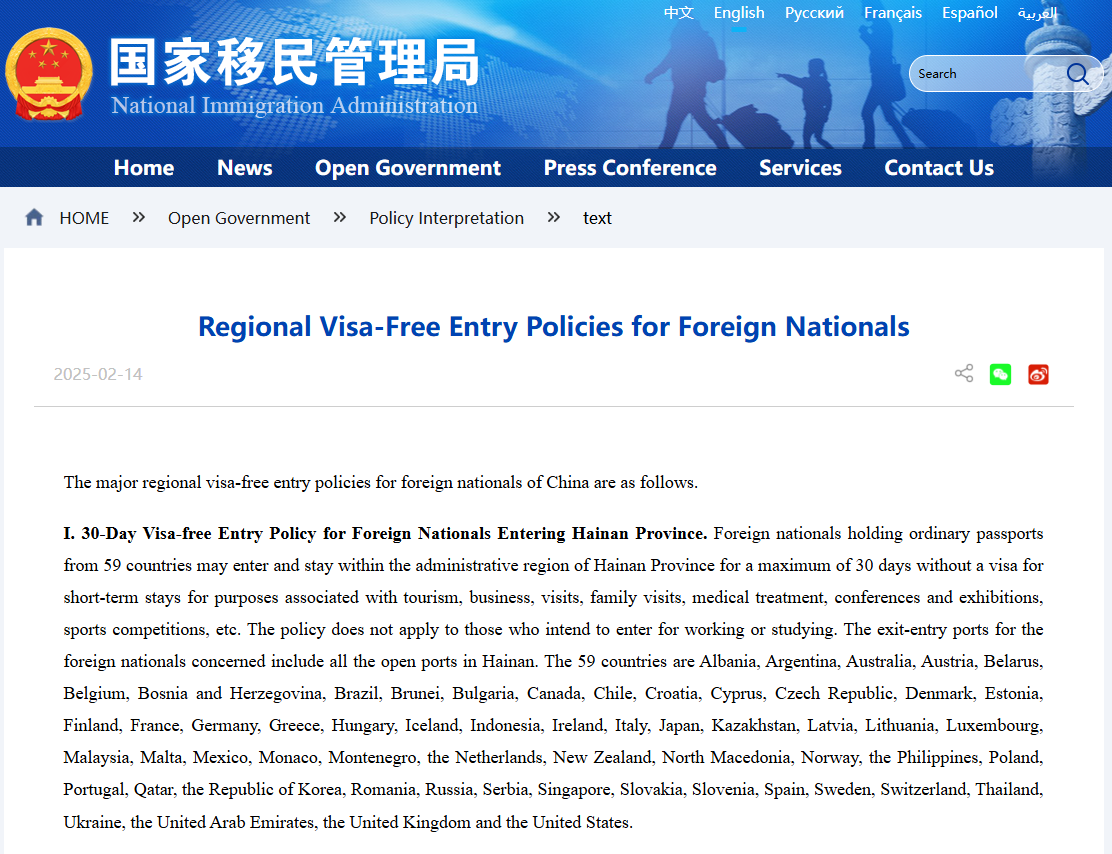
China NIA official policy: Hainan Island 30-day visa-free entry for ordinary passport holders from 59 countries
Official source at National Immigration Administration
Hainan, a tropical island province in the south of China (often compared to Hawaii or Phuket for its resorts), has a wide range of visa-free entry policy to attract foreign tourists. Travelers from 59 countries can visit Hainan for up to 30 days without a visa, as long as they stay within Hainan Province. This policy covers many of the same countries eligible for the transit program – including the US, Canada, UK, Australia, New Zealand, most of Europe, Russia, South Korea, Japan, Indonesia, Malaysia, Thailand, etc. – in fact, citizens of those 59 countries can fly directly into Hainan and enjoy a month in the sun visa-free.
There are a few conditions to be aware of:
- Direct entry to Hainan: You should enter Hainan directly via one of its international airports (Haikou or Sanya) or cruise ports. If you land in another mainland city first, you won’t be able to use the Hainan visa waiver unless you’re on a certified Hainan tour group. Easiest is to book a flight that arrives in Hainan from abroad (or via Hong Kong).
- Purpose: Allowed purposes include tourism, business meetings, family visits, sports events, exhibitions, medical treatments, etc. – pretty broad. As usual, no work or long-term study.
- Registration: In the past, Hainan’s visa-free program required arranging your trip through a registered travel agency and submitting your details in advance. Recent updates have streamlined the process, and many travelers can now go independently. However, to be safe, check if you need to pre-register your visa-free visit through a travel agency or an online system. Often, hotels or travel agents in Hainan can help register your information with immigration before you arrive, which is sometimes a requirement. It’s a good idea to get confirmation of the latest procedure from a Hainan tourism official website or your airline.
- Stay within Hainan: This visa-free entry is only valid within Hainan Province. You cannot land in Hainan under this policy and then hop to mainland cities like Guangzhou or Shanghai; that would require a visa. If you do need to visit other parts of China after Hainan, you’d have to either get a visa beforehand or possibly use the transit scheme (for example, Hainan → third country → then re-enter mainland China separately).
Hainan’s visa-free scheme is great for travelers planning a beach holiday. For instance, a traveler from Germany can fly to Sanya, enjoy two weeks on the beach and maybe golfing or visiting the rainforests, all without any visa paperwork. Likewise, a group of friends from Indonesia or Russia can plan a holiday in Hainan easily. This has made Hainan a growing international destination. Just remember not to stray off Hainan Island towards the mainland. If you absolutely must cut your Hainan trip short and go to another Chinese city, you’d have to find a way to obtain a visa.
30-Day Visa-free Entry Policy for Foreign Nationals Entering Hainan Province
Foreign nationals holding ordinary passports from 59 countries may enter and stay within the administrative region of Hainan Province for a maximum of 30 days without a visa for short-term stays for purposes associated with tourism, business, visits, family visits, medical treatment, conferences and exhibitions, sports competitions, etc. The policy does not apply to those who intend to enter for working or studying. The exit-entry ports for the foreign nationals concerned include all the open ports in Hainan.
The 59 countries are Albania, Argentina, Australia, Austria, Belarus, Belgium, Bosnia and Herzegovina, Brazil, Brunei, Bulgaria, Canada, Chile, Croatia, Cyprus, Czech Republic, Denmark, Estonia, Finland, France, Germany, Greece, Hungary, Iceland, Indonesia, Ireland, Italy, Japan, Kazakhstan, Latvia, Lithuania, Luxembourg, Malaysia, Malta, Mexico, Monaco, Montenegro, the Netherlands, New Zealand, North Macedonia, Norway, the Philippines, Poland, Portugal, Qatar, the Republic of Korea, Romania, Russia, Serbia, Singapore, Slovakia, Slovenia, Spain, Sweden, Switzerland, Thailand, Ukraine, the United Arab Emirates, the United Kingdom and the United States.
Visa-Free Entry (6-day) for ASEAN Tour Groups (Xishuangbanna & Guilin)
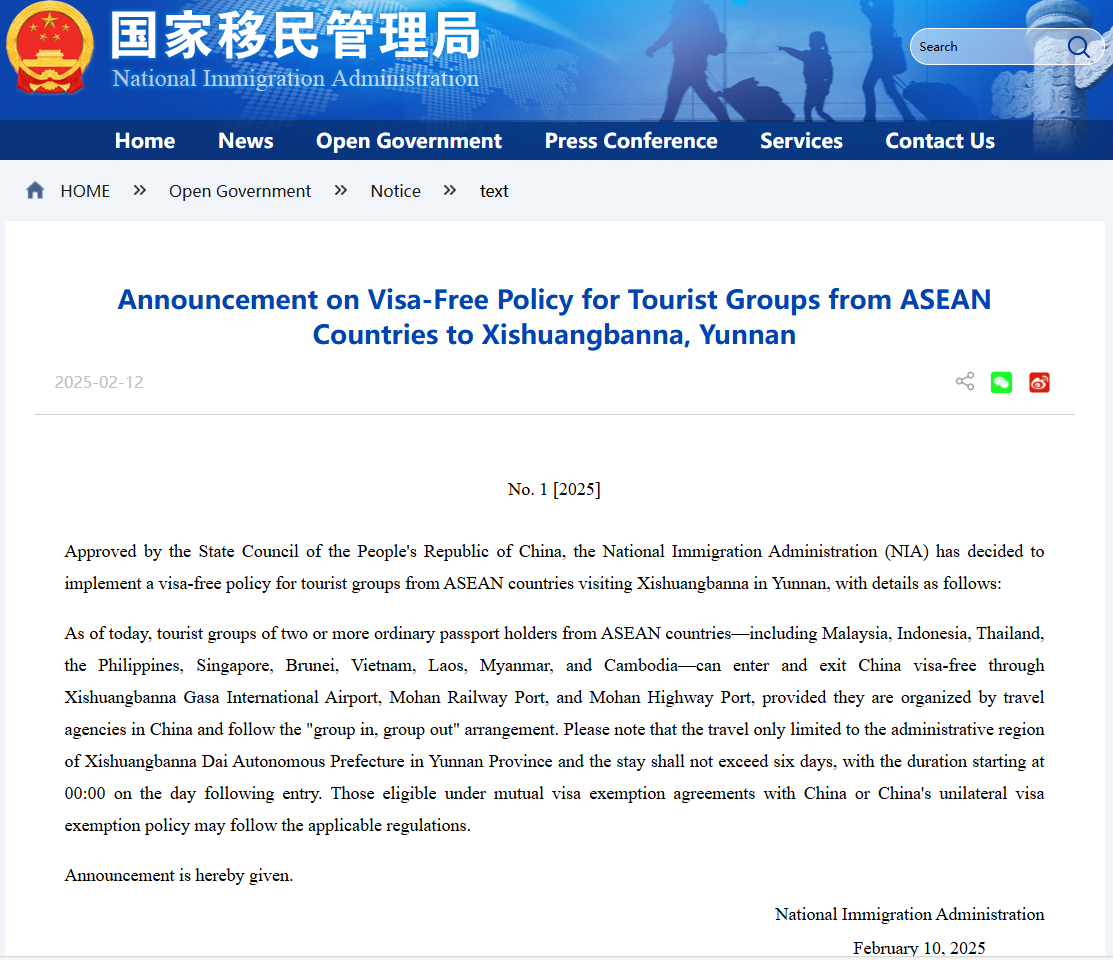
NIA official notice: ASEAN tour groups can visit Xishuangbanna (Yunnan) visa-free, entering via Gasa Airport/Mohan ports, with group travel rules and a 6-day stay limit.
National Immigration Administration Official Release Source
China has introduced special visa exemptions for organized tour groups from ASEAN countries (Association of Southeast Asian Nations). This policy is a bit specialized: it allows tour groups (at least 2 people, traveling together) from ASEAN member states to enter certain regions in China for up to 6 days without visas. The two regions currently offering this are:
- Guilin, Guangxi Province – a famous scenic city known for its karst mountains and Li River cruises.
- Xishuangbanna, Yunnan Province – a tropical region in southwest China bordering Laos and Myanmar, known for its rainforest and ethnic Dai culture.
If a tour agency organizes a group of, say, Thai or Malaysian tourists to Guilin or Xishuangbanna, they can get 6-day visa-free entry limited to that region. They must enter and exit through specific ports: for example, Guilin Liangjiang International Airport for Guilin, or Xishuangbanna’s Gasa Airport or Mohan border checkpoint for Yunnan. The group has to stay together and leave as a unit. This policy is aimed at boosting regional tourism from neighboring Southeast Asian countries.
For an average traveler, this policy is most relevant if you are from an ASEAN country and want to join a group tour to those areas. If you’re traveling independently, you wouldn’t use this. But it’s a nice option for, say, a group tour from Singapore to Guilin – you could book with a travel agency and they handle the visa-free entry paperwork, so no visa needed for the short trip. The ASEAN countries include Brunei, Cambodia, Indonesia, Laos, Malaysia, Myanmar, the Philippines, Singapore, Thailand, and Vietnam – citizens of those countries can ask local travel agencies about Guilin or Yunnan tour packages that use the visa exemption.
Visa-Free Entry for Cruise Ship Tour Groups (15 Days)
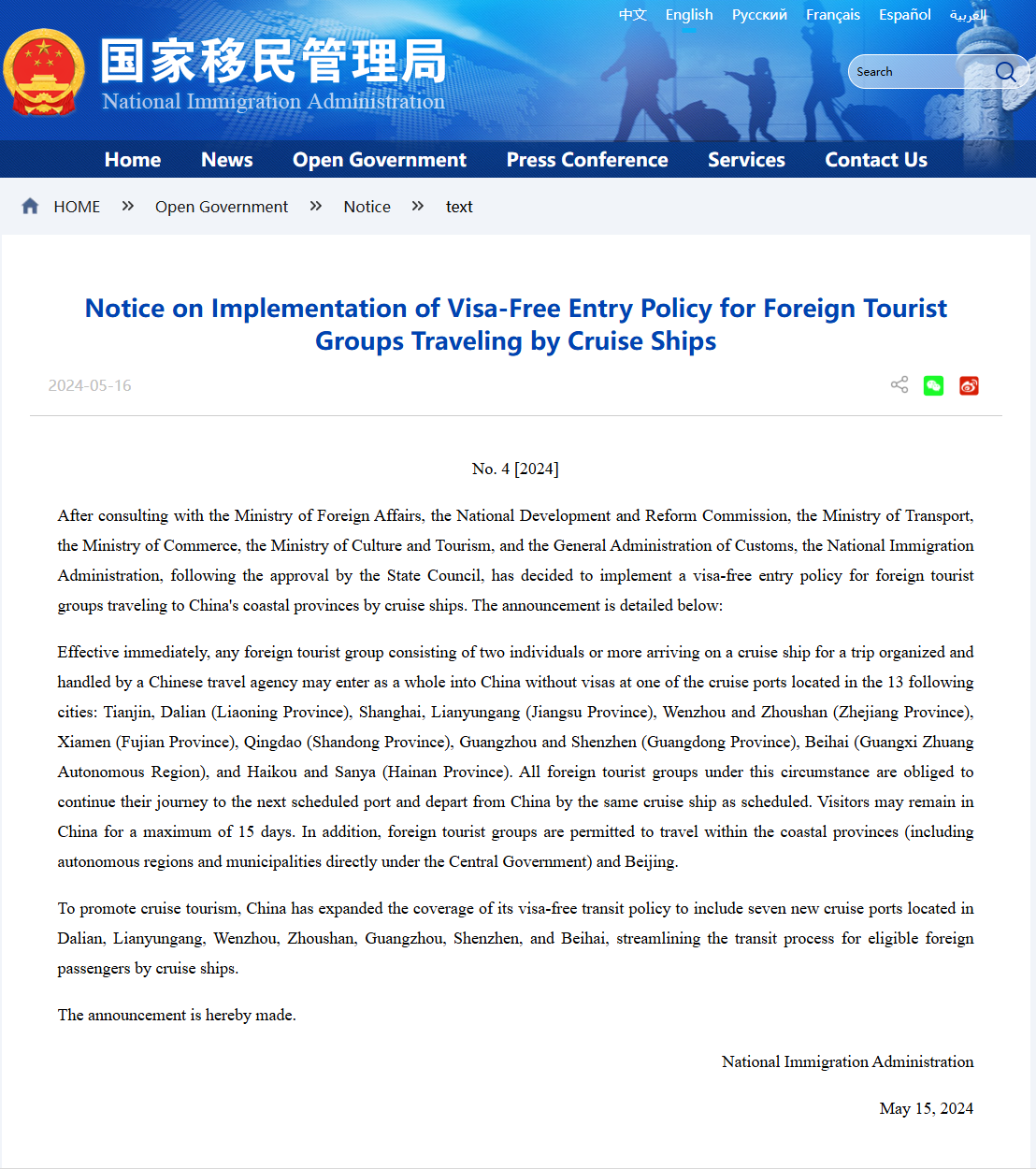
China National Immigration Administration (NIA) official notice: visa-free entry for foreign cruise tour groups (2+) via designated China cruise ports, with up to 15 days stay.
National Immigration Administration Official Release Source
Love cruising? If you arrive in China as part of an international cruise ship tour group, you could enjoy up to 15 days visa-free on land. China now allows foreign tourist groups traveling by cruise to enter without visas at all its major cruise ports. This policy requires that you are part of a tour group (at least 2 people) organized by a Chinese travel agency and that you arrive and depart by the same cruise ship. Essentially, if a cruise itinerary includes stops in China, those passengers can disembark and sightsee without needing individual visas.
Key points of the cruise policy:
- It covers 13 coastal cities’ ports, including Shanghai, Tianjin, Dalian, Qingdao, Shenzhen, Guangzhou, Xiamen, Haikou, Sanya, Wenzhou, Zhoushan, Lianyungang, and Beihai. These span the range of China’s cruise-capable ports (northern, eastern, and southern coasts).
- The group can stay in China up to 15 days as the cruise travels along the coast. During that time, passengers are allowed to visit the port city and even nearby tourist areas. In fact, the policy explicitly says such groups can travel within Beijing and 11 coastal provinces/regions as part of their excursion. For example, if a cruise docks in Shanghai, the group might take an overland excursion to Beijing or Xi’an while the ship moves to the next port, then rejoin it – the visa-free policy covers that, provided it’s all organized and within 15 days.
- All members must re-board the cruise and leave China on the cruise ship (you can’t just skip out on the tour and stay in China). Everyone in the tour group should stick together according to the itinerary.
- You need to be part of an official tour organized by a qualified agency. As an individual traveler, you can’t just show up on a cruise and wander off independently visa-free; you’d go through the cruise’s tour arrangements.
This policy is great for cruise tourism. For instance, a cruise from Singapore to Japan might stop in several Chinese ports – thanks to this rule, an American or European passenger on that cruise can enjoy sightseeing in each port (Shanghai, Dalian, etc.) for up to 15 days in total without ever dealing with a visa. It simplifies things for cruise operators and passengers alike.
If you’re planning a cruise that includes China, check with the cruise line – they often organize the necessary paperwork for the visa-free entry as long as you book the shore excursions with them. It means you can visit places like the Great Wall on a cruise stop without a visa. Just don’t wander off from the group or stay longer than allowed!
China Visa-Free Policies Compared: Who Qualifies, How Long, and Where You Can Go
| Policy Type | Who Qualifies | Max Stay | Onward Ticket Required? | Where You Can Travel | Best For |
|---|---|---|---|---|---|
| 48-Country Unilateral Visa-Free Entry | Citizens of 48 countries (mostly Europe, Asia, Oceania, S. America) | 30 days | Recommended (may be checked randomly) | Anywhere in mainland China | Tourists, business visitors, Canton Fair buyers |
| 29-Country Mutual Visa-free agreements | Citizens of 29 bilateral partner countries | 30 days (some 90 days/180 rule) | Recommended | Anywhere in mainland China | Tourism & reciprocal travel |
| 240-Hour Visa-Free Transit | Citizens of 55 countries transiting to a third country | 10 days (240 hours) | Required (must show onward ticket) | Within approved 24 provinces / entry region | Short-term visitors, stopover tourists, quick business trips |
| Hainan 30-Day Visa-Free Entry | Citizens of 59 eligible countries | 30 days | Return ticket required | Within Hainan Island only | Beach vacations, resort tourism |
| ASEAN Tour Group Visa-Free (6 Days) | Group tours (2+ people) from ASEAN countries | 6 days | Handled by travel agency | Guilin (Guangxi), Xishuangbanna (Yunnan) | Regional short tours |
| Cruise Ship Visa-Free (15 Days) | Organized cruise groups (2+ people) | 15 days | Covered by cruise itinerary | Coastal provinces & Beijing | Cruise passengers visiting multiple ports |
Tips for a Smooth Entry and Customs Experience
Whether you enter China with a visa or visa-free, you’ll have to go through immigration and customs. Here are some practical tips to ensure your arrival and departure go without a hitch:
- Fill out the arrival card (now available online): All travelers need to complete an arrival/departure card with basic personal and trip info. China has launched an online arrival card system that you can fill out before you land. This generates a QR code – present it at immigration and it saves time compared to filling a paper form. It’s not mandatory to do it online, but highly recommended. (On the plane, they often distribute paper cards if you haven’t done the digital version. With the new system, many passengers breeze through by just scanning their QR code.) Also note, you might need to do a quick digital health declaration (China had a health QR code system during COVID-19; by 2025 it’s mostly routine but check if any health form is needed – as of now, China has lifted most COVID restrictions, but you may still need to declare items or health status electronically).
- Have your documents ready: At the immigration counter, you’ll present your passport and possibly the onward/return ticket if you’re on a transit waiver or visa-free entry (to prove you will leave on time). If you obtained a Chinese visa, have the printed visa page in your passport (or the e-visa confirmation if applicable). For visa-free entry, it can be useful to carry a printout of the official policy or confirmation (for instance, if you’re using the 48-country visa-free, a print of the policy listing your country might help in case the airline staff is unaware – though most are informed by now). It’s usually smooth, but being prepared never hurts.
- Customs declaration: After immigration, you’ll collect luggage and go through customs. China has strict rules on certain items. Declare any items of concern on the customs form (they usually ask if you have items to declare). Prohibited items include firearms, certain drugs, fresh fruits or meats, etc. Large quantities of commercial goods might attract duty. Since many readers might be buyers coming for wholesale goods in Yiwu or Guangzhou, note that bringing in large amounts of foreign currency (over USD $5,000 or equivalent) or valuable equipment should be declared. For most tourists, this is routine – just walk through the green channel if nothing to declare. If you bought expensive items (like high-value electronics) abroad and are bringing them in, keep receipts in case of questions.
- Be ready for biometrics: China typically collects fingerprints of foreign visitors upon entry (usually at an automated kiosk or by the officer). This is normal procedure. Follow the instructions to place your fingers on the scanner. If you’re part of a cruise tour group, note that they have special arrangements – cruise group tourists may be exempted from fingerprinting and receive streamlined processing as mentioned in official statements. But for individual travelers, expect fingerprints and perhaps a photo.
- Language and communication: Have your destination address (hotel or host’s address) written down in Chinese characters, if possible. Sometimes immigration forms ask for your address in China. It’s also helpful if a customs officer asks where you’re going – showing a Chinese address (or at least the city and hotel name) can overcome language barriers. Keep contact info for your host, tour guide, or business partner handy in case officials need a point of contact.
- Respect the rules: This goes without saying, but always tell the truth to immigration and customs officers. If you’re entering visa-free for tourism, state “tourism” as your purpose (no need to over-explain). If you’re carrying drone cameras, professional video equipment, or large quantities of medication, declare them if required. China is quite efficient and welcoming to international visitors, but they are strict about law enforcement. As long as you’re honest and law-abiding, you’ll be fine.
- During your stay: Carry your passport with you at all times in China. Police may do random ID checks (rarely for tourists, but legally you should have ID). If you’re on a visa-free stay, your passport stamp is proof of your legal stay. Also, note that you must register your residence within 24 hours of arrival – hotels do this for you automatically (they will take your passport at check-in and register you with local public security). If you’re staying at a friend’s home or an Airbnb, you should go to the nearest police station with your host to register. Again, for short stays most travelers are in hotels so it’s handled behind the scenes.
- Leaving China: When departing, arrive at the airport a bit earlier than usual if you were on a transit visa-free stay, just in case airline staff or exit immigration have any questions. They generally won’t – you’ll simply hand your passport and they’ll verify you did not overstay and stamp you out. If you overstayed even by a day, expect a fine and possibly a delay (don’t let that happen!). If you entered visa-free for 30 days, ensure you leave by or before day 30. There is no grace period. Also, remember to claim tax refunds for any eligible shopping and surrender any temporary entry import forms if you brought in high-value items that needed declaration on arrival.
- Keep informed: Lastly, policies can update. Before your trip, it’s wise to double-check with the Chinese embassy/consulate or official immigration website for the latest information on visa exemptions. For instance, the number of visa-free countries could increase, or specific procedures might change. Being informed will save you any last-minute issues.
China’s opening-up has made it much more convenient to visit without a visa, but always ensure you fall within the exact rules. When in doubt, consult official sources or get a visa to be safe. With the groundwork covered in this guide, you should be well-prepared to navigate China’s entry requirements and enjoy your trip, whether you’re shopping in Yiwu, touring in Guilin, or sourcing products at the Canton Fair!
FAQ: Common Questions on China’s Visa-Free Entry
Q: Which countries can visit China without a visa?
A: China has two main lists of visa-free countries. First, there are 48 countries (mostly in Europe, plus a few in Asia/Oceania/South America) whose citizens can visit China visa-free for up to 30 days under China’s unilateral policy.
Second, China has mutual visa exemption agreements with 29 countries, including Singapore, Malaysia, Thailand, Serbia, UAE, Barbados, Fiji and more, allowing usually 30-day visits visa-free. If you are from any of those countries, you can enter China without a visa for short stays. (We have provided the full lists above in the article for your reference.) If your country isn’t on those lists, you likely need a visa unless you qualify for a transit visa exemption (see next question).
Q: I’m from the US/UK/Canada/Africa/India – can I travel to China without a visa?
A: If your nationality is not on China’s visa-exempt lists (and the US, UK, Canada, India, most African and Middle Eastern countries are not on the 30-day visa-free list), then you generally need to apply for a Chinese visa for a normal visit. However, you can still visit China visa-free for up to 10 days if you take advantage of the 240-hour transit visa exemption. This means planning your trip as a transit: for example, a US citizen can fly from Los Angeles to Shanghai, stay 6-10 days, then fly onward to a third country (like Japan or Thailand) without ever getting a visa. This transit rule applies to 55 nationalities including Americans, British citizens, Canadians, etc. If you don’t want to do a transit and just want to fly round-trip for a longer tour, then yes, you would need to obtain a tourist visa in advance. There are also the special cases of Hainan (which Americans, Canadians, British citizens can visit visa-free for 30 days, but only that island), or joining an approved tour group (e.g. a cruise or ASEAN group tour, if relevant). So in summary: for a direct visit from those countries – visa required; for a short transit-style visit – possible visa-free for 10 days with proper routing.
Q: What is the 240-hour transit visa-free policy and how do I use it?
A: The 240-hour policy allows citizens of 55 eligible countries to stay in certain Chinese cities for up to 240 hours (10 days) without a visa, as long as they are in transit to another country. To use it, you must have an onward flight (or ship/train ticket) to a third country that leaves within 240 hours of your arrival. When you land, tell the immigration officer you’re using transit without visa (TWOV) and show your onward ticket. You’ll get a temporary entry permit stamped in your passport. During those days, you can travel around the defined region of your entry city (for example, if you enter in Beijing, you can explore Beijing and nearby areas allowed, but not fly to a far province). Depart from an approved port before the 240 hours are up. It’s import that your itinerary is Country A → China → Country B (where A ≠ B). If it’s A → China → A (returning to same country), the transit visa exemption does not apply. This is a fantastic option for making a long layover into a mini-China-trip. Just be sure to follow the rules, have your paperwork, and leave on time.
Q: Do I need an onward ticket for visa-free entry?
A: It depends on the type of visa-free entry:
- For the 30-day unilateral or mutual visa exemption (e.g. you’re French entering under the 48-country visa-free), an onward or return ticket isn’t strictly mandated by law, but in practice you may be asked for proof of onward travel or a return flight at immigration. It’s always safest to have a round-trip ticket or onward ticket and be prepared to show it, as it shows you intend to leave within the allowed time.
- For the 240-hour transit visa-free, YES, absolutely – an onward ticket is required. You won’t be allowed to board your initial flight without it, and immigration will definitely check that you have a ticket departing China to somewhere else within the 240-hour window.
- For Hainan visa-free visits, you should have a return or onward ticket as well (the policy requires you’re a tourist coming and then leaving Hainan, so having a round-trip ticket within 30 days is expected).
- Cruise and group tour visa-free entries are handled by tour operators, so you do have onward transport (the cruise itself or tour itinerary).
In summary, always have proof of onward travel when entering visa-free, even if it’s not explicitly asked 100% of the time. It could be a return flight to your home, a flight to the next country on your trip, a cruise booking, etc.
Q: How long can I stay in China without a visa?
A: It depends on the policy you’re using:
- 30 days per visit is the limit for most standard visa-free entries (the 48-country unilateral visa-free and most of the 29 mutual visa exemptions are 30 days). Some mutual agreements allow longer (a few allow 60 or 90 days, but those are exceptions and often for specific nationalities). Always double-check your country’s agreement. But 30 days is a good general rule.
- 10 days (240 hours) for the transit visa-free stay, strictly calculated.
- 15 days for the cruise tour group visa-free entry.
- 6 days for the ASEAN tour group regional entries (Guilin, Xishuangbanna, etc.).
- 30 days for Hainan Province visa-free.
- 24 hours visa-free transit for anyone of most nationalities if just changing planes and not leaving the airport area.
Remember, these cannot be simply added together – they’re separate policies. You cannot, for example, enter visa-free for 30 days then decide to tack on a transit visa-free to get 10 more days; once you’re in China, you can’t switch status without exiting. So, plan according to whichever single policy fits your trip. If you need more than 30 days in China, it’s advisable to get a visa (tourist visas can often be extended once in China if needed, but the initial entry via visa-free won’t allow extension).
Q: Can I extend my stay or convert to a different visa if I’m in China visa-free?
A: Generally, no – you can’t extend a stay that was visa-exempt, because you don’t have a visa to extend. Visa-free entry is a firm cap. In rare hardship cases (like serious illness or flight cancellations stranding you beyond your allowed time), the local immigration authority might issue a temporary visa or permit to allow a short extension, but that’s an exception, not a given. You also typically cannot convert a visa-free status into a different visa type from within China. For example, if you enter visa-free and then get a job offer, you would have to leave China and apply for a work visa abroad; you can’t just apply for a work visa on the spot in China. So, plan to depart on time. If you realize you need a longer stay while you’re there, your best bet is to contact the Exit-Entry Bureau well before your time is up to see if any solution exists, or leave and come back with a visa.
Q: What if I overstay my visa-free period in China?
A: Overstaying in China, even by accident, is taken seriously. If you overstay the allowed visa-free period (or a visa period, for that matter), you will likely face a fine (usually 500 RMB per day of overstay, up to a certain maximum) and potential administrative detention or a mark on your record. It could also hurt your ability to get visas or enter China in the future. If the overstay is only a day or two and clearly unintentional (e.g. airline cancellation), immediately report to immigration and explain. They may still fine you but go easier on you. Overstays longer than a few days can result in being deported. It’s absolutely best to avoid overstaying. Set reminders, double-check your departure date against the stamp in your passport (the officer will write or punch in the allowed date). If you realize you cannot depart in time due to an emergency, contact the Public Security Bureau’s immigration division before the overstay happens. In short, don’t overstay – it’s not worth the trouble. China’s rules here are strict.
Q: Can I work or study in China on a visa-free entry?
A: No. Visa-free entries are only for tourism, business visits, short exchanges, family visit, etc. You cannot take up employment (paid or unpaid) during a visa-free stay. You also cannot enroll in a long-term education program (short workshops or conferences are fine). If you intend to work or study in China, you must obtain the appropriate work visa or student visa beforehand. If you break these rules (for example, come on a visa-free stay and secretly work as an English teacher or do other business beyond the scope of a “business visit”), you risk legal penalties and deportation if caught. Volunteer work can also be a gray area – it’s generally not allowed without a valid visa permitting work. So enjoy your visa-free visit as a traveler, but for any professional activities beyond attending meetings or signing contracts, get a proper visa.
Q: Do I need to do anything special at customs and immigration since I’m entering without a visa?
A: For the most part, the process is the same as any traveler. You will go through the “Foreigners” immigration line, present your passport, and state your purpose. The officer will know from your passport and ticket that you are eligible for visa-free entry (they often have your flight info). You might say a brief phrase like “visa-free entry – my country is exempt” or “transit visa-free to X country” to clarify. The officer may ask you a couple questions (e.g. “How long will you stay? What will you do?”). Answer honestly: “10 days, tourism” or “attending trade fair, then going to Hong Kong,” etc. They will then stamp a temporary entry permit in your passport. At customs, nothing different – just declare items as usual. The only “special” thing is remembering to register your address (hotels do it, if not in hotel then you do it at a police station). Also carry your passport during travel in China. When leaving, allocate a bit of time in case border control wants to verify your transit ticket or that you didn’t overstay. Typically, it’s straightforward. Many travelers have reported the visa-free process in big airports like Shanghai or Beijing is smooth – officers are familiar with it now and it’s routine.
Q: Are Hong Kong and Macau included in these visa-free policies?
A: No – Hong Kong and Macau have separate immigration systems. The discussion above is for mainland China (the People’s Republic of China mainland). Hong Kong and Macau have their own visa rules for foreigners. The good news is Hong Kong and Macau themselves are visa-free for many nationalities (for example, Americans, Europeans, Australians, etc. get 7 to 90 days visa-free entry to HK and Macau easily). But if you enter mainland China from Hong Kong or Macau, you need to have a valid Chinese visa or fall under one of the mainland’s visa exemption schemes. Hong Kong and Macau are often used as the “third country/region” in transit scenarios – for instance, US → Shanghai (no visa, 10 days) → Hong Kong. But going the other way, say you want to visit Hong Kong and then go to Guangzhou: you would either need a Chinese visa or to be eligible for the Guangdong 10-day group tour from HK (which requires being on a group tour). So treat Hong Kong/Macau separate. Also, Taiwan has its own entry rules (many can visit Taiwan visa-free, but that doesn’t cover mainland). And Tibet: if you plan to visit Tibet, be aware that foreign nationals need special permits and guided tours in Tibet in addition to a Chinese visa (if not visa-free) – visa-free entry doesn’t exempt you from the Tibet Tourism Bureau permit requirements.
Q: What are some common mistakes to avoid for visa-free travel?
A: A few pitfalls to watch out for:
- Misunderstanding the transit rule – e.g. thinking you can do round-trip on transit visa-free. (You can’t – must be transit to another country.)
- Forgetting to count the days correctly. Remember, China counts from the next day 00:00 for most cases. But still, double-check the exact exit date on your stamp.
- Booking separate tickets that might confuse the transit. If you plan a transit visa-free, it’s safer if your onward ticket is confirmed and not a stand-by or something. If you have separate tickets (say on different airlines), be prepared to show both e-tickets. Sometimes airline staff on departure might not be familiar with the transit visa-free rules – be ready to politely explain or have the IATA regulations handy that show visa-free transit is allowed for your nationality.
- Thinking visa-free means you can up and move to China – no, it’s short-term only.
- Overpacking restricted items – China bans certain religious literature in bulk, political materials, etc. For most people this isn’t an issue, but just be mindful of customs rules.
- Not registering accommodation (if you stay in an Airbnb or friend’s home, you must register at a police station; failing to do so could incur a fine when you exit or if authorities check).
- Lastly, not carrying travel insurance – not a visa issue, but strongly advisable. Visa-free or not, you should have medical/travel insurance coverage for your trip to China.
Q: How can I verify if I can enter China without a visa?
A: The best way is to check official sources. The Chinese National Immigration Administration (NIA) website and the Chinese Ministry of Foreign Affairs websites have sections on visa exemption policies (often updated in English). Chinese embassies abroad also list current visa-free arrangements.
Additionally, reputable sites like Timatic (used by airlines) or visa advisory services can confirm what’s needed for your nationality. For instance, you could call your airline and ask, “I’m flying to China, do I need a visa?” – they will use their database to see your nationality and routing and let you know if you’re clear under a visa-free scheme. It’s wise to print out any relevant policy notice (like a screenshot from an official website) when you travel, just in case you encounter an airline agent unaware of a new rule (these policies have been changing, and some airline staff only know the old rules). Having proof can help.
Ultimately, if you’re ever unsure and your trip doesn’t neatly fit the visa-free criteria, obtaining a Chinese visa beforehand is the fail-safe. But millions of people have successfully traveled to China visa-free under these policies, so with the right information, you can too!
China’s visa policies are evolving to welcome more visitors. If you plan carefully and meet the requirements, you might not need a visa at all for your next trip – whether it’s a week-long factory visit in Guangzhou / Yiwu Market or a quick tour of the Great Wall. Safe travels and enjoy your time in China!
If you have any questions about China Visa or China Visa-free Policies, we’re here for you. Feel free to reach out, we’re happy to help.
Contact Information as below:
Email:kevin@china-buying-support.com
Phone | WhatsApp:+86 1860 5899 103
Thank you.
Joining Us With 1,200+ Happy Clients Enjoying Buying From China now!
Becoming One of China-Buying-Support family to Get a Easier and Trouble-Free Sourcing and Shipping Service.