
Best Time to Source Christmas Products from China: Timeline, Shipping, Tips, and Real Buying Advice
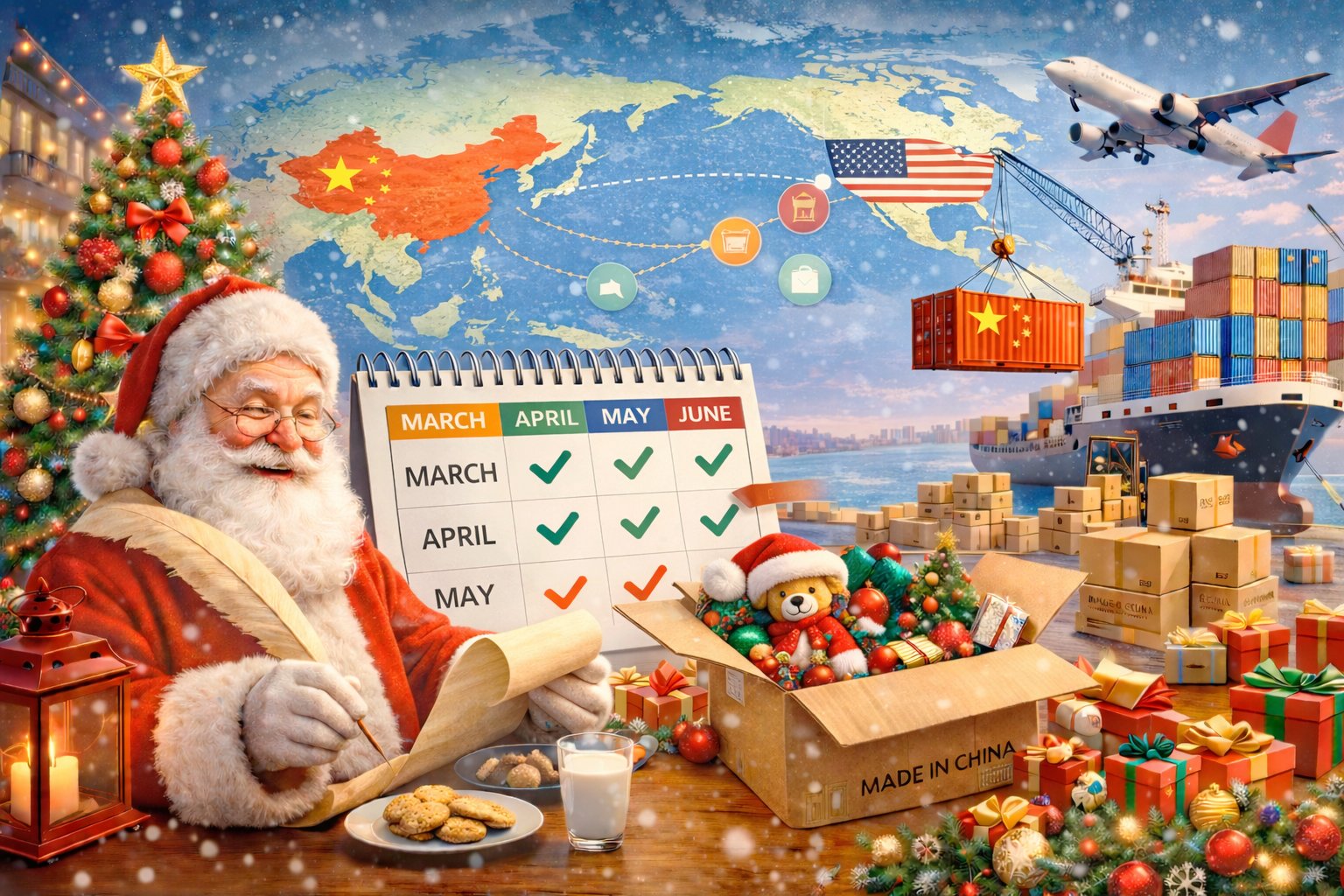
Planning ahead is essential when sourcing Christmas products from China — from early production to global shipping, timing directly impacts cost, availability, and delivery before peak season.
If you buy Christmas products from China, timing is not a small detail – it is the whole game. Nobody wants holiday stock landing after Christmas or after New Year. In practice, Chinese suppliers follow a very clear seasonal rhythm: factories slow down around Lunar New Year, samples and early orders pick up in spring, production gets busy in early summer, exports peak in July and August, and by September many overseas buyers are already running out of easy, low-cost shipping options.
Ocean transit alone can take roughly 15–20 days to the U.S. West Coast, 25–35 days to the U.S. East Coast, and around 25–45 days to Europe, while air freight is usually much faster but far more expensive.
So, when is the best time to source Christmas products from China? For most importers, wholesalers, and retail brands, the best time is March to June. That is when new designs are out, factories still have room in their production schedule, and you still have time for samples, revisions, inspections, and sea freight.
A Simple Sourcing Timeline That Actually Works
January to February: use this period for planning, not for expecting fast production. Many factories slow down or close during Lunar New Year, and response times are usually slower. This is the right time to review last season’s sales, set your budget, shortlist suppliers, and start discussing concepts for the next Christmas.
March to April: this is one of the best stages to request samples, compare suppliers, visit Yiwu or factories, and place early orders. Suppliers have fresh designs ready, production has resumed, and you have more room to negotiate before peak season pressure builds.
May to June: this is when serious Christmas sourcing is in full swing. If you want your goods to move by sea at a reasonable cost, this is the safest time to lock in orders, packaging details, and carton specs. It is also smart to book ocean space early before summer pressure pushes rates up and capacity gets tighter.
July to August: this is peak export season. Factories are busy, lead times stretch, and quality risks go up if you leave things too late. If you are buying in this window, stay very close to production and do not skip pre-shipment inspection.
September to October: for Europe and North America, this is usually late. Some suppliers stop accepting new orders for distant markets because regular production plus standard sea shipping will no longer comfortably hit the season. At this stage, buyers often have to switch to ready stock, air freight, or simply start planning next year earlier.
Seasonal Sourcing Timeline Table for Christmas Decorations, Quicker and Easier to Understand
| Time of Year | Sourcing & Production Activities (China) | Tips for Buyers (Global) |
|---|---|---|
| January – February | Chinese factories slow down or close for Lunar New Year (dates vary late Jan/Feb). Minimal production during the holiday. Many factories design new products for next Christmas during this off-season. | Use this time for planning and research. Identify product trends, line up budgets, and shortlist suppliers online. Be mindful of the New Year shutdown – inquiries may only get responses after factories reopen (usually mid-Feb/end-Fed). |
| March – April | Production resumes at full speed. Peak sample development and order placement period. In normal years, many US/EU buyers would visit Yiwu or trade fairs in spring (e.g. Canton Fair in April) to place Christmas orders. Early orders start getting into the production queue. | Place orders as early as possible – especially for large orders or custom items. By end of Q1, try to finalize designs and confirm with suppliers. Early booking secures your spot before the rush. This is also a good time to order samples for evaluation, before mass production. |
| May – June | Global orders for the Christmas season are now in full swing. Factories ramp up output; container bookings for ocean freight begin for early shipments. By May, Christmas exports are visibly increasing – e.g. May 2024 saw a 90% YoY jump as the season kicked in early. Some suppliers stop accepting new far-distance orders by late June if production slots are full. | Finalize orders by June for on-time delivery via sea. Ensure all artwork/packaging details are confirmed. It’s wise to book ocean freight space early (or work with a freight forwarder) as summer approaches – rates can spike and space gets tight. If you’re running behind, you may still order now, but be prepared for faster shipping modes or limited choices if factories are near capacity. |
| July – August | Peak export season. Chinese suppliers are incredibly busy fulfilling Christmas orders. Containers are leaving ports in huge numbers – July and August often see the highest export volumes for Christmas items. Yiwu’s market is abuzz with foreign buyers and inspectors. By late August, production for overseas orders winds down, as goods must depart to reach in time. | This is the last call for sea shipments to reach most Western markets by Oct/Nov. If you order now, use expedited production if available and expect to pay premium freight (or consider rail/truck for EU). Stay on top of QC – consider hiring a third-party inspection in August to check goods before they ship. Also, have a backup plan (like some air freight for urgent items) in case of delays. |
| September – October | Shipping cut-off for distant markets. By September, many Yiwu vendors stop accepting new orders from Europe or North America because production + standard shipping would not meet the Christmas deadline. Factories complete last batches and focus on domestic China orders or nearby Asian markets, which have later timelines. In October, the export season wraps up – October 31st is like “season end” for Christmas exports, and any remaining goods might go by air if absolutely needed. Meanwhile, domestic sales in China pick up in October/November (for the small but growing local Christmas celebrations). | If you still need inventory and it’s September, you’ll likely need to use air freight or find local wholesalers with existing stock. However, you can also switch focus to next year: Many experienced buyers start product development for the next Christmas as early as October of the current year. Gather feedback on this year’s products and communicate with suppliers about new designs or improvements. You might even visit Yiwu in October to see post-season clearance deals and preview some prototypes for next year – suppliers often welcome input while ideas are fresh. |
| November – December | Chinese suppliers catch their breath or turn to fulfilling last-minute domestic orders. Some factories may start maintenance or retooling once export rush is over. They also begin planning for trade shows or new catalogs for the next year. Yiwu shops in November might still have ready goods to sell (great for small immediate needs, if you’re nearby or want to air ship a few cartons). Overall, the Christmas industry in China winds down as the world enjoys the festive season. | This is selling season in your market! Focus on marketing and selling the products you sourced. Keep in touch with your supplier and provide sales feedback – they’ll appreciate knowing what’s selling well (helps them prepare for repeat orders). Also, evaluate your logistics: did your goods arrive on time? Any bottlenecks? Use these lessons to refine your plan for the next cycle. By December, you should already be thinking of next year’s lineup, so you can hit the ground running with suppliers come January. |
* if you are reviewing this timeline table via a mobile phone and the table doesn’t display completely, simply swipe the table to the right to see the rest.
Where Many Buyers Start: Yiwu
For buyers who want variety in one place, Yiwu is still one of the easiest entry points. It is especially useful for ornaments, stockings, gift packaging, wreaths, garlands, small home décor, and a lot of semi-custom seasonal items. If you want to visit in person, March to May is especially practical because factories are fully running again, new lines are out, and the market is easier to walk than in the busiest periods. Late January to mid-February is less ideal because of Lunar New Year disruption, and the first week of October can also be slower because of the National Day holiday.
That said, Yiwu is not only for “small buyers.” One smart way to use it is to discover trends, compare packaging ideas, and build a mixed sourcing plan: some items from market-ready suppliers, some from factories for bigger or more customized runs. If you are sourcing next year’s program, even an October visit can still be useful for previewing new ideas rather than placing urgent current-season orders.
How Early Should You Order Different Kinds of Christmas Products?
Not all Christmas products move at the same speed. Standard ornaments and simple decoration items can often be produced in roughly 2–4 weeks for medium orders, while more complex or bulkier products such as artificial trees can need 4–6 weeks. If you add custom colors, private-label packaging, or new product development, you should also allow time for sampling and revisions, and overall production can stretch to 4–8 weeks or more. That more complex categories like advent calendars can have longer lead times, around 45–75 days.
This is why experienced buyers rarely jump straight into a big PO (Purchase Order) with a new supplier. A better flow is: sample first, approve one “golden sample,” confirm artwork and carton details, then move into mass production. If your order volume is not large enough for full customization, a very practical workaround is semi-custom sourcing – keep the supplier’s standard product, but customize hangtags, boxes, inserts, or stickers so the item still feels like your brand without forcing a huge MOQ.
As a rule, bulky items like artificial trees are better suited to ocean freight because freight cost matters more than speed. Smaller, lighter, urgent orders may go with air freight. Typical air freight at around 5–10 days and express courier at around 3–7 days, which makes them useful for late replenishment – but only if your margins can survive it. There is no doubt, in most cases, sea freight is the best economical choice for larger volumes and air freight is the fastest but most expensive option.
One more thing buyers often underestimate: packaging affects freight almost as much as the product itself. Fragile ornaments need better inner protection, oversized decorations can blow up your CBM, and mixed cartons without clear labeling create problems later in the warehouse. Good export cartons, moisture protection for sea freight, and accurate carton marks are not “nice to have” – they are part of the buying decision.
To make the shipping decision easier, the table below gives you a quick side-by-side view of the main shipping options for Christmas products from China. You can see the typical transit time, cost level, charging method, main pros and cons, and which types of buyers and products each option is best suited for. Transit times and cost patterns vary by season, route, cargo size, and destination, but this comparison gives you a practical starting point for planning.
Shipping Options for Christmas Products from China
| Shipping Method | Typical Transit Time | Cost Level & How It’s Usually Charged | Best Advantages | Main Drawbacks | Best For | Typical Christmas Products |
|---|---|---|---|---|---|---|
| Sea Freight (LCL) | Usually around 30–45 days overall, depending on destination and consolidation time. Ocean transit from China typically takes about 15–20 days to the U.S. West Coast, 25–35 days to the U.S. East Coast, and 25–45 days to Europe, while LCL is generally slower because it involves consolidation and deconsolidation. | Low to medium cost. Usually charged by CBM (cubic meter), plus local charges such as CFS, terminal handling, customs brokerage, pickup/delivery, and insurance. | A flexible and cost-effective option for smaller or mixed orders. It works well when you do not have enough cargo to fill a full container and want to keep the initial shipping budget under control. | Slower than FCL, with more handling points and a higher risk of delay or carton damage. It can also become less economical once shipment volume increases. | Buyers shipping less than about 15 CBM or 2–3 pallets. Small and medium buyers, trial orders, mixed SKUs, and buyers sourcing from multiple suppliers. | Ornaments, stockings, wreaths, garlands, gift packaging, ribbons, and other small-to-medium décor items. |
| Sea Freight (FCL) | From major Chinese ports, roughly 15–20 days to the U.S. West Coast, 25–35 days to the U.S. East Coast, and 25–45 days to Europe depending on route and disruptions. | Low unit cost at scale. Usually charged at a flat rate per container such as 20ft or 40ft, plus origin and destination local charges. FCL often starts to make more sense once cargo volume reaches about 15 CBM or more. | Best for larger seasonal programs because it offers, better carton protection, fewer handling points, and lower cost per unit when volume is high. | Requires a larger upfront order and ties up more cash in inventory. It is usually not the best fit for small tests or uncertain demand. | Importers, wholesalers, chain stores, and buyers with stable seasonal forecasts. | Artificial Christmas trees, inflatables, bulky retail cartons, oversized wreaths, bulky display décor, large assortments, and high-volume decoration programs. |
| Air Freight | Typically 5–10 days; Freightos uses about 8–10 days as a general China–U.S. benchmark. | Medium to high cost. Usually charged by chargeable weight, which means the carrier uses whichever is higher: actual weight or volumetric weight. General cost about $5–8/kg for some China–U.S. shipments in the 150–500 kg range. | Much faster than ocean freight and a practical solution for urgent replenishment, launch orders, or products with better margins. | Considerably more expensive than sea freight, and pricing rises quickly for bulky cartons or peak-season bookings. Space can also become tight before the holiday rush. | Buyers with urgent deadlines, and products missing the selling window, late replenishment needs, or medium-sized shipments where speed matters more than freight savings. | Premium ornaments, boxed LED décor, fast-moving SKUs, urgent packaging materials, and selected gift sets. |
| Express Courier (DHL / FedEx / UPS) | Usually 3–7 days while DHL says most international express shipments arrive by the next possible business day depending on route and service level. | Highest cost. Usually charged by actual or volumetric weight, with premium pricing for door-to-door speed, tracking, and customs support. Generally, courier is often the most economical fast option only for parcels under about 150 kg. | Fastest option, easiest to manage, door-to-door, strong tracking and ideal for documents, urgent samples, replacement parts, or very small last-minute shipments. DHL also highlights time-definite delivery, real-time tracking, and customs clearance support. | The most expensive option by far, so it is usually not suitable for bulky or low-margin products. | Buyers sending samples, artwork approvals, packaging mockups, or emergency restock parcels. | Samples, packaging mockups, catalogs, labels, printing inserts, small lighting samples, replacement parts, and urgent product approvals. |
| Rail / Intermodal (mainly for Europe) | Rail on some China–Europe corridors can be 15–17 days from Xi’an to Duisburg and 18–20 days from Yiwu to Duisburg. Sea-rail combinations can reach Europe in around 30 days, though current war disruptions (in middle east) can extend timing. | Medium cost. Usually more expensive than standard ocean freight but cheaper than air freight on many Europe-bound routes, with pricing depending on service type, container option, and route conditions. | Good balance when ocean is too slow and air is too expensive. It can work well for European buyers who need better timing without paying full airfreight rates. | Not a global solution, and availability depends on destination, route stability, and current corridor conditions. It is much less universal than ocean or air. | Europe-based importers with medium urgency and medium-value cargo. | Boxed décor sets, artificial greenery, gift assortments, and selected seasonal lines for European distribution. |
* if you are reviewing this comparison table via a mobile phone and the table doesn’t display completely, simply swipe the table to the right to see the rest.
Planning note: for Christmas products, the shipping method should match not only your deadline, but also your product type, carton volume, margin, and risk tolerance. Bulky items like artificial trees usually make more sense by sea, while urgent replenishment or samples are better suited to air freight or courier. If your market is Europe, rail can be a useful middle option when timing is tighter than ocean but your budget cannot support air.
Compliance and Paperwork: Boring, But Expensive to Ignore
This is where many first-time buyers get into trouble. A nice sample does not mean the shipment is market-ready. At minimum, your shipment paperwork should be complete and consistent: commercial invoice, packing list, and bill of lading or air waybill. Product descriptions also need to be specific enough for customs and brokers to work with.
For Christmas products, a few areas deserve extra attention:
- U.S. holiday lights and decorative lighting: the CPSC says seasonal and decorative lighting products that lack minimum wire size, sufficient strain relief, or overcurrent protection can be considered a substantial product hazard.
- Battery-powered products: if your wreaths, garlands, string lights, or other items contain lithium batteries, IATA guidance makes clear that battery shipments must follow dangerous goods rules and supporting guidance, including proper classification, packaging, labeling, and documentation. UN38.3 paperwork for battery-powered goods needed.
- EU market: the EU’s GPSR has applied since 13 December 2024, and CE marking plus technical documentation remain central where product rules require them. The EU also requires a responsible economic operator in the EU supply chain for covered consumer products.
- UK market: for products that lawfully need UKCA, the UK Declaration of Conformity must be available, and technical documentation generally needs to be kept for 10 years.
There is also the customs classification side. In the U.S., festive goods can fall into different tariff categories depending on what they are. The HTS chapter notes festive articles under heading 9505, while “electric garlands of all kinds” are excluded there and fall under heading 9405. In other words, do not assume every Christmas item is classified the same way just because it looks festive. Confirm the HS/HTS code before production, not after the container is on the water.
A few real-world buying lessons that save money
The first lesson is simple: do not wait for a “perfect” sales forecast before ordering. The later you buy, the fewer choices you have – fewer factories with open capacity, fewer easy shipping options, and less room to fix mistakes.
The second lesson: never skip pre-shipment inspection. Use your approved sample as the benchmark, and if the order matters, hire a third-party QC company to do an AQL inspection before balance payment. That small cost is nothing compared with a whole shipment of broken ornaments, weak carton packing, wrong colors, or lights that fail after one test.
The third lesson: vet the supplier like you mean it. Check whether they are a factory or trader, ask for business credentials, request samples, test communication speed, and start with a small trial order if needed. Reasonable payment terms such as 30% deposit and 70% balance are common; demanding 100% upfront on a large bulk order is not a great sign.
Kevin:
If I had to make this advice as simple as possible, it would be this: plan in Q1, place serious orders in Q2, ship most sea freight in Q3, and do not rely on Q4 to fix what should have been decided months earlier. That one rhythm alone will help you buy better, ship cheaper, and sleep a lot better during the holiday season.
Related Reading:
-> How to Import Christmas Decorations from China
-> How to Import Christmas Trees from China
-> FCL vs LCL: How to Choose the Right Ocean Freight
-> Bill of Lading (B/L) Explained
-> Navigating Yiwu Market: Layout, District Guide and Product Categories
-> How to Buy from Yiwu Market: The Only Guide You Need
-> Yiwu Jewelry Market – The Best Jewelry Wholesale Market in China
If you have any questions about buying from Yiwu / China, we’re here for you. Feel free to reach out – whether you need a trustworthy China Sourcing Agent on the ground, guidance on shipping options, or just someone to talk through your product ideas with, we’re happy to help.
Contact Information as below:
Email:kevin@china-buying-support.com
Phone | WhatsApp:+86 1860 5899 103
Thank you.
Joining Us With 1,200+ Happy Clients Enjoying Buying From China now!
Becoming One of China-Buying-Support family to Get a Easier and Trouble-Free Sourcing and Shipping Service.