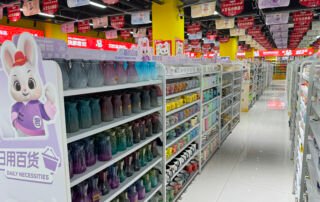

Yiwu Daily Necessities Market, Really Worth a Visit
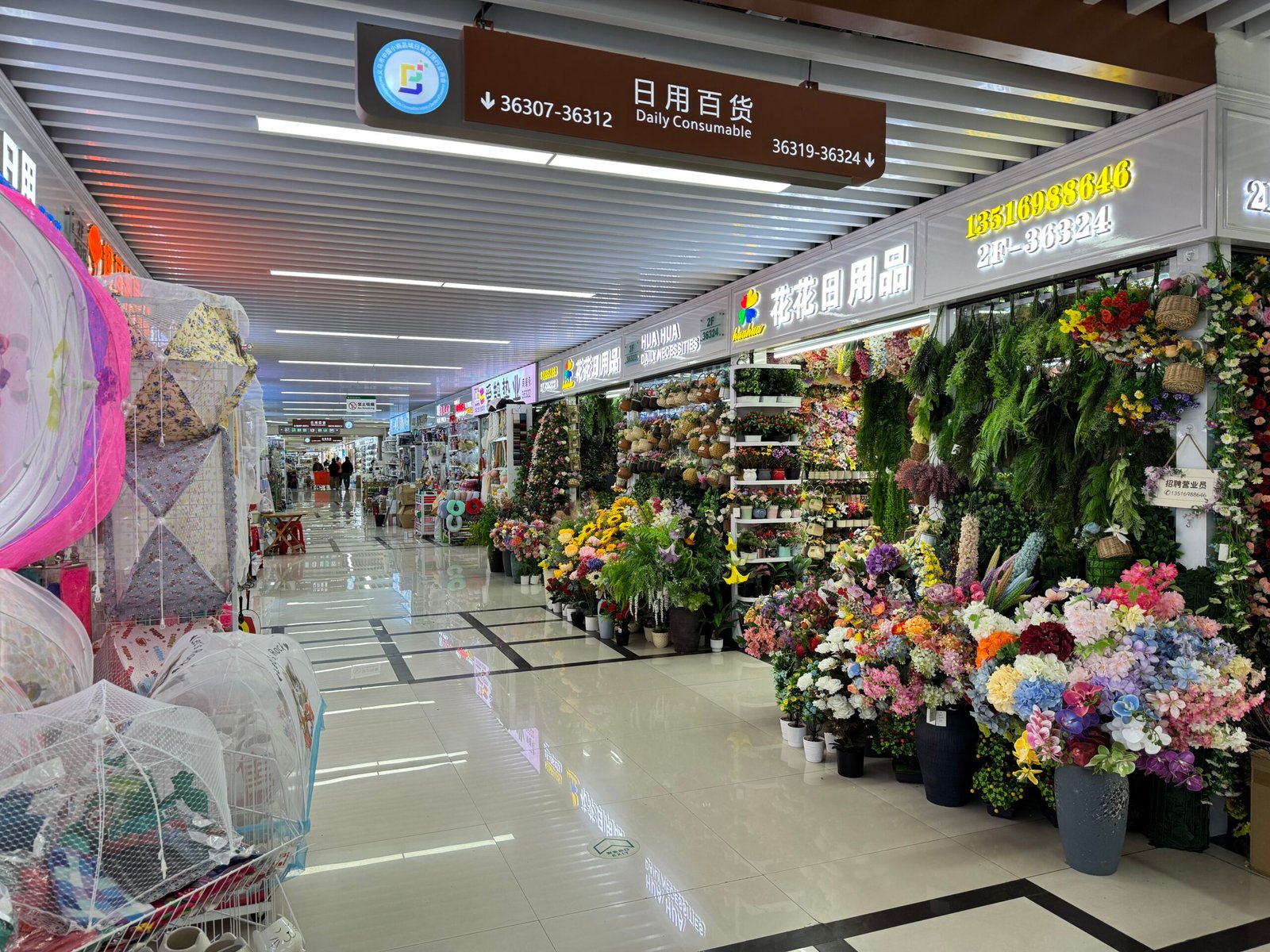
Daily consumables floor inside Yiwu Futian Market District 4 with wholesale shops selling artificial flowers, plants and floral supplies along a busy corridor
Introduction: Yiwu, a city in China’s Zhejiang province, is home to the world’s largest wholesale market for small commodities. This global marketplace, officially known as Yiwu International Trade City, spans 8 million m² with over 80,000 booths (As of Nov. 2025, the new District which is District 6 had been Opened) across multiple districts. It serves as a vital node in global supply chains, attracting buyers from all over the world. For small and medium-sized buyers, dollar store owners, and first-time international visitors, Yiwu’s Daily Necessities Market is a top choice.
This guide will walk you through everything you need to know about the Yiwu Daily Necessities Market – from what it is and why it’s special, to how to navigate, purchase, and ship your goods home – in a friendly, accessible way.
Yiwu and Its Markets: A Global Sourcing Playground
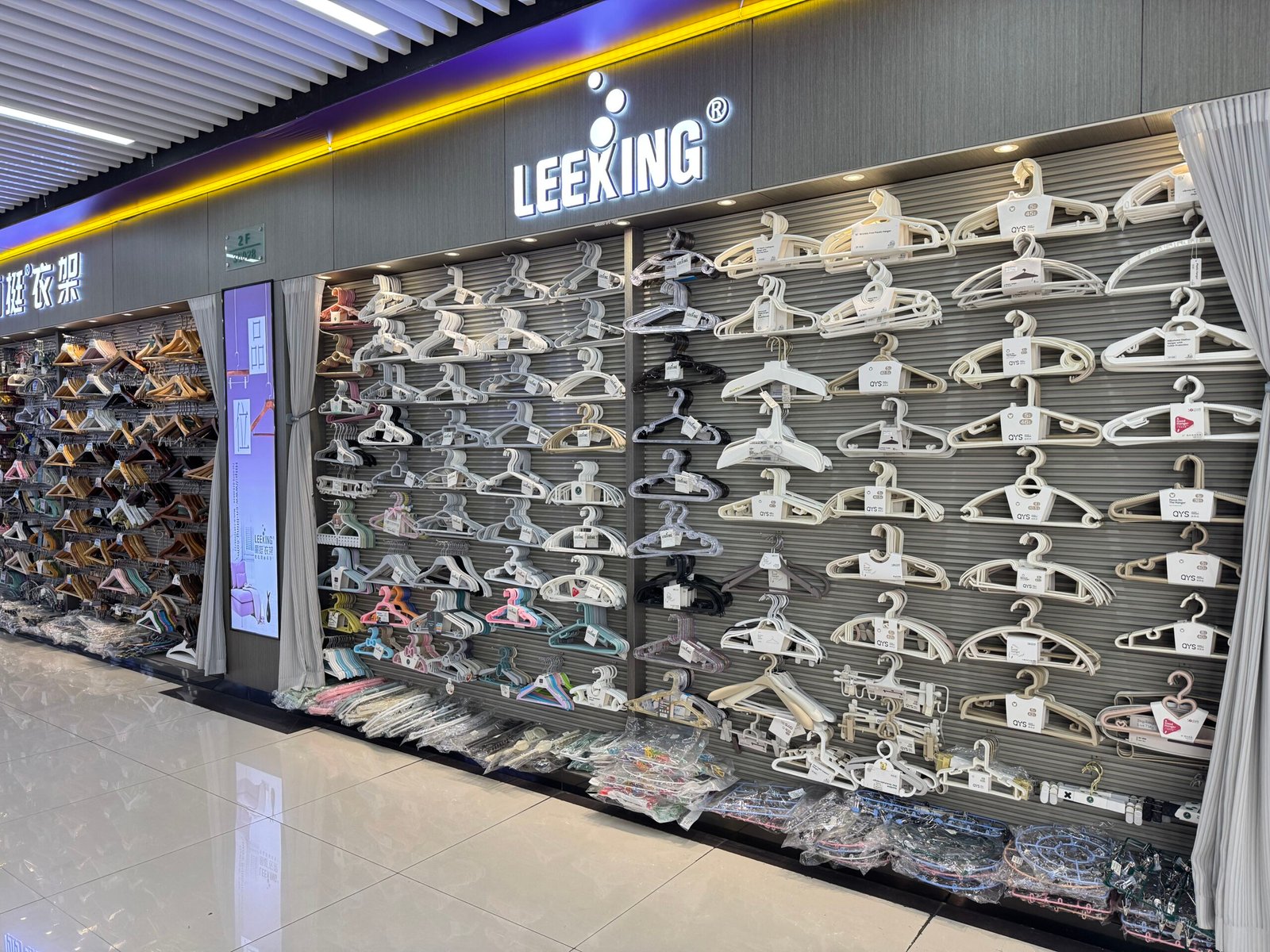
Leeking in Yiwu Market District 4 showcases its full range of plastic and wooden clothes hangers on an impressive display wall.
Yiwu may be a county-level city, but it has earned a world-class reputation in trade. Nicknamed the “Capital of Small Commodities,” Yiwu is globally recognized as a one-stop sourcing hub for daily-use products and more. Over the past few decades, the Yiwu market has grown from a humble street bazaar into a huge International Trade City with six interconnected districts (District 6 had been opened at October 2025). Each district specializes in certain product categories, creating a vast mosaic of merchandise. The diversity of products is unparalleled – an estimated 2.1 million types of products in 2,000 categories are on display. International businesspeople come to Yiwu to source everything from socks to electronics.
Notably, District 4 is famous for daily necessities, socks, and kitchenware, making it a favorite stop for household goods retailers worldwide. The city’s excellent location, surrounded by manufacturing hubs (near places famous for plastics, hardware, textiles, etc.) means Yiwu can offer an incredible variety of goods at very competitive prices. Simply put, Yiwu has become the marketplace of the world for everyday consumer goods – all under one roof.
Where to Find the Yiwu Daily Necessities Market
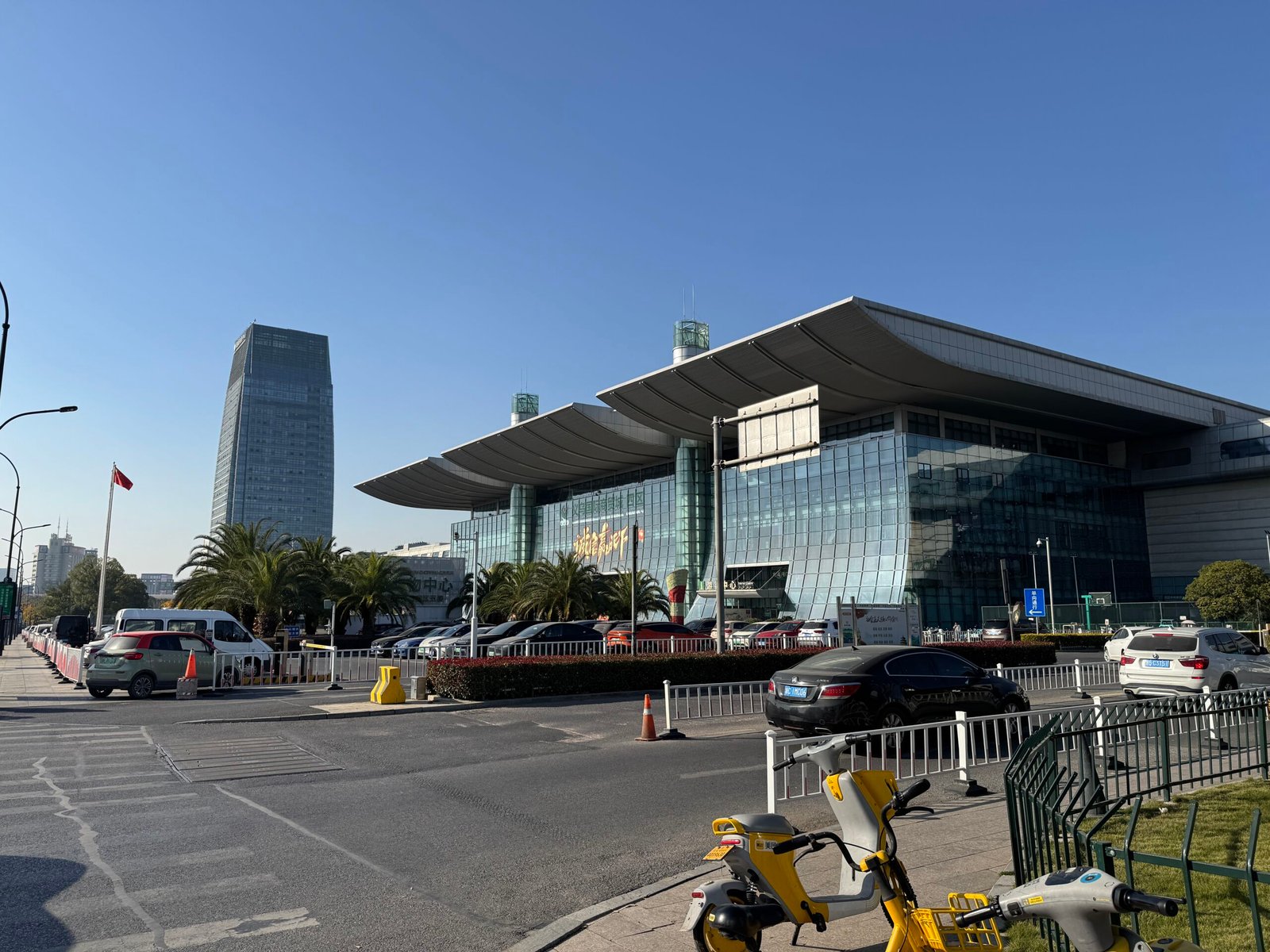
Yiwu International Trade City (Yiwu Market) District 4 South Gate in Yiwu, Zhejiang, China, featuring a modern glass façade, sweeping rooflines and a bustling street filled with cars on a sunny day.
The Yiwu Daily Necessities Market is a specific section of Yiwu International Trade City dedicated to daily-use household items (often called “general merchandise” or “daily sundries”). It is located on the 2nd floor of District 4 in the Yiwu international trade city (also known as Yiwu Futian Market). District 4 is one of the newer sections of the market (opened in 2008) and is ultra-modern in design. The daily necessities floor alone houses over 3,200 stalls, offering 200,000+ different products across 20 major categories.
The environment is notably comfortable and well-organized: District 4 was built with wide aisles, air conditioning, bright lighting, elevators, and even noise-control systems to make browsing easy. All the booths are arranged in long straight lines behind glass storefronts, so you can literally walk for 20 minutes without having to turn a corner.
The market operates year-round, opening 9:00 a.m. to 5:00 p.m., 7 days a week (with only closes for about 15 days during Chinese New Year Holiday). Whether you visit on a Monday morning or a Saturday afternoon, you’ll find the stalls abuzz with activity. The scale is truly amazing – imagine a mall of household goods that stretches as far as the eye can see. If you’re entering Yiwu International Trade City District 4, just head to the second level and you’ll find yourself immersed in the Daily Necessities Market.
What Can You Buy at the Yiwu Daily Necessities Market?
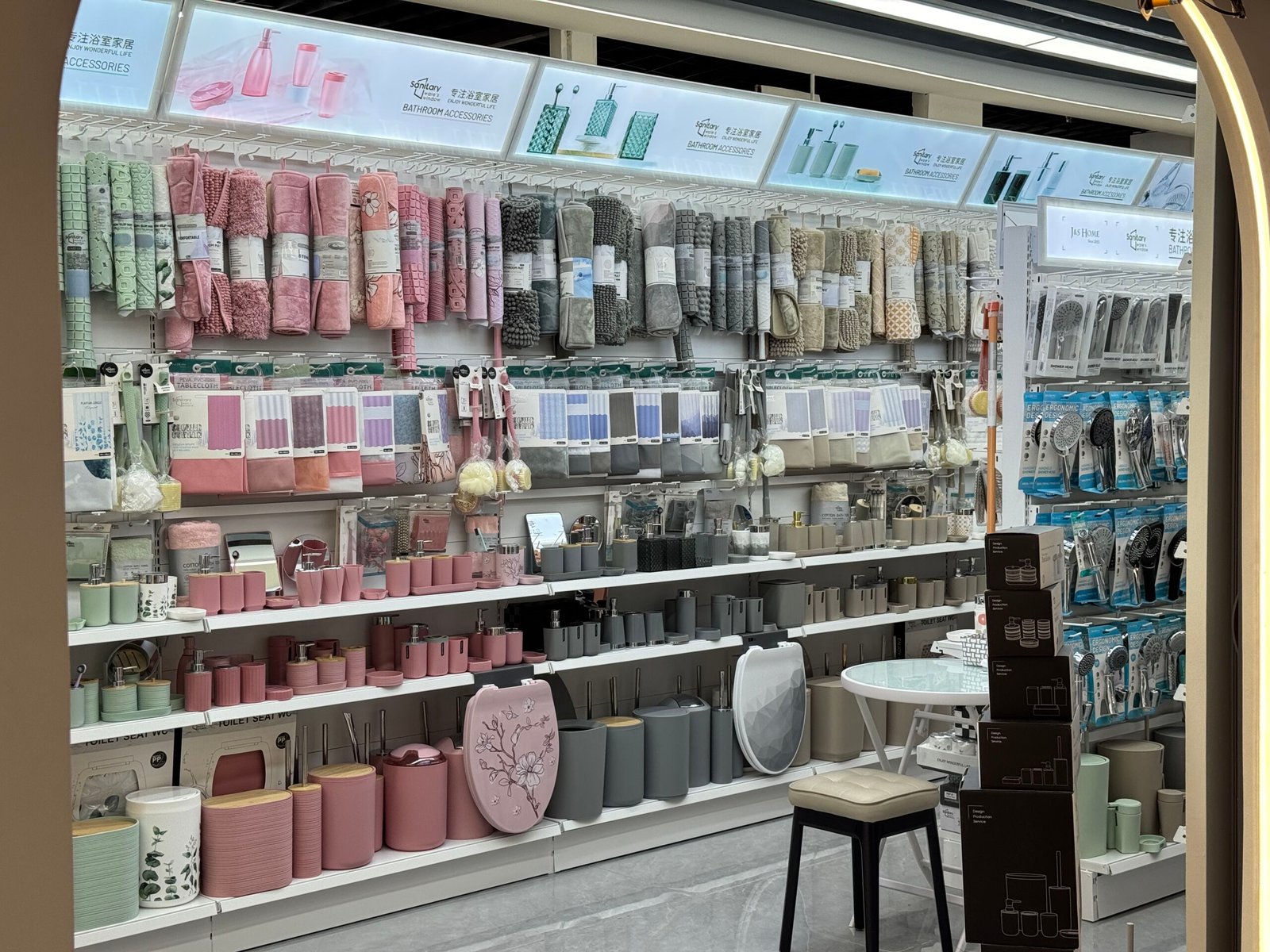
Bath mats, shower curtains and coordinated bathroom sets neatly fill the shelves of a bathroom accessories supplier in Yiwu International Trade City District 4, in China
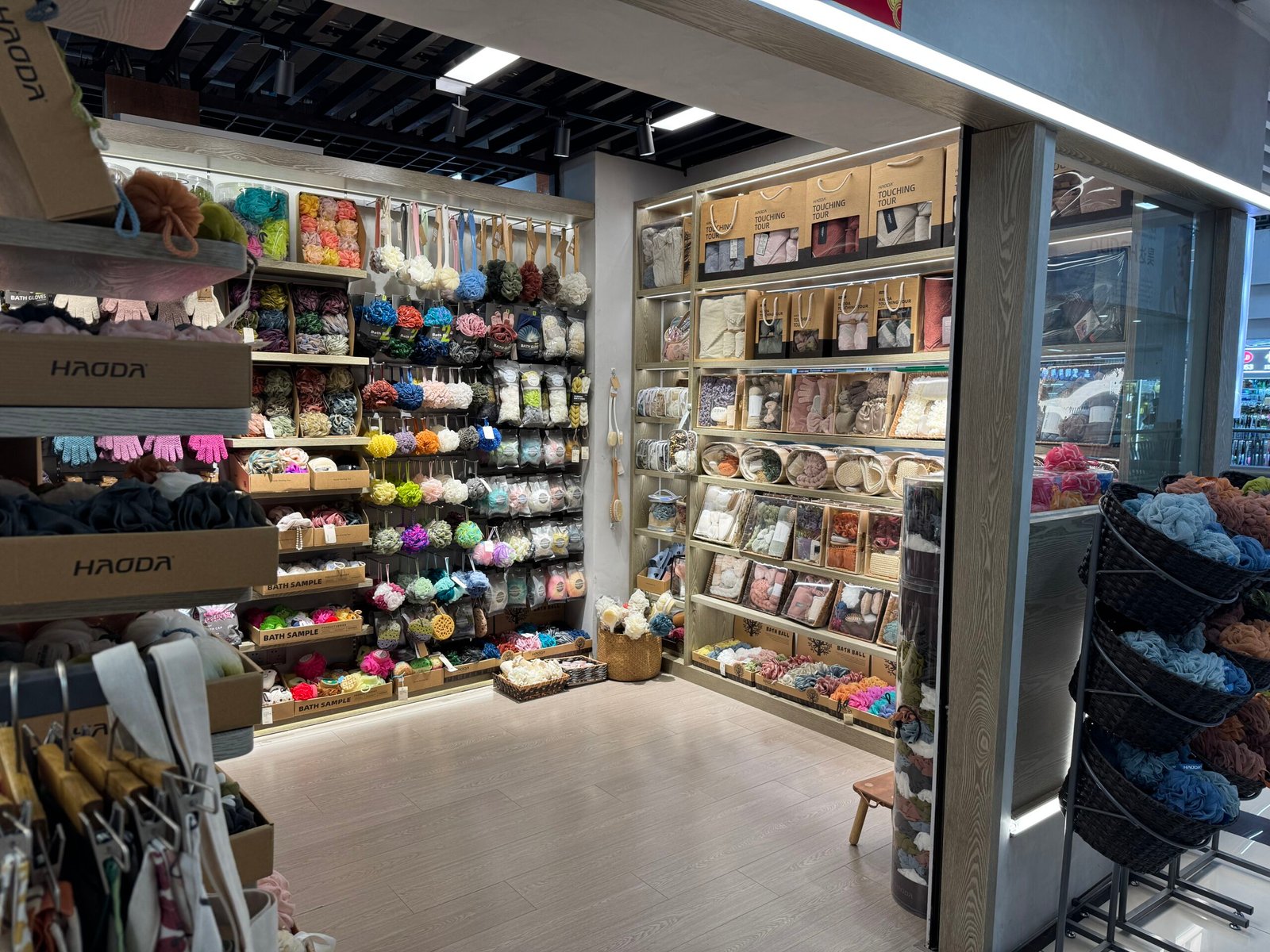
A wholesaler in Yiwu District 4 displays rows of colorful shower puff, bath sponges, loofahs and bath gift sets for international buyers. Photoed in Yiwu Market, China
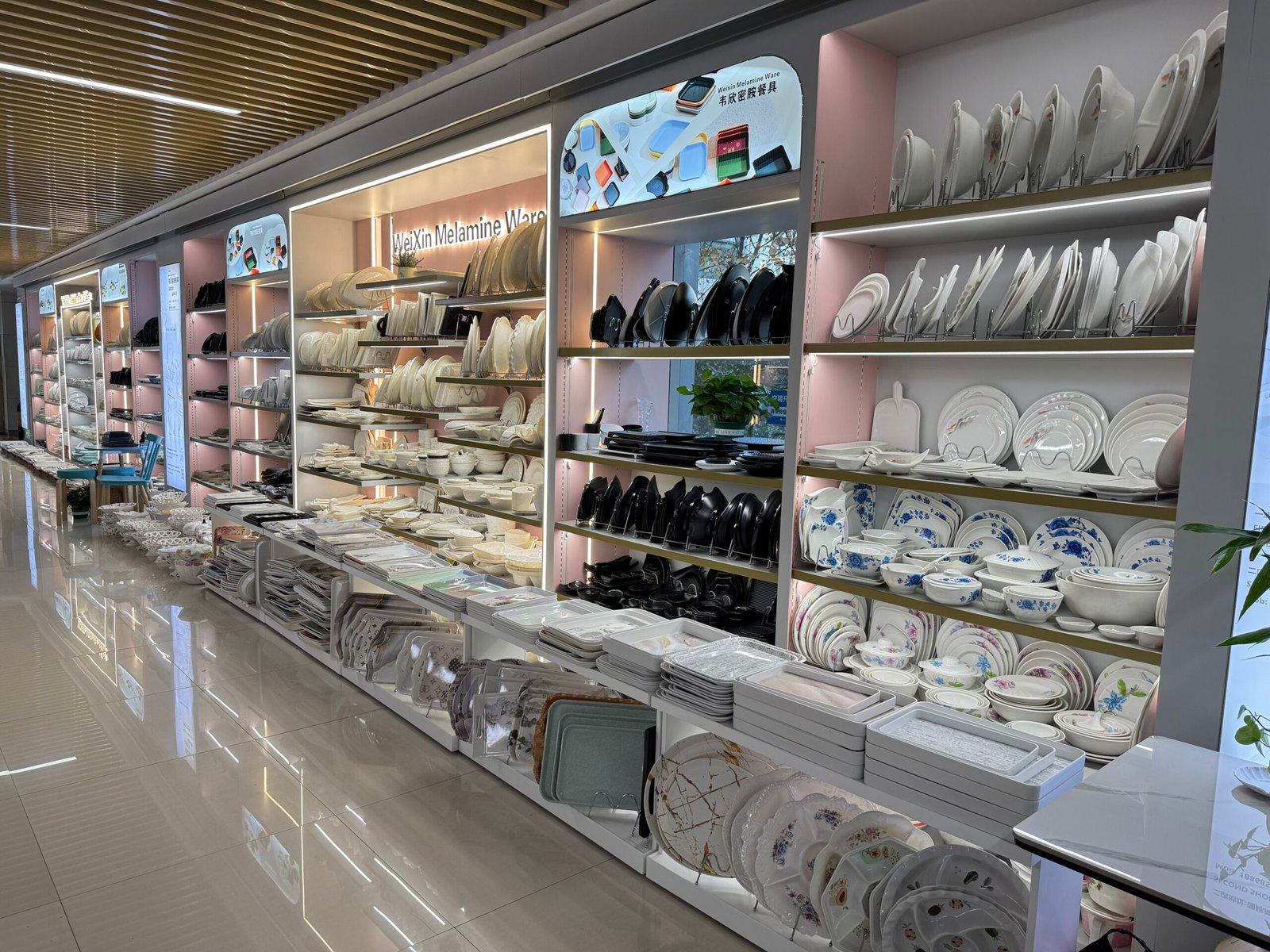
A melamine tableware factory shop in Yiwu District 4 displays complete collections of plates, bowls and trays for restaurant and household buyers. Location: Yiwu Market, China
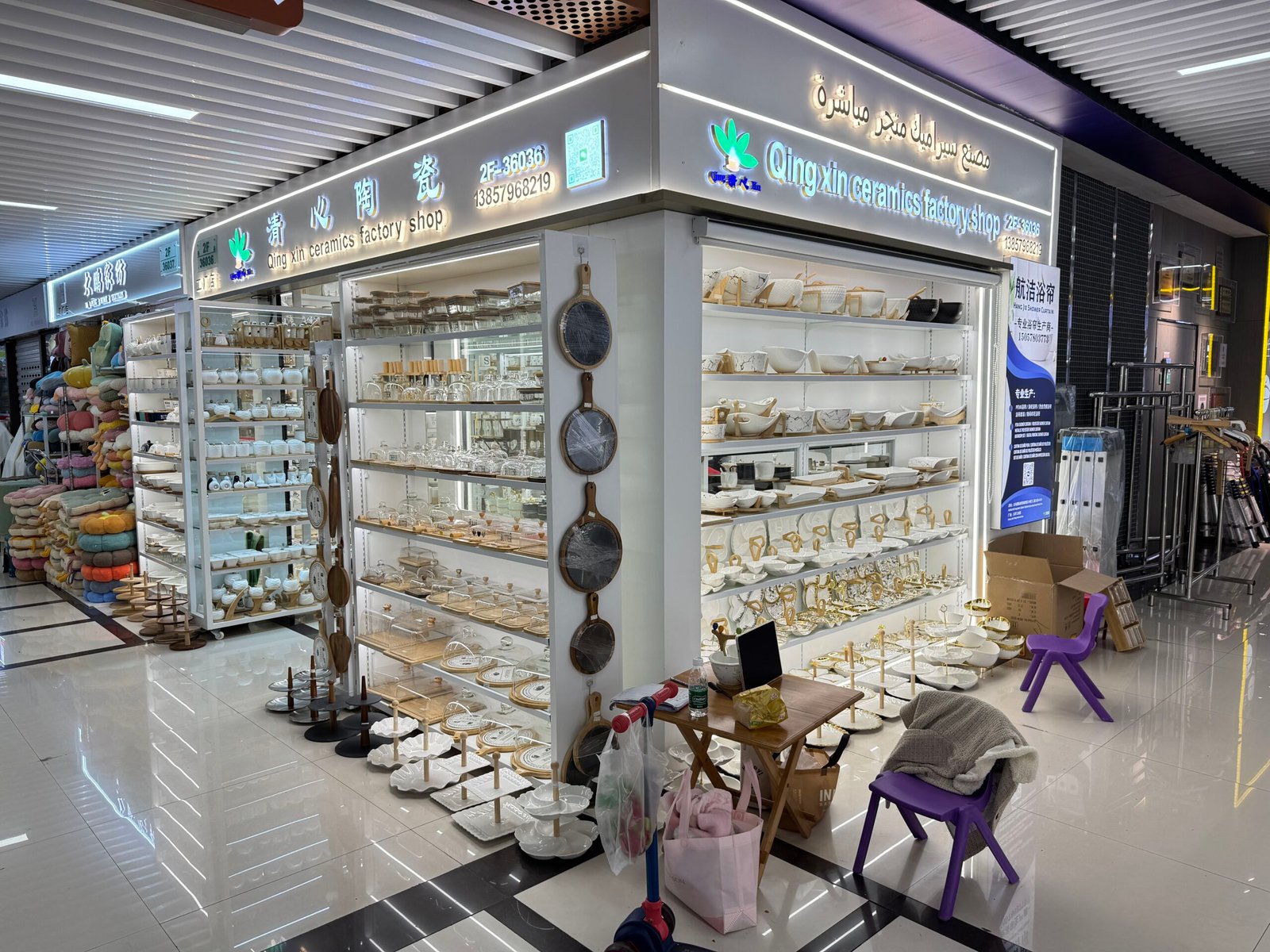
Qingxin ceramics factory shop in Yiwu District 4 offers elegant white and gold ceramic tableware and glassware for wholesale customers.
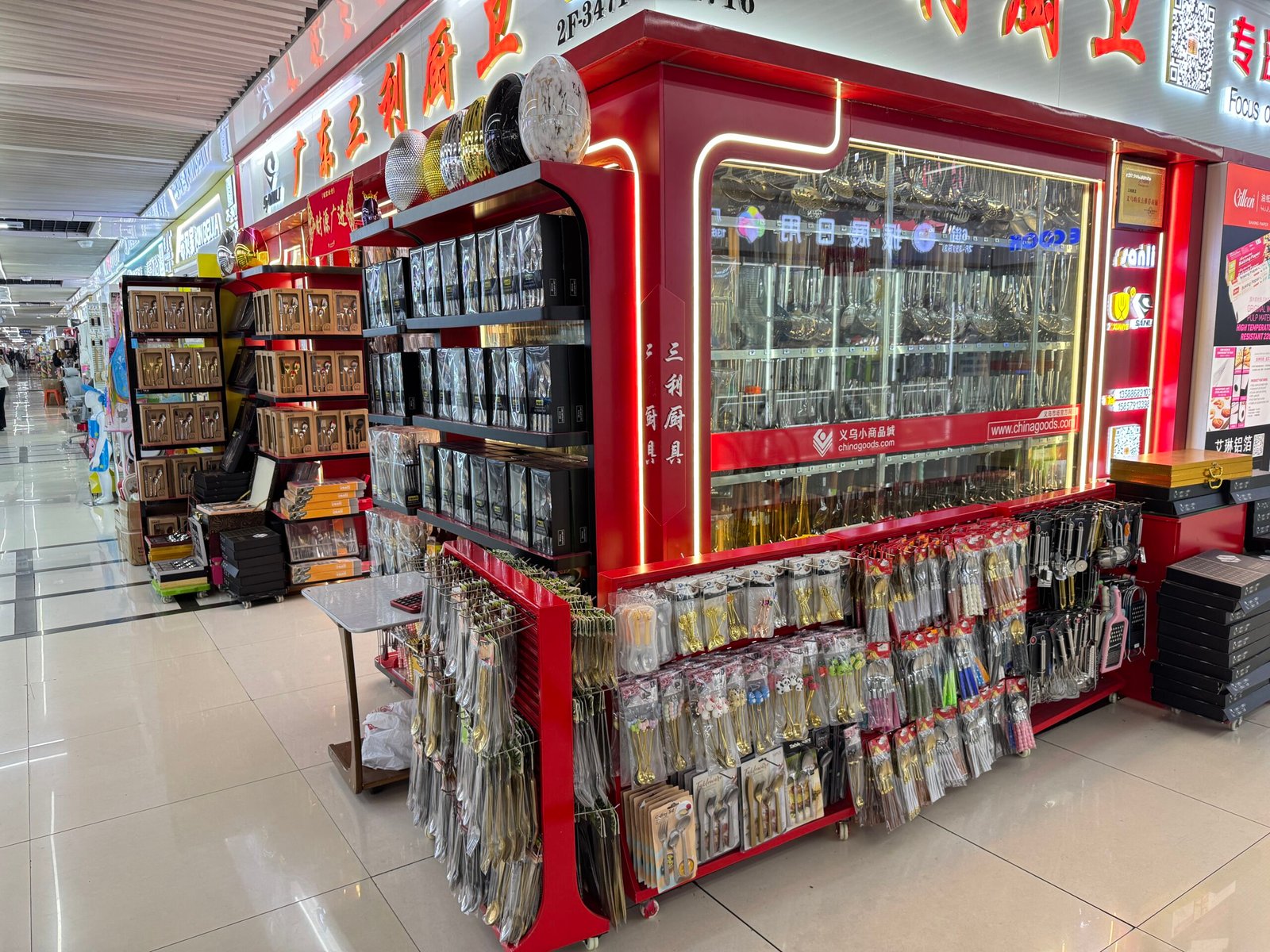
A stainless steel cutlery and kitchen utensils factory shop in Yiwu International Trade City District 4 attracts buyers with bold red branding and densely packed displays.
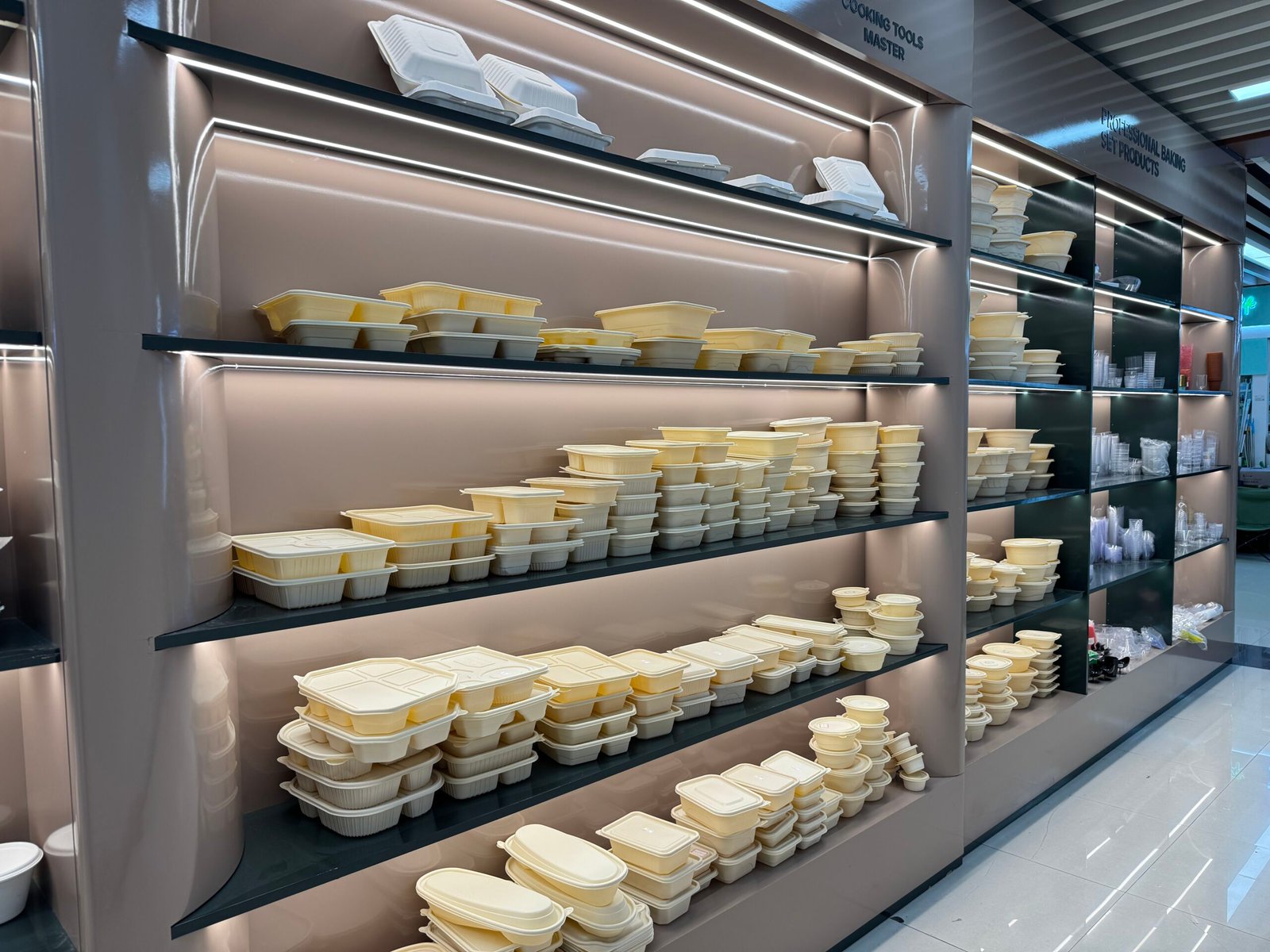
Eco-friendly takeaway lunch boxes and food containers from a biodegradable disposable tableware manufacturer are neatly arranged on a sample wall inside a factory showroom in Yiwu International Trade City District 4, China
In a word: everything! The Daily Necessities Market offers an amazing range of daily-use products. Walk down the aisles and you’ll find entire sections devoted to:
- Kitchenware & Dining Supplies: All the gadgets and tools that make cooking easier. Think kitchen utensils, cookware, knives, cutting boards, and clever gadgets for food prep. You might see a new type of apple peeler or a flexible cutting board that you never knew you needed (and at Yiwu’s prices, it’s hard to resist). Plastic storage containers, water bottles, thermoses, and tableware of every shape and color line the shelves. A stall might display cheap plastic water bottles by the hundreds, while next door you’ll find beautiful ceramic bowls and plates.
- Household Plastic Products: Yiwu is famous for its plastic goods. You’ll discover plastic storage bins, organizers, baskets, buckets, cups, lunch boxes, hangers, trash bins, and more, in every size and color. If it’s a handy household item made of plastic, chances are you can find it here. For example, one booth might showcase colorful disposable plastic cups and food containers in bulk, while another specializes in spray bottles and cleaning caddies.
- Cleaning Supplies: Need to stock up on cleaning tools? Yiwu’s got you covered with brooms, mops, scrub brushes, sponges, microfiber cloths, spray bottles and even quirky items like metal wire scouring balls with handles to make scrubbing pots more fun. Many ordinary products have a creative twist here – the market is full of those “why didn’t I think of that?” items.
- Personal Care & Daily Hygiene: You’ll find toothbrushes (even fun character toothbrush holders), combs, hairbrushes, mirrors, toiletries, soap dishes, shower caps, and countless small personal care accessories. Brands and unbranded items sit side by side – from global brand toothbrushes to generic but attractive packaging, all at wholesale prices. There are even sections for cosmetic accessories, travel bottles, and grooming kits, making this floor a go-to for health and beauty shop owners.
- Home Decor & Miscellaneous Tools: Spread throughout the aisles are stalls for wooden and bamboo products (like bamboo baskets, cutting boards, or small wooden stools), small hardware tools (hammers, screwdrivers, measuring tapes for household use), picture frames, candles, and decorative items. You might find a vendor selling handy little gadgets (think “As Seen on TV”-style innovations) that simplify household jobs. We’ve all been charmed by such gadgets in shops – and indeed, many of them start right here.
- Baby & Pet Supplies: There are sections for baby daily needs – from baby bottles and sippy cups to bibs and baby wipes. Likewise, pet store owners can source pet bowls, leashes, pet toys, grooming brushes, pet beds, and other pet accessories here. Yiwu’s variety means even niche daily-use items for infants or furry friends are available.
- Seasonal & Holiday Goods: Many stalls rotate inventory to include seasonal items. For example, in summer you might see inflatable pool toys or picnic accessories; heading into year-end, you could spot Christmas decorations, New Year party supplies, or other festive items. (Yiwu is actually a huge source of Christmas décor globally, though those are mostly found in another district dedicated to holiday goods.) Still, the daily necessities section will reflect seasonal trends – whether it’s mosquito-repellent gadgets in summer or holiday-themed kitchenware in winter. New trend items appear very fast; suppliers often introduce innovative products here earlier than anywhere else to test the global market.
In short, the Yiwu Daily Necessities Market is like a bazaar of everyday life. Shop owners from around the world love it because they can find both the basics and the latest novelties in one place. As you walk around, you might see, for instance, a new style of toothpick dispenser, a funky suction-cup toothbrush holder shaped like Spiderman (a hit with kids), or an eco-friendly alternative to a common product, like plant-based mosquito repellent instead of the traditional smoky coils.
Over 70% of the products here end up exported to Africa, the Middle East, Europe, and the Americas – so the assortment reflects a world of tastes and needs. The amount and variety of products are simply staggering – in a very good way: whether you run a dollar store, a home goods shop, or an e-commerce business for household gadgets, Yiwu’s daily-use product selection is the best you can find.
Why Do Global Buyers Choose Yiwu for Daily-Use Products?
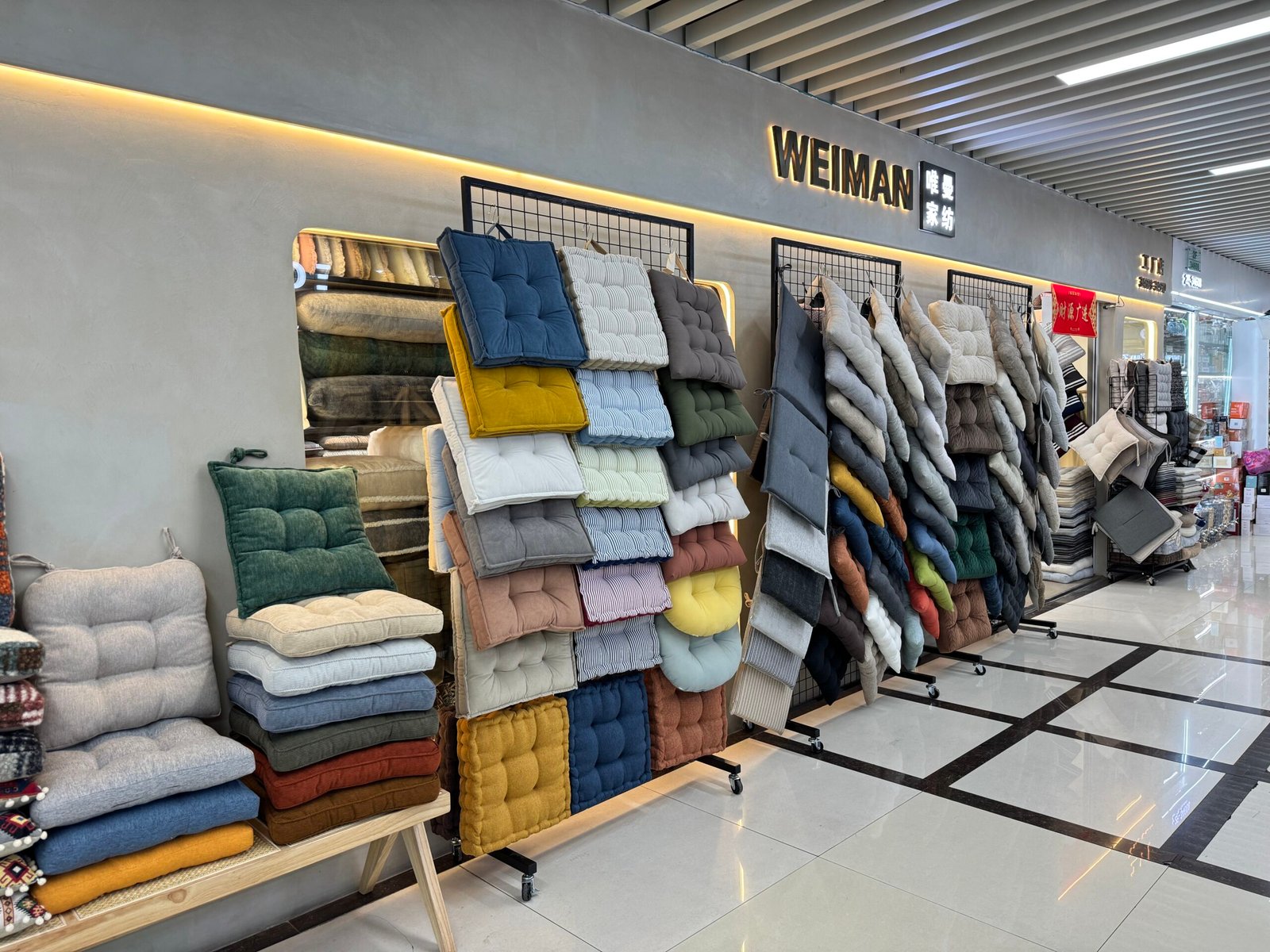
The WEIMAN home textile shop in Yiwu District 4 showcases a wide range of seat cushions and chair pads for wholesale buyers from around the world.
With so many wholesale markets in China (and around the world), what makes Yiwu’s Daily Necessities Market so special? Here are the key reasons global buyers flock here:
- Unbeatable Product Variety: Nowhere else can you find such a rich diversity of daily-use products under one roof. Yiwu is literally a one-stop shop: you can source all your store’s merchandise in one trip – from kitchen gadgets to cleaning supplies to personal care items – without having to visit multiple factories. The convenience of browsing thousands of products in person, comparing styles and quality side by side, is a huge draw for buyers. This variety also means you can easily discover new trending items to make your business different. Yiwu is “globally recognized as a one-stop sourcing hub for importers”. If you’ve ever wondered how dollar stores or variety shops can carry such an wide mix of goods, Yiwu is often the answer.
- Low Minimum Order Quantities (MOQ): For small and medium businesses, Yiwu is a dream come true in terms of MOQ. Unlike factories that might require you to order thousands of units, many Yiwu vendors are willing to sell in smaller batches – often by the carton or a few dozens of pieces per item. This flexibility allows you to mix and match products in one shipment without overstocking. For example, you could buy 10 cartons of kitchen tools, 5 cartons of assorted plastic containers, and 3 cartons of cleaning brushes, all from different stalls, and still meet each vendor’s easy-to-meet MOQ. Yiwu’s market was built to meet the needs of traders who want a bit of everything. It’s especially appealing to dollar stores and small retailers: you can diversify your product range without a huge investment in each item. This low MOQ advantage is probably Yiwu’s biggest draw for global Small and Medium Businesses buyers.
- Competitive Prices and Profitable Margins: Yiwu is known for budget-friendly pricing. Because you’re often buying directly from manufacturers or their representatives (over 35% of stalls in the daily necessities market are factory-direct outlets), you cut out many middlemen. The strong competition among the 3,200+ stalls also keeps prices in check. Buyers frequently report that items bought in Yiwu for a few cents can retail back home for several dollars. For instance, a small plastic toothbrush holder might cost $0.30 in Yiwu and sell for $3.00 in the US – a 10x markup is not unusual. Those kinds of margins can significantly boost a small retailer’s profits. Moreover, negotiation is common in Yiwu; purchasing larger quantities or a mix of items can often earn you a discount. Overall, the cost advantages in Yiwu help global buyers stay competitive in their own markets.
- New Products and Trends First: Yiwu’s daily necessities vendors are quick on the draw when it comes to trendy or innovative products. Many suppliers use Yiwu as a showroom to bring out new designs and inventions for everyday items. This means buyers often get an early look at new trends before they hit other markets. Whether it’s a creative kitchen gadget that just went viral online or a new eco-friendly household product, you’re likely to spot it in Yiwu early. Staying ahead of trends is crucial for retail success, and Yiwu offers that steady supply of fresh products. As the saying goes, “if you’ve seen it in a store, it probably was in Yiwu a few months earlier.” For buyers, this means you can be the first in your region to introduce a hot new item.
- One-Stop Logistics and Support Services: Yiwu’s market isn’t just about buying products; it has built-in support for packing, logistics, and export. The trade city complex houses freight forwarders, shipping agents, banks, and customs declaration services. There are even designated zones for consolidation and loading shipments. So a buyer can, for example, purchase goods from 20 different stalls, and then easily arrange in Yiwu to have them collected, packed together, and shipped as one lot. This one-stop service ecosystem is very helpful for international buyers, especially first-timers. Additionally, Yiwu’s culture of trade means most vendors are experienced in handling foreign trade orders, no matter how small. Overall, Yiwu offers a convenient, efficient sourcing experience from product selection to getting the goods on a vessel.
All these factors explain why Yiwu has become the go-to market for daily necessities sourcing for tens of thousands of global buyers. It’s rich in products, friendly to small buyers, easy on the budget, and quick to adapt to the world’s needs. As a bonus, the market’s modern facilities (clean, wide aisles, English signage, information desks, etc.) make the experience even smoother for international visitors.
Simply put: if you’re looking to stock your store with a wide range of daily-use items, Yiwu Daily Necessities Market checks all the boxes.
How to Source from Yiwu: In Person, Through Agents, or Online
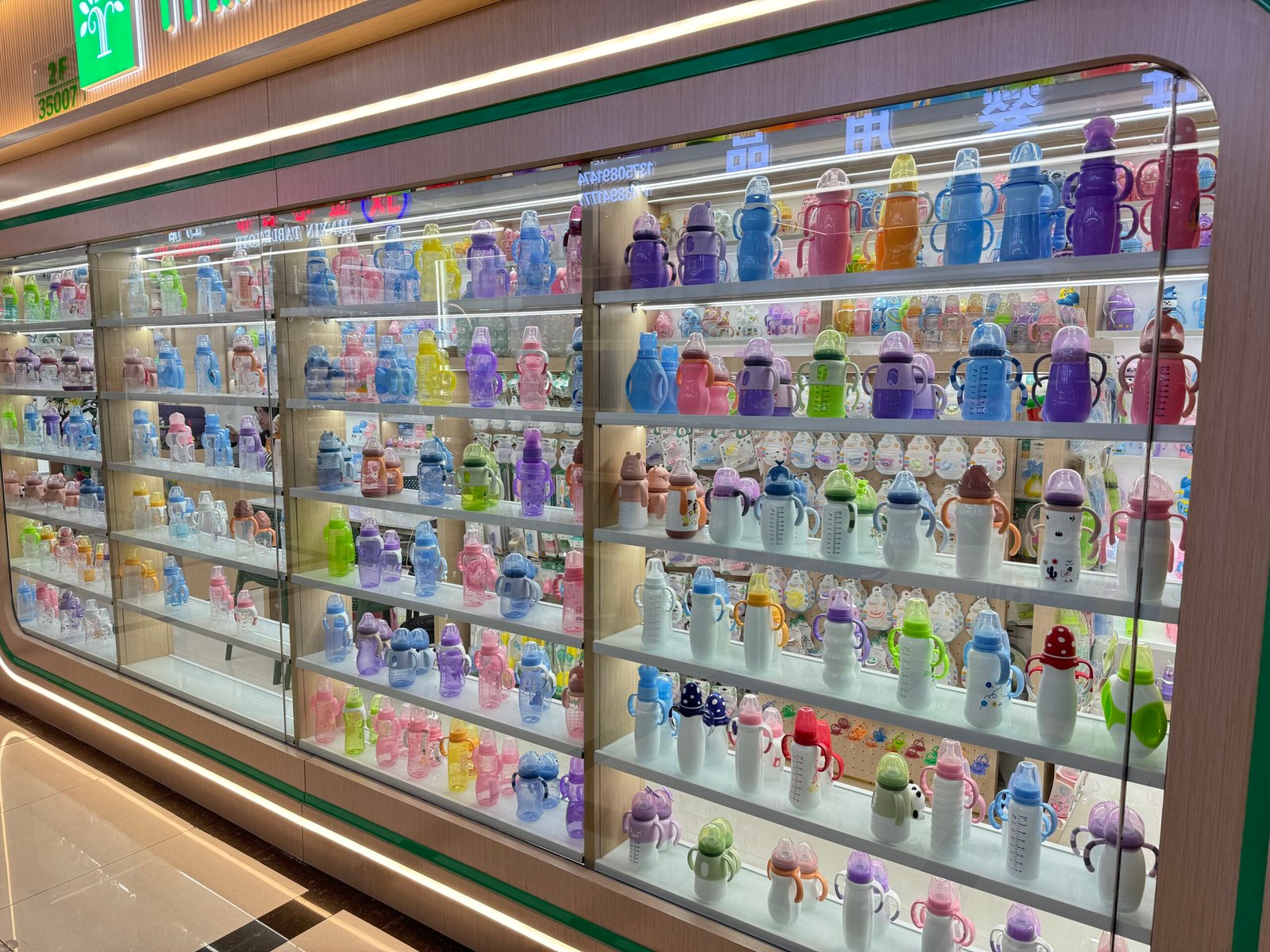
Colorful baby feeding bottles and sippy cups are displayed floor to ceiling in a baby products showroom in Yiwu International Trade City District 4, in China
So, you’re interested in buying from Yiwu – now how do you actually go about purchasing from the Yiwu Daily Necessities Market? Generally, global buyers use one (or a combination) of the following methods:
-
Visiting Yiwu in Person
Nothing beats being there. Many buyers, especially those who want to hand-pick products and build relationships, choose to fly to China and visit Yiwu personally. By walking the market floor, you can see and touch the products, judge quality on the spot, and compare multiple suppliers in a day. You’ll get real-time quotes (usually via a calculator screen if language is a barrier) and can even negotiate face-to-face. Visiting in person is ideal for discovering unexpected new items – you might stumble on a gadget you didn’t plan to buy but realize that it is perfect for your shop. It’s also useful for buying in very small quantities; some vendors will sell stock on hand to you directly if you’re here, even if it’s below their normal wholesale MOQ (especially if they have ready stock in their booth).
The obvious downsides are the cost and effort of travel: you’ll need to arrange a Chinese visa (many countries now are entering China visa-free, check <List of Countries Covered by Unilateral Visa Exemption Policies> for detailed reading on this), international flights to Shanghai or Guangzhou (then a 2-hour high-speed train or a short domestic flight to Yiwu), as well as accommodation. If you don’t speak Chinese, you might need a translator or assistant (though many vendors know basic English or will need to use translation apps). Visiting can be a whirlwind – the market is huge – so preparation is key (more on travel tips later).
Still, many buyers find an in-person trip well worth it, at least once, to understand the market and connect with suppliers directly.
-
Working with a Yiwu Sourcing Agent
If traveling to Yiwu yourself isn’t feasible, the next best thing is to hire a local Yiwu agent. Yiwu has numerous professional sourcing agents and companies that specialize in helping foreign buyers. A good agent essentially becomes your “eyes and ears” in the market.
Here’s what they typically do: you provide them with a list or idea of the products you want, and they will thoroughly source the Yiwu market to find the best matches, often sending you photos, prices, and supplier details. They handle price negotiations (often getting better deals thanks to existing relationships), inspect product quality, consolidate goods from different suppliers, and arrange shipping for you. Many agents also assist with paperwork and customs clearance.
Using an agent can be very convenient – you benefit from their local expertise and language skills. It’s an especially popular option for first-time Yiwu buyers or those who have a very specific shopping list but can’t travel. Of course, agents charge a service fee or commission (usually a percentage of your purchase volume), so you’ll need to factor that into cost. The key is to find a reputable, trustworthy agent – one that is transparent about prices and truly acts in your interest. The good news is that Yiwu agents are plentiful and competitive, and most of them have English-speaking staff. Working with an agent can make your importing process “seamless and efficient” – they take care of the legwork while you focus on running your business. It’s a great middle-ground approach for those who want Yiwu’s advantages without physically being there.
-
Using Online Platforms (Yiwugo)
In the digital age, you can also explore Yiwu’s market online. The primary official platform is Yiwugo, which is essentially the online version of Yiwu’s 75,000 booths. Yiwugo allows you to search products and suppliers by category, see photos of their booths, and even chat with sellers. It’s a handy way to get an overview of what’s available and perhaps do some initial supplier sourcing. For example, if you search “daily necessities” on Yiwugo, you’ll find countless listings for kitchen tools, cleaning items, etc., from different Yiwu vendors. You can make inquiries directly through the site.
Some suppliers on Yiwugo are open to doing business entirely online – you place an order, pay via online, and they ship to you. This can work fine for smaller sample orders or repeat orders of items you already know. However, be mindful that not all Yiwu products are listed online, and the info may not always be up-to-date (products in the market are constantly being updated and replaced). Also, verifying quality remotely can be challenging. Many buyers use Yiwugo as a supplementary tool – for instance, to shortlist vendors and then either visit or have an agent follow up. Another online option is sourcing through B2B platforms like Alibaba or Made-in-China, where many Yiwu suppliers also list products.
In recent years, some larger Yiwu trading companies have set up their own websites or even live-stream sales. These can be useful, but be cautions: as with any online international trade, you should verify the supplier’s credibility (request samples, check certifications, etc.) before making large payments. In summary, online sourcing from Yiwu is possible and convenient for initial research or small orders, but for bulk purchasing of daily goods, buyers often combine it with agent services or an in-person visit to ensure everything goes smoothly.
Pros & Cons at a Glance: Visiting in person gives you maximum control and firsthand experience (but costs more time and money). Using an agent offers expertise and convenience (for a fee) and is great for handling complexity like multi-supplier orders and logistics. Going online is fastest and cheapest initially (no travel, no commission), but carries more risk if you haven’t vetted the products/suppliers. Many experienced importers will actually blend these methods – e.g., make an initial trip to establish relationships and then reorder online through an agent or directly afterward. Choose the approach that fits your budget and what you’re comfortable with.
Tips for Visiting the Yiwu Daily Necessities Market
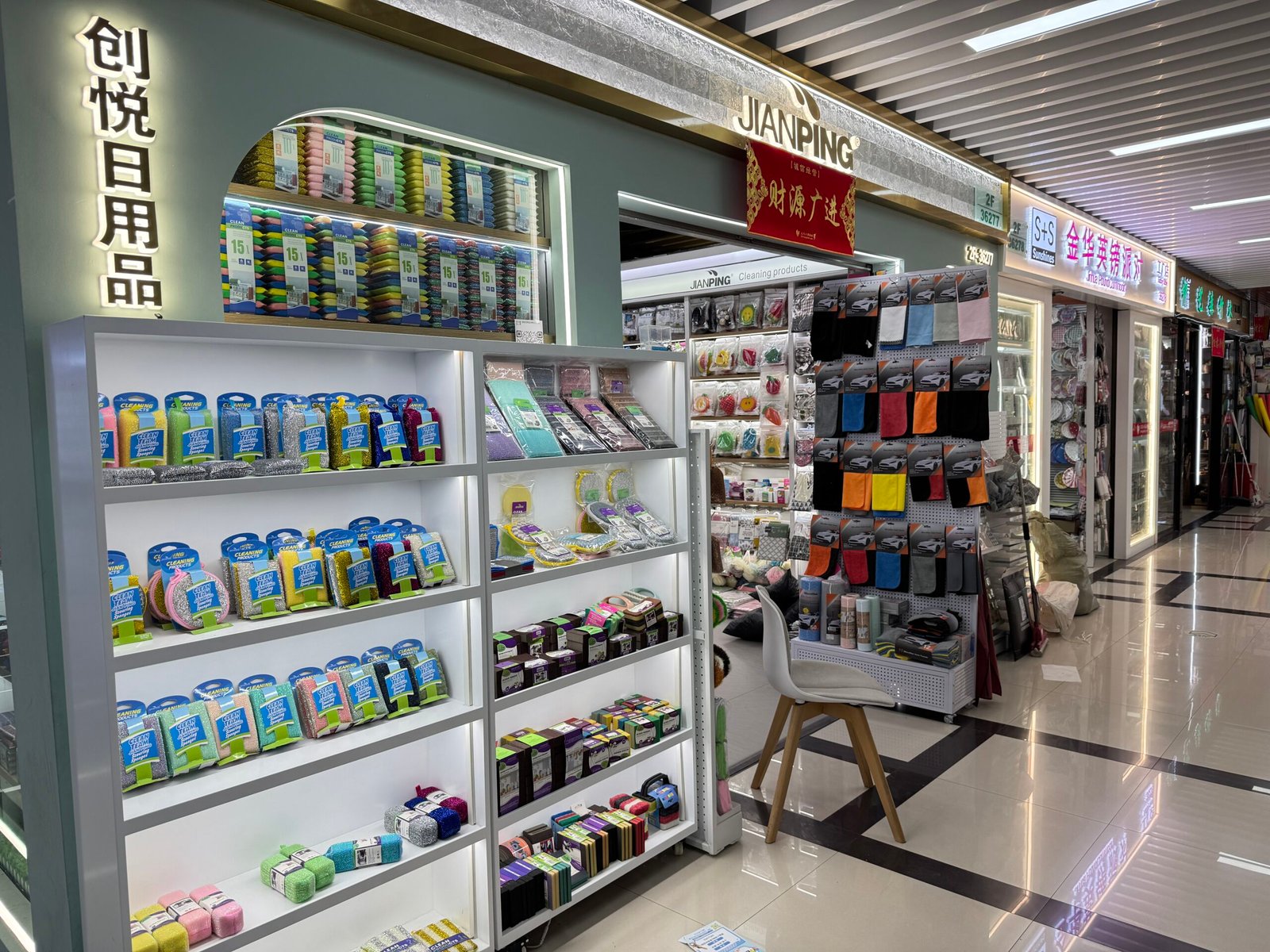
The Jianping daily necessities shop in Yiwu District 4 presents a wide range of cleaning products, scouring pads and color cleaning cloths under bright illuminated shelves in Yiwu Market, China
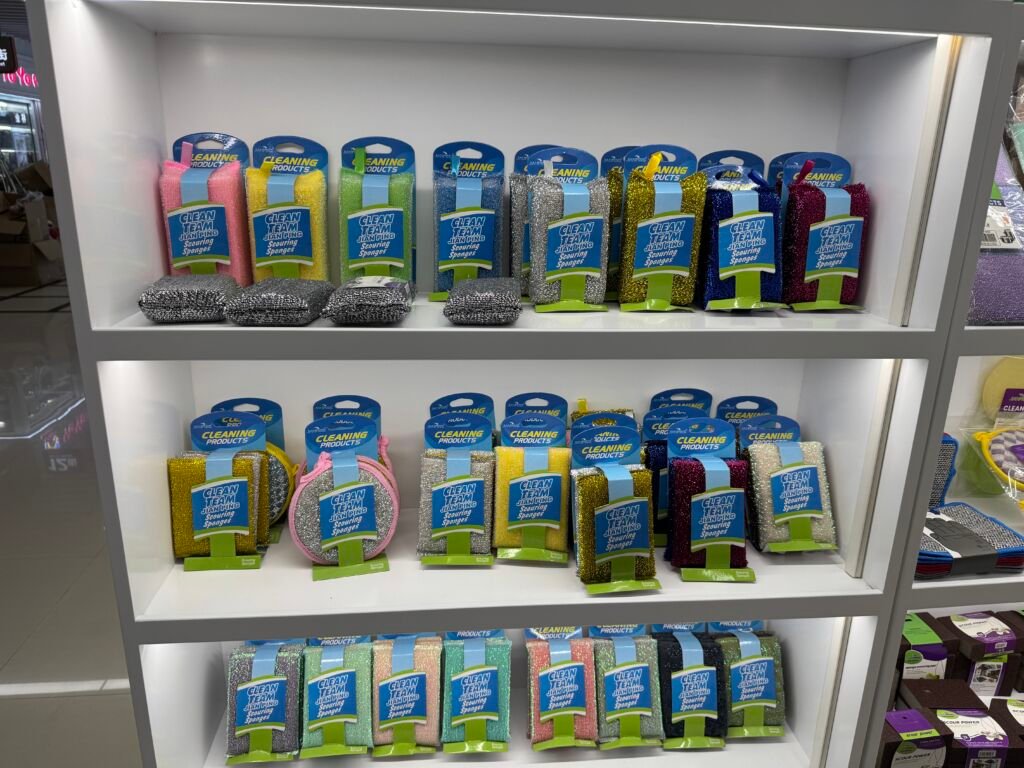
Glitter scouring sponges and cleaning pads in many colors line the shelves of a cleaning products supplier in Yiwu International Trade City District 4, in China
If you decide to come to Yiwu for a buying trip, some preparation and local know-how will help you make the most of it. Here are essential tips for first-time visitors:
- Plan Your Route and Schedule: The International Trade City is massive. Identify that the Daily Necessities Market is in District 4, 2nd Floor of Yiwu Market ahead of time, and get a market map or directory if possible. It’s wise to list the product categories you’re interested in and note their locations. Within District 4’s 2nd floor, booths are numbered and grouped by product type – try to browse in a systematic order (aisle by aisle) so you don’t get lost or miss sections. Allow at least a full day (or more) for this floor alone if you have wide interests. Remember, the market closes at 5 p.m., so start early. Many vendors take a lunch break around noon (though shops stay open), so the pace might slow midday.
- Dress Comfortably: You’ll be doing a lot of walking. Wear light, comfortable shoes – a pair of trainers or walking shoes is perfect. Opt for casual, comfortable clothing suitable for the season (summers in Yiwu are hot and humid, winters can be chilly indoors as heating is not strong). A business suit is not necessary – Yiwu market is a place of hustle and comfort, so business-casual or even jeans and a t-shirt are fine. You’ll notice people from around the world in all kinds of attire, but the one thing everyone has in common is comfortable footwear and clothing that lets you move easily.
- Bring a Rolling Suitcase or Big Tote: One practical tip – carry a small rolling luggage or wheeled shopping bag to hold product samples and catalogs. As you visit booths, vendors will happily give you samples (some free, some paid) and lots of brochures/name cards. These get heavy quickly! A carry-on sized suitcase you can pull, plus a backpack for your personal items, works great. Vendors are very used to seeing buyers pulling suitcases down the aisles. It sure beats lugging dozens of sample items in plastic bags on your shoulder.
- Transportation in Yiwu: Getting to and around the market is easy. Yiwu city has taxis and ride-hailing (like Didi, a Chinese Uber) – just show or tell the driver “Futian Market” (the local name for Yiwu International Trade City) and they will know.Many hotels offer free shuttles to the market as well. There is also a free shuttle bus looping around the different districts of the market if you plan to explore beyond District 4.If you’re coming from Shanghai or Hangzhou, high-speed trains to Yiwu are fast and frequent, and Yiwu’s airport also has some domestic flights. Once at the Trade City, be prepared to do a lot of walking inside, so allocate time for that. District 4 has multiple entry gates – note which gate or hall you entered from so you can find your way out or direct a taxi to pick you up there.
- Communication & Language: While Yiwu is an international market, English is not universally spoken. Many vendors know basic terms and prices in English, and almost all will have a calculator – the typical way to communicate price is they’ll type the number and show you (and you can counter-offer on the calculator as well). That said, if you want to discuss product details, materials, or negotiate complex terms, it helps to have a translator or agent with you. You can hire an English-Chinese interpreter for the day in Yiwu – many freelancers are available.Alternatively, use a good translation app on your phone; vendors are patient with this and some even have apps on their side.Learning a few basic phrases (like greetings or asking “how much?” in Chinese) can also create goodwill. Business cards of vendors are usually in English/Chinese, and stall signs have numbers and often some English. Don’t let language shy you away – trading in Yiwu often goes beyond language barriers with a smile and a calculator.
- Etiquette and Precautions: The market environment is generally friendly and safe. Still, follow basic etiquette: ask permission before taking photos of a booth or product (some vendors are sensitive about that).No smoking inside the market halls – there are special smoking rooms; vendors may get fined if they allow a visitor to smoke openly, so be respectful of that rule.Keep your belongings secure (petty theft is very rare inside, but with crowds anywhere, it’s wise to mind your wallet/passport).Bargaining is expected for larger orders, but do so politely. If you’re just asking for a sample or one-off item, some vendors might sell it to you retail, but don’t try to haggle hard on single pieces – remember these are wholesale folks. They might quote a slightly higher price if you’re buying only one of something; that’s normal.
Collect business cards and note down what you saw where – it’s easy to get confused with so many stalls. Jotting a note on the vendor’s card like “blue plastic buckets” to jog your memory later helps, since by evening you might have a dozen different suppliers in mind.
- Facilities and Personal Care: Yiwu International Trade City is well-equipped. You’ll find restrooms, ATMs, and food courts in each district. However, the cuisine in the immediate area is mainly Chinese. If you’re not used to local food, pack a snack or two. There are some western fast-food options in the city, but in the market complex the restaurants are Chinese-style and lunch hour can be crowded. Bringing a bottle of water and a few snacks in your bag is a good idea if you plan to spend all day shopping. Wear a lightweight backpack to carry these and any essentials (hand sanitizer, etc.). By the way, the market is open year-round, but if you visit in the winter, note that indoor heating is limited, so dress in layers.
Following these tips will help you stay comfortable and efficient during your Yiwu adventure. Image it like going to an enormous shopping mall for work – you want your most comfortable shoes, a game plan, and an open mind for the unexpected finds. Many international buyers end up enjoying the experience – it’s truly fascinating to see the global market of goods in action. By the end of the day, you might be tired, but you’ll also be pulling a suitcase full of product samples and a head full of new ideas for your business.
Shipping and Customs: Getting Your Goods Home from Yiwu
After you’ve placed orders at the Yiwu Daily Necessities Market, the next step is to ship those products to your home country. Yiwu makes this part relatively straightforward, with plenty of logistics services on hand. Here’s a brief overview of the post-purchase process:
- Order Consolidation: If you bought from multiple stalls (very likely when sourcing daily necessities), you’ll want to consolidate your goods into one shipment. Typically, your Yiwu agent can handle this, or there are independent freight forwarders with warehouses in Yiwu. The vendors will deliver the goods to your agent’s warehouse or the forwarder’s facility (usually free or for a small local transport fee). There, all your items from different suppliers can be packed together. This way, you ship one big lot instead of many small parcels, saving significantly on freight costs. The warehouse team can also do a quick check for you – ensuring you got the right quantities and items from each vendor.
- Shipping Options: Yiwu offers every mode of shipping. For large volumes, sea freight is most economical – you can book a full container (FCL) if you have enough goods, or use less-than-container load (LCL) to share a container with other shipments if your volume is smaller. Yiwu is close to Ningbo and Shanghai ports, which makes sea shipping convenient. Transit times by sea can range from 2–6 weeks depending on destination.If you need goods faster (or have a smaller volume), air freight or express couriers (DHL, FedEx, etc.) are available – Yiwu even has an international mail and courier center. Keep in mind air shipping is more expensive but gets your products in days instead of weeks. Some buyers choose air for a small urgent batch and sea for the rest.There’s also the China-Europe Railway option (Yiwu is the start of a freight train route to Europe), which can be a middle-ground in cost/time for European destinations, though it’s used more for certain products. Discuss with your freight forwarder or agent to pick the best option based on your timeline and budget.
- Customs and Documentation: Proper paperwork is key to a smooth export/import process. Thankfully, Yiwu agents are experienced with export documentation. They will provide a commercial invoice, packing list, and Chinese customs declaration for your goods. If any items require special certificates (for example, some countries require extra certifications for certain plastics or electronics), your agent can help arrange those.China’s export customs in Yiwu/port will need to clear the goods – if you’re using a reliable forwarder / agent, they handle this for you. On your side, when importing, you’ll usually need to work with a customs broker or the shipping company’s agent in your country to clear the goods through your customs. Ensure you’re aware of your country’s import regulations for the products (e.g., are there any items that are restricted or require licenses? Most daily household items are straightforward, but always good to double-check). Duties and taxes (if applicable) will need to be paid according to your local laws. The paperwork from Yiwu will list the contents and value; usually the process is routine since Yiwu exports are so common worldwide.
- Logistics Services in Yiwu: One great thing about Yiwu is there are so many logistics providers right around the market. You’ll find international freight companies and local shipping agents with offices in the market or nearby. Many of them offer door-to-port or even door-to-door service. For instance, you can find a service to send a few boxes via air courier, or arrange a 20-foot sea container – all without leaving the trade city. If you used an agent, they will coordinate shipping as part of their service, often providing you quotes from Yiwu to your destination. They can also help with cargo insurance if you want to insure the shipment. If you’re consolidating goods yourself, there are public logistics centers where multiple small buyers’ goods are consolidated into shared containers regularly headed to popular destinations in Africa, Middle East, etc. Yiwu’s high volume means shipping rates are competitive.
- After-Sale and Follow-Up: Before your goods ship out, do take time to inspect or have them inspected. If you can’t be there in person, photos or a third-party QC can be arranged by your agent. Ensure the packaging is sturdy for the long trip (usually vendors know how to pack for export packaging, but it’s okay to specify if you need extra protection).Once shipped, you’ll get a tracking number or Bill of Lading. Shipping by sea will have you tracking a vessel, whereas express will have a tracking number. Stay in communication with your shipping agent until delivery. When the goods arrive in your country, your customs broker will handle import clearance, then the goods will be delivered to you. It might sound complex, but once you’ve done it once, it becomes a routine. Many small buyers start with a mixed container (LCL) of assorted daily items from Yiwu and gradually scale up.
In summary, Yiwu is set up to make international shipping as hassle-free as possible. From consolidation to paperwork, the processes are in place and time-tested (recall that hundreds of billions of dollars of goods flow out of Yiwu annually). Just be sure to partner with a good logistics provider or agent, and you’ll find that getting your Yiwu-sourced products home is very easy to handle – whether it’s a few boxes by air or several pallets by sea. Yiwu truly offers a complete end-to-end sourcing experience: you purchase the goods, and the local infrastructure helps ensure they’re packed, shipped, and on their way to fill your store shelves back home.
Kevin’s Final Thoughts: Start Your Yiwu Sourcing Journey
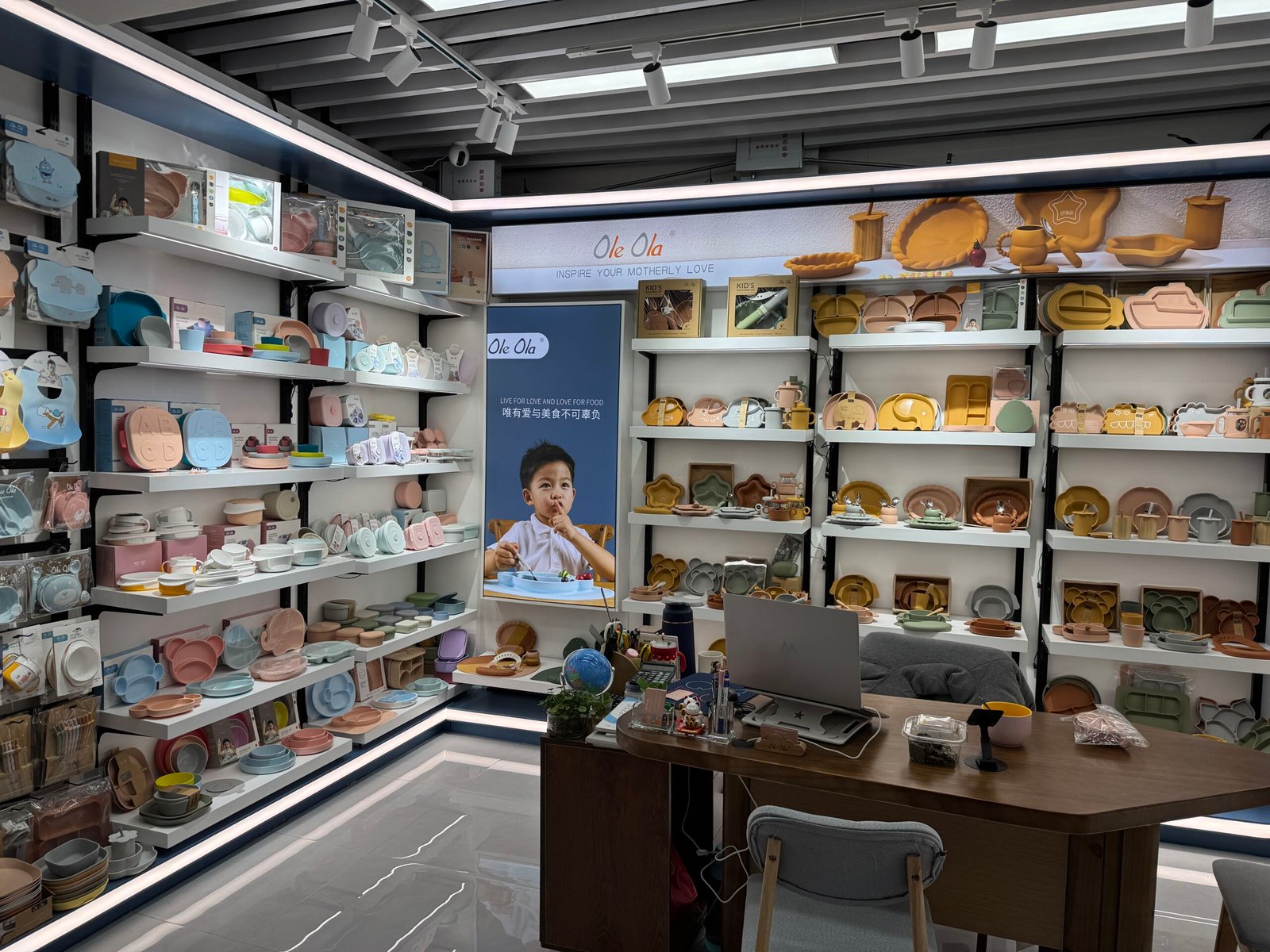
The Ole Ola showroom in Yiwu International Trade City District 4 highlights colorful silicone tableware designed for children and toddlers.
The Yiwu Daily Necessities Market shows the magic of Yiwu – a place where the world’s everyday products gather in one vibrant marketplace. From this single location in China, small shop owners across the globe can stock their shelves with an incredible variety of kitchenwares, cleaning tools, personal care items, and inventive gadgets that make consumers’ lives a little easier. The market’s friendly environment, coupled with its professional wholesale operations, creates a unique blend of warmth and efficiency. As we described, Yiwu welcomes the international buyer, whether you’re running a local dollar store or sourcing products for an online shop. It offers riches in variety, low barriers to entry, and robust support for getting goods from its halls to your homeland.
If you have never been here, Yiwu can sound overwhelming – but hopefully this guide has made it clearer and shown you that with some preparation (and maybe a comfy pair of shoes!), it’s a journey well worth taking. The story behind many successful businesses starts the same way: with a first trip to Yiwu, wandering the daily necessities aisles and thinking “Wow, I could sell this back home.” So, why not give it a try? And remember, you’re not alone in the process. There’s a whole ecosystem of agents and services ready to assist, and a community of global buyers who return to Yiwu again and again.
In the end, Yiwu’s Daily Necessities Market is more than just a market – it’s an experience of global trade at your fingertips. Whether you visit in person or connect remotely, you’ll be amazed at the scope of products and the vibrant, fast-paced environment in the air. So why not take the next step? If you need more information or assistance with sourcing from Yiwu or other cities of China, don’t hesitate to reach out for help. Our team are happy to guide newcomers through the process. With the right approach, you’ll soon have those clever little gadgets – the ones that make people smile and say “where did you find this?!” – proudly sitting on your store shelves. And you’ll know the answer: it came from Yiwu.
Happy sourcing!
Contact Information as below:
Email:kevin@china-buying-support.com
Phone | WhatsApp:+86 1860 5899 103
Thank you.
Joining Us With 1,200+ Happy Clients Enjoying Buying From China now!
Becoming One of China-Buying-Support family to Get a Easier and Trouble-Free Sourcing and Shipping Service.